
What Is Well Completion, and Which of Its Connections Are Made Up in a Shop?
Completion turns a cased hole into a producing well. This page walks the completion string from the tubing hanger to the tailpipe, explains what each part does, and shows which of its threaded connections are made up on the rig and which were made up in a workshop first.
Well completion is the work that turns a drilled, cased hole into a producing well: perforating the reservoir, running production tubing with a packer, landing a tubing hanger and fitting the tree. The completion string is the most engineered threaded assembly in the well, and most of its accessories are made up in a shop, on a bucking unit, before the rig picks them up.
At a glance
| What completion does | Connects the reservoir to the surface through a controlled path: perforations, production tubing, a packer to seal the annulus, a hanger at the wellhead and a tree on top |
| The string, top to bottom | Tubing hanger, subsurface safety valve, tubing joints, gas-lift mandrels, sliding sleeves, landing nipples, production packer, tailpipe. Every part threaded to the next |
| Who makes it up | The rig floor makes up the joint-to-joint tubing connections as the string is run. A completion shop makes up the accessories onto pup joints beforehand, tests them and tags them |
| Why the shop matters | Completion connections are often premium, metal-to-metal seals with narrow torque windows. A horizontal bench with a torque-turn trace is where that make-up is controlled and recorded |
| Decision this page supports | Separating the completion connections a workshop owns from those the rig owns, so the shop’s machine, jaws and records are specified for the right work |
What completion is
Drilling ends with a hole lined by cemented casing and sealed from the reservoir. Nothing flows. Completion is everything that follows to make it flow: the production casing is perforated across the pay zone, or a lower completion with screens is run in an open hole; production tubing is run inside the casing; a packer seals the space between tubing and casing so that formation fluid is forced up the tubing; the tubing is hung from a hanger in the wellhead; and a tree of valves is bolted on top to control the flow. In many wells the reservoir is also stimulated, fractured or acidised, as part of the same programme. EKT Interactive’s Oil 101 describes completion as the point where the well is prepared to produce, with casing, tubing, downhole valves and the fluids pumped to prepare the formation (EKT Interactive, Well Completion), and iFluids sets out the casing and wellhead side of the same work (iFluids, Oil and Gas Well Completion).
What the sector guides tend to leave out is that a completion is a threaded machine. From the hanger at the top to the tailpipe at the bottom, every component is screwed to the next, most of them on premium connections, and each of those joints will be relied on for years without anyone being able to see it. Where and how they were made up therefore counts for as much as what they are, and that is the angle this page takes. Why that make-up record matters for the life of the well is explained in well integrity: the two barriers.
The completion string, top to bottom
Completions vary enormously, from a bare tubing string in a shallow well to a multi-zone intelligent completion offshore, but the same family of parts appears in most of them. Reading down from the wellhead:
| Component | What it does | How it is made up, and by whom |
|---|---|---|
| Tubing hanger | Suspends the whole tubing string in the wellhead and seals the annulus at the top; the tree sits above it. Hangers are made with clearance for the control lines and valves below them (Weatherford, Tubing Hangers) | Threaded onto the top joint or a hanger pup on the rig floor at the end of the run, then landed; the pup itself is usually prepared in the shop (the stack it lands in is described section by section in what is a wellhead) |
| Subsurface safety valve | Closes the tubing automatically if control pressure is lost, isolating the well below the wellhead; held open by a control line from surface | Made up into the string on the rig with its control line; the valve is tested and its connections prepared in the shop beforehand |
| Tubing joints | The production conduit itself, run joint by joint inside the production casing | Joint-to-joint connections made up on the rig floor with tubing tongs; couplings were bucked on at the threader |
| Gas-lift mandrels | Pockets in the string that hold gas-lift valves, letting injected gas enter the tubing at set depths; conventional valves are threaded into the mandrel at surface and cannot be changed without pulling the string (the lift methods and what each pulls are compared in artificial lift systems) | Mandrels made up onto pup joints in the completion shop, pressure tested, then run as sub-assemblies |
| Sliding sleeves | Ports that can be opened or closed by wireline to communicate tubing and annulus, for circulation or zone control (Drilling Manual, Sliding Sleeve) | Made up onto pup joints in the shop with the correct spacing, function tested, run as sub-assemblies |
| Landing nipples | Profiled receptacles for wireline plugs and flow-control devices, at planned depths | Made up in the shop onto pups, with the profile protected; depth set by the spacing of the sub-assembly |
| Production packer and tailpipe | Seals the tubing-casing annulus above the reservoir; the tailpipe hangs below it with a nipple and often a wireline entry guide | Packer redressed and tested in a service shop; tailpipe assembly made up in the shop; the packer is set downhole after the string is landed |
Read the right-hand column and a division appears that the rig crew knows well and buyers of equipment sometimes miss. The rig floor makes up the long, repetitive connections, joint to joint, quickly and vertically. Everything with a function, a profile, a port or a valve was made up somewhere else first, horizontally, slowly and with a record.
Upper and lower completions
Engineers split the completion at the packer. The upper completion is the tubing string and its accessories from the hanger down to the packer, the part that carries production to surface and can usually be pulled and replaced in a workover. The lower completion is what sits below or across the reservoir: perforated casing, or screens, gravel packs and isolation packers in an open-hole design, sometimes with sleeves for stimulation. Lower completions are often run and left; upper completions are the part of the well that comes back to a workshop, which is why the workover rig operations page follows the tubing string to the yard.
The split has a practical meaning for a shop. Lower completion equipment tends to be made up once, by the vendor, and never seen again. Upper completion accessories are made up, run, pulled, redressed and made up again through the life of the well, and each of those cycles happens on a bench. A completion shop’s workload is the upper completion.
Who makes up the completion string
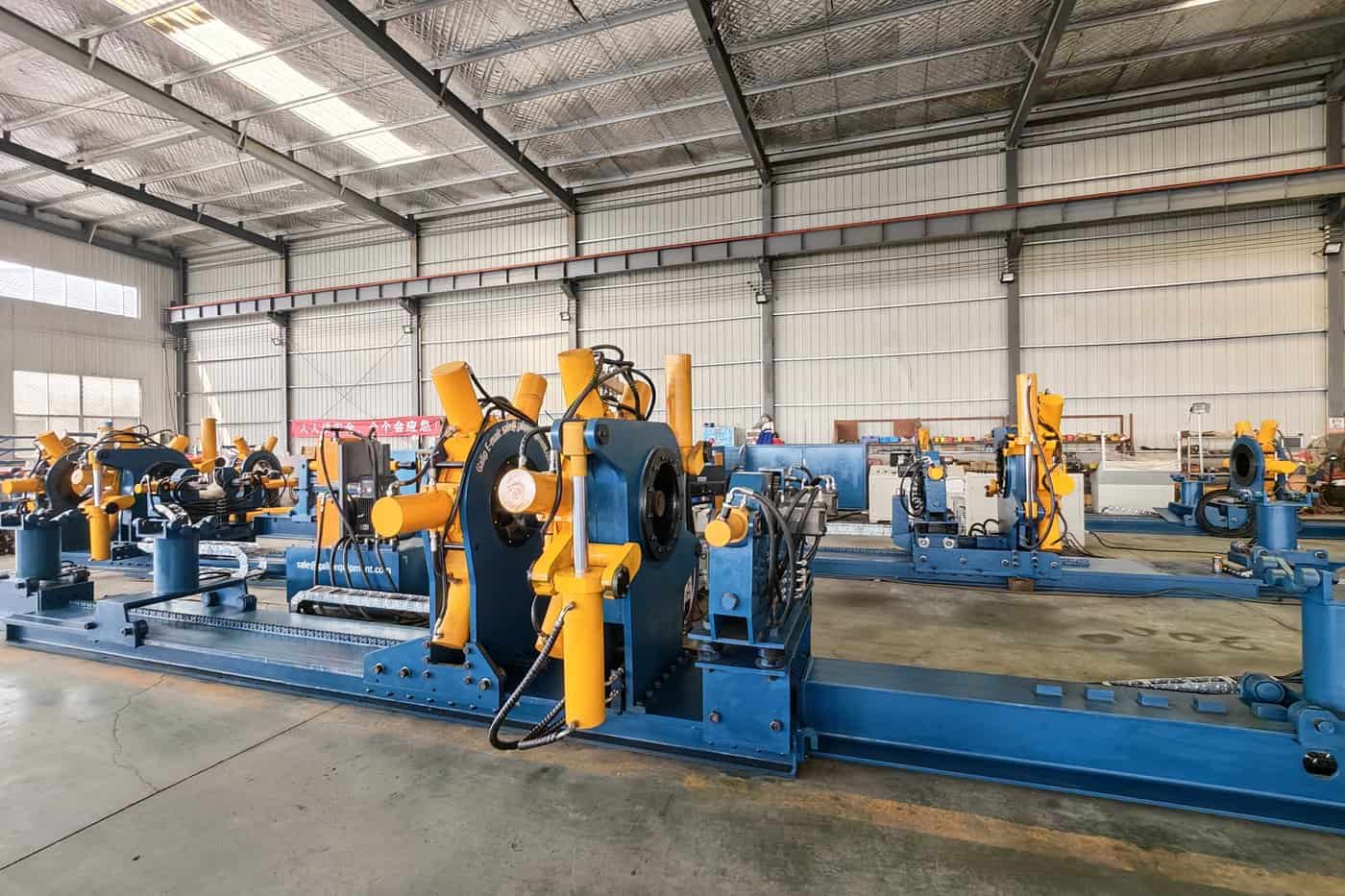
Three parties share the work. The operator or its completion engineer designs the string and specifies the connections. The rig crew, or a tubular running services crew, makes up the tubing joint by joint as the string is run, with power tongs and, on premium connections, a torque-turn monitor. And a completion shop, which may belong to the service company that supplies the accessories or to the operator’s own base, assembles every accessory onto its pup joints before the string is picked up: mandrels, sleeves, nipples, crossovers, flow couplings, the hanger pup, the tailpipe. It pressure tests those sub-assemblies, records the torque-turn trace for each connection, tags them with their position in the string, and ships them to the rig in order.
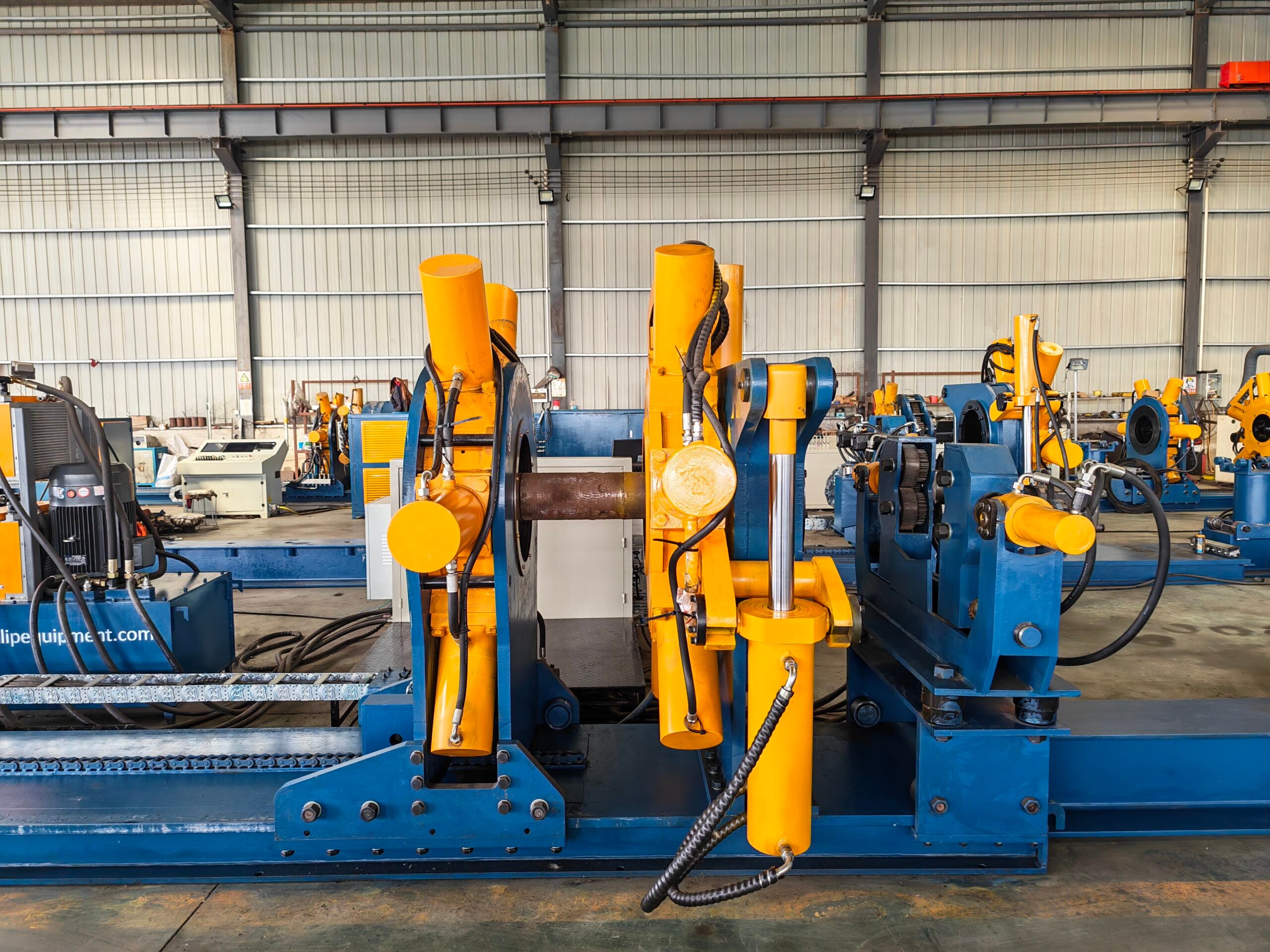
The reason that shop uses a horizontal hydraulic bucking unit rather than a tong in the yard is the connection. Completion tubing is commonly premium, with a metal-to-metal seal and a shoulder that must be brought up at low speed and stopped inside a narrow torque window. On a bench the accessory is supported along its length, clamped on a jaw set that will not mark it, rotated slowly at the shoulder and stopped by the controller, with the trace saved against the tag. The particular family rules for the major premium connections are collected in the page on VAM and Tenaris connection torque control, and the layout of a shop built around this work in completion tool service shops and the make/break cell.
Volume changes the shape of that shop. A conventional field may complete a few wells a month and assemble a handful of sub-assemblies for each. A shale programme completes wells continuously, with long tubing strings and many repeated accessories, and the shop becomes a production line; the way a bucking unit fits that line is covered in shale completion workshop make-up. Either way the machine is specified from the same facts: the smallest and largest tubing and accessory outside diameters, the connection families and their make-up torques, the break-out torque on retrieved equipment, and the record the operator’s completion engineer will ask to see.
After the run: the completion comes back
A completion is not permanent. Tubing corrodes or erodes, valves fail, the lift method changes, a zone waters out. When that happens a workover pulls the upper completion, and every accessory that was assembled in the shop returns to one. The packer is stripped, inspected, rebuilt with new elements and seals, and tested again, following the sequence in packer redress. Mandrels and sleeves are broken out from their pups, inspected, refurbished and made up onto fresh pups for the next well. The tubing itself goes to a pipe yard for break-out, inspection and re-coupling. When the well itself is closed, the same string comes out for the last time; see plug and abandonment.
That return trip is why the break-out side of the bench counts for a completion shop as much as the make-up side. A connection that has been downhole for years, with production fluid on one side and packer fluid on the other, does not come apart at the torque that made it up. The machine, the jaws and the procedure have to be chosen for that joint, and the reasons break-out runs higher are set out in what is breakout force.
Where completion sits in the well’s life
Completion is the second phase of the upstream sequence, after drilling and before production, and it is the phase where the well’s threaded connections stop being the drilling contractor’s problem and become the operator’s. The phase-by-phase view is in upstream oil and gas; for the wider industry picture, the sector page on upstream, midstream and downstream oil and gas explains why completion connections, and the shops that make them up, are an upstream matter and nothing else.
When another page is the better start
A completion engineer choosing between packer types, sleeve systems or lift methods is making a well design decision that this site does not attempt; the vendors’ own engineering data are the place for that. A shop that already knows its accessory range and connection families should go to the bucking unit product page and the acceptance checklist, and ask specifically about low-speed shoulder control, non-marking jaws and trace export. A reader whose question is about what happens to the string years later, when it is pulled, should read the workover page first. And anyone wondering what tubing actually is, its grades and connections, should start with the OCTG explainer.
One limit is worth stating. Completion designs are proprietary and varied; a hanger from one supplier and a sleeve from another are made up to their own makers’ data, and no general page, including this one, replaces those data sheets. Galip supplies the bench and the record; the torque comes from the connection’s owner.
Frequently asked questions
What is well completion?
The phase between drilling and production in which a cased hole is made to flow: the reservoir is perforated or fitted with screens, production tubing is run with a packer to seal the annulus, a tubing hanger is landed in the wellhead and a tree is fitted on top. Stimulation of the reservoir is often part of the same programme.
What is a tubing hanger?
The component that suspends the production tubing string in the wellhead and seals the annulus at the top. The tree sits above it. It is threaded onto the top joint or a hanger pup at the end of the run and then landed and locked in the tubing head, with clearance for the control lines and valves below.
What is the difference between upper and lower completion?
The upper completion is the tubing string and its accessories from the hanger down to the production packer; it carries production and can be pulled and replaced in a workover. The lower completion is what sits across the reservoir, perforated casing or screens, gravel packs and isolation packers, and is usually run once and left.
Which completion connections are made up in a workshop?
The accessory connections: gas-lift mandrels, sliding sleeves, landing nipples, flow couplings, crossovers, hanger pups and tailpipe assemblies are made up onto pup joints in a completion shop, pressure tested and tagged before the rig picks them up. The rig floor makes up only the joint-to-joint tubing connections as the string is run.
Why are completion connections made up on a bucking unit?
Because they are often premium connections with metal-to-metal seals and a narrow torque window. A horizontal bench supports the part, clamps it on jaws that do not mark it, brings the shoulder up at low speed, stops inside the window and saves the torque-turn trace against the tag. A tong in the yard can apply the torque but not that control or that record.
What happens to the completion when the well is worked over?
The upper completion is pulled. Tubing goes to a pipe yard for break-out, inspection and re-coupling; packers, mandrels and sleeves go to a service shop for redress and are made up onto fresh pups for the next well. Break-out torque on equipment that has been downhole for years is higher than the make-up torque, which sizes the shop’s machine.
Send the accessory list with the enquiry
A completion shop enquiry answers itself fastest when it names the string. The useful set for a bucking unit quotation is: the tubing sizes and connection families run, the accessories assembled (mandrels, sleeves, nipples, hanger pups, tailpipes) with their outside diameters and lengths, the make-up torques the connection owners specify, the break-out torque expected on retrieved equipment, whether the operator requires a torque-turn trace per connection and in what format, the site power supply, and a sketch of the assembly bay. The Galip team quotes from that list and will say which jaw sets the premium connections need.
The completion checklist
- List the completion string from hanger to tailpipe for the wells the shop serves, and mark each part as rig-made-up or shop-made-up.
- Collect the connection families and their make-up data from the connection owners; the shop applies them, it does not invent them.
- Specify the bench for the smallest accessory and the largest tubing it will see, with jaws that do not mark premium connections.
- Require low-speed shoulder control and a saved torque-turn trace for every accessory connection.
- Pressure test sub-assemblies and tag them with their string position before dispatch.
- Plan for the return trip: break-out torque on retrieved accessories, and a redress cell beside the bench.
- Keep the trace with the tag and the well, because the workover crew and the completion engineer will ask for it.
- Where the shop also runs shale-style volume, lay it out as a line, with the machine as one station.
{“@context”: “https://schema.org”, “@type”: “FAQPage”, “mainEntity”: [{“@type”: “Question”, “name”: “What is well completion?”, “acceptedAnswer”: {“@type”: “Answer”, “text”: “The phase between drilling and production in which a cased hole is made to flow: the reservoir is perforated or fitted with screens, production tubing is run with a packer to seal the annulus, a tubing hanger is landed in the wellhead and a tree is fitted on top. Stimulation of the reservoir is often part of the same programme.”}}, {“@type”: “Question”, “name”: “What is a tubing hanger?”, “acceptedAnswer”: {“@type”: “Answer”, “text”: “The component that suspends the production tubing string in the wellhead and seals the annulus at the top. The tree sits above it. It is threaded onto the top joint or a hanger pup at the end of the run and then landed and locked in the tubing head, with clearance for the control lines and valves below.”}}, {“@type”: “Question”, “name”: “What is the difference between upper and lower completion?”, “acceptedAnswer”: {“@type”: “Answer”, “text”: “The upper completion is the tubing string and its accessories from the hanger down to the production packer; it carries production and can be pulled and replaced in a workover. The lower completion is what sits across the reservoir, perforated casing or screens, gravel packs and isolation packers, and is usually run once and left.”}}, {“@type”: “Question”, “name”: “Which completion connections are made up in a workshop?”, “acceptedAnswer”: {“@type”: “Answer”, “text”: “The accessory connections: gas-lift mandrels, sliding sleeves, landing nipples, flow couplings, crossovers, hanger pups and tailpipe assemblies are made up onto pup joints in a completion shop, pressure tested and tagged before the rig picks them up. The rig floor makes up only the joint-to-joint tubing connections as the string is run.”}}, {“@type”: “Question”, “name”: “Why are completion connections made up on a bucking unit?”, “acceptedAnswer”: {“@type”: “Answer”, “text”: “Because they are often premium connections with metal-to-metal seals and a narrow torque window. A horizontal bench supports the part, clamps it on jaws that do not mark it, brings the shoulder up at low speed, stops inside the window and saves the torque-turn trace against the tag. A tong in the yard can apply the torque but not that control or that record.”}}, {“@type”: “Question”, “name”: “What happens to the completion when the well is worked over?”, “acceptedAnswer”: {“@type”: “Answer”, “text”: “The upper completion is pulled. Tubing goes to a pipe yard for break-out, inspection and re-coupling; packers, mandrels and sleeves go to a service shop for redress and are made up onto fresh pups for the next well. Break-out torque on equipment that has been downhole for years is higher than the make-up torque, which sizes the shop’s machine.”}}]}
Expert Consultation
Need more information on optimizing your equipment performance? Our engineering team is available for technical consultations.
Request a Quote
Tell us about your requirements and our engineering team will prepare a detailed proposal with specifications, pricing, and delivery timeline.
