
Workover Rig Operations: What Comes Out of the Well, and Where It Goes Next
A workover rig is a small drilling rig that comes back to a producing well to pull and replace what is in it. This page follows the tubing and tools it pulls to the yard and the service centre, which is where the bucking unit meets workover.
A workover rig is a scaled-down drilling rig brought back to a completed well to pull and replace what is in it: tubing, rods, pumps, packers and other downhole equipment. Workover operations kill the well, remove the tree, pull the completion, repair or recomplete, and run it back. Everything pulled goes to a pipe yard or service centre, which is where workover meets the bucking unit.
At a glance
| What a workover rig is | A mobile, usually truck- or trailer-mounted rig with a mast, drawworks, tubing tongs and a small pump, sized to pull and run tubing and rods, and too small to drill |
| The jobs | Tubing pulls and re-runs, artificial lift repair and replacement, packer and completion changes, recompletions to a new zone, fishing, clean-outs, plug and abandonment |
| How it differs from intervention | A workover removes the tree and pulls the completion; a light intervention by wireline or coiled tubing works through the tree with the completion in place |
| Where the threads go | Pulled tubing to a pipe yard for break-out, inspection and re-coupling; pulled tools to a service centre for redress; replacement strings assembled in a shop before dispatch |
| Decision this page supports | Specifying the make-up and break-out equipment behind a workover fleet from the work that actually arrives at the yard, including the break-out load that dominates it |
What a workover rig is
A well that has produced for a few years starts to need attention. The tubing corrodes or parts, the pump wears out, a packer leaks, sand fills the bottom of the hole, water finds its way in, or the operator decides to produce a different zone. The drilling rig left long ago. What comes back is a workover rig: a mast on a truck or trailer, a drawworks to hoist, a floor with slips and tongs, a small mud pump, blowout prevention equipment and a crew of a handful of people. The AAPG’s overview describes the category simply, as the operations carried out on a completed well to restore or increase production, and the rigs that perform them as smaller cousins of drilling rigs (AAPG Wiki, Workovers).
The equipment list is a drilling rig’s in miniature. The mast supports the crown block and gives the crew somewhere to stand pulled tubing; the drawworks spools the line that hoists it; elevators carry each joint, slips hold the string at the floor, and hydraulic tubing tongs spin and torque each connection as it is broken out or made up (Goldenman, Workover Rig Systems Explained). What the rig does not carry is any way of inspecting, repairing or re-threading the tubing it pulls. That work happens somewhere else, and following it there is the point of this page.
Workover, servicing and intervention: three words for different depths of work
The industry uses three overlapping terms and it helps to separate them. Well servicing is the broad category: any maintenance or repair on a well after completion, from changing a valve on the tree to pulling the whole completion. Well intervention, in modern usage, tends to mean the lighter end of that range, work done through the tree with the completion in place, by wireline, slickline or coiled tubing: logging, perforating, setting plugs, milling scale, cleaning out fill. Workover is the heavy end: the well is killed, the tree comes off, and the tubing and downhole equipment are pulled out of the hole with a rig. One field guide draws the line exactly there, with light intervention leaving the tree in place and heavy intervention, the workover, removing the wellhead barriers for full access to the wellbore (Oil Gas Leads, Workovers, Drillouts and Well Interventions).
The distinction matters to a workshop because it decides what arrives. A wireline or coiled tubing job returns a tool string and nothing else. A workover returns the whole completion: every joint of tubing, the rods and pump if the well is on rod lift, the packer, the accessories, and whatever was fished out of the hole. A field with a busy workover programme produces a steady flow of used tubulars and tools, and that flow is the workload that a pipe yard and a tool service centre are sized for.
The six jobs a workover rig does
Workover programmes vary by field, but most of what a rig does falls into six kinds of job, and each sends something different to the workshop.
| Job | What the rig does at the well | What arrives at the yard or service centre |
|---|---|---|
| Tubing pull and re-run | Kills the well, removes the tree, pulls the tubing string joint by joint, inspects visually, runs new or reconditioned tubing back | The full string: every joint broken out from its coupling, inspected, drifted, and either re-coupled and returned to stock or scrapped |
| Artificial lift repair | Pulls rods and a sucker rod pump, or an electric submersible pump on its tubing, or gas-lift valves by wireline; replaces and re-runs | Pumps to a pump shop, rods to a rod yard, ESP tubing to the pipe yard, gas-lift mandrels to the completion shop for valve changes The five lift methods, and what each sends to the yard, are compared in artificial lift systems. |
| Packer and completion change | Releases and pulls the packer and accessories, runs a new completion, sets the packer, lands the hanger | The retrieved packer and accessories to a service centre for redress; the new completion assembled and tested in a shop beforehand |
| Recompletion | Plugs the old zone, perforates a new one, may run a different tubing size or a new lift method | Old tubing and tools out, a newly designed string in; the shop assembles the new string to drawing |
| Fishing and clean-out | Recovers parted tubing, dropped tools or junk; mills, washes or bails fill from the wellbore | Fishing tools and the recovered fish to the service centre; damaged tubing to the yard for evaluation, usually scrap |
| Plug and abandonment | Pulls tubing and recoverable casing, sets cement plugs, cuts and removes the wellhead | Recovered tubulars to the yard for sorting, reconditioning or scrap; the last connections the well will ever see The full programme is in plug and abandonment. |
Read the right-hand column and one fact stands out. Almost everything a workover sends to a workshop arrives still made up, often corroded, sometimes damaged, and the first thing the workshop does is break it out. The breakout force on a coupling that has spent years in a producing well is routinely higher than the torque that made it up, and a yard sized only for make-up torque discovers this on its first load of pulled tubing.
From the rig to the yard: what happens to what comes out
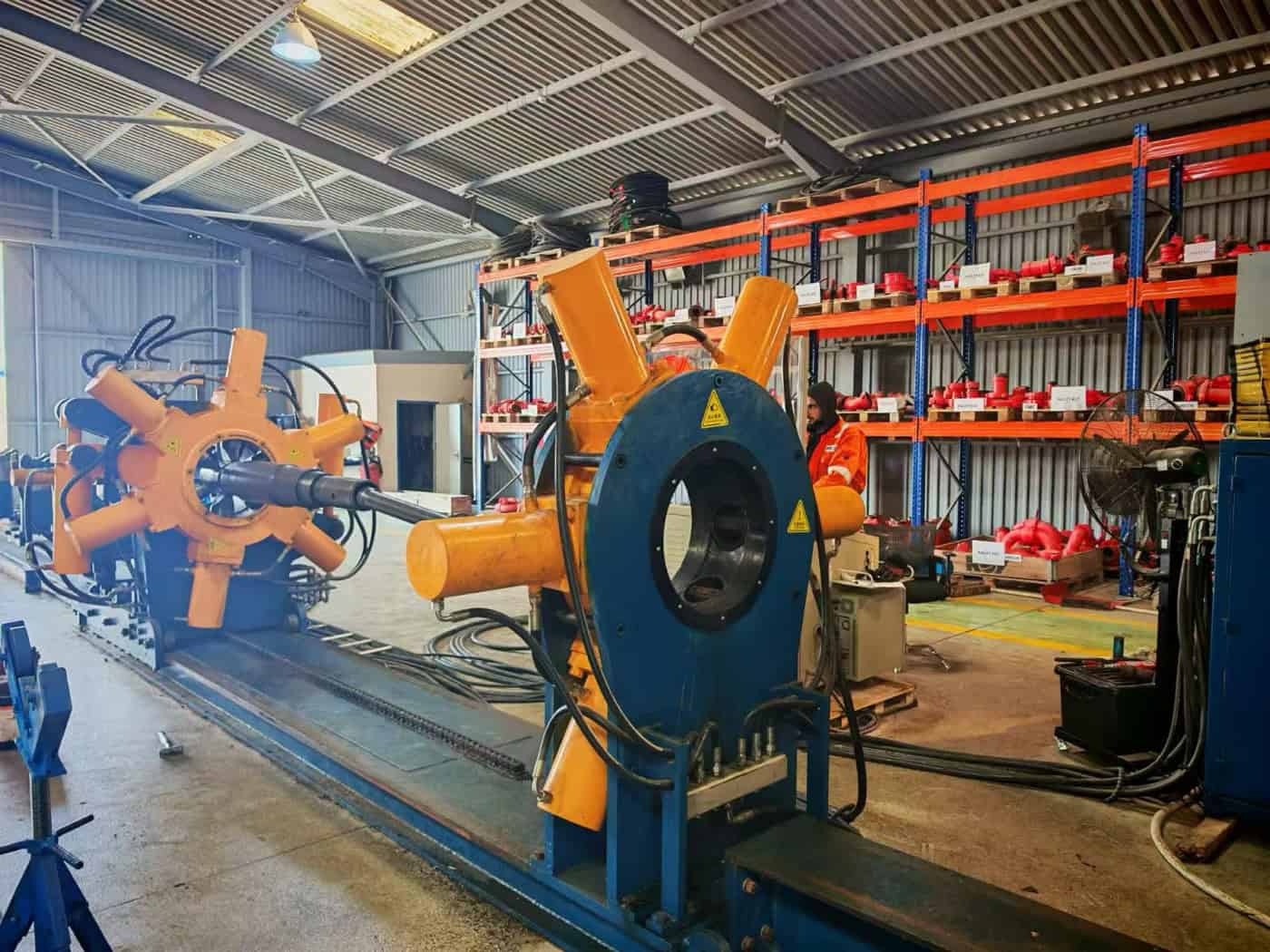
Pulled tubing leaves the location on a truck and arrives at a pipe yard in racks. The yard’s job is to turn a used string into either stock or scrap, and it does so in a sequence: the coupling is broken out on a horizontal machine, the joint is cleaned inside and out, the threads are inspected and gauged, the body is inspected for wall loss, pitting and cracks, the joint is drifted to confirm the bore, and the passing joints are re-threaded or re-cut if needed and fitted with a new coupling. The drift test and its limits are described in casing and tubing drift; the thread inspection follows the gauging practice of API 5B for round-thread tubing.
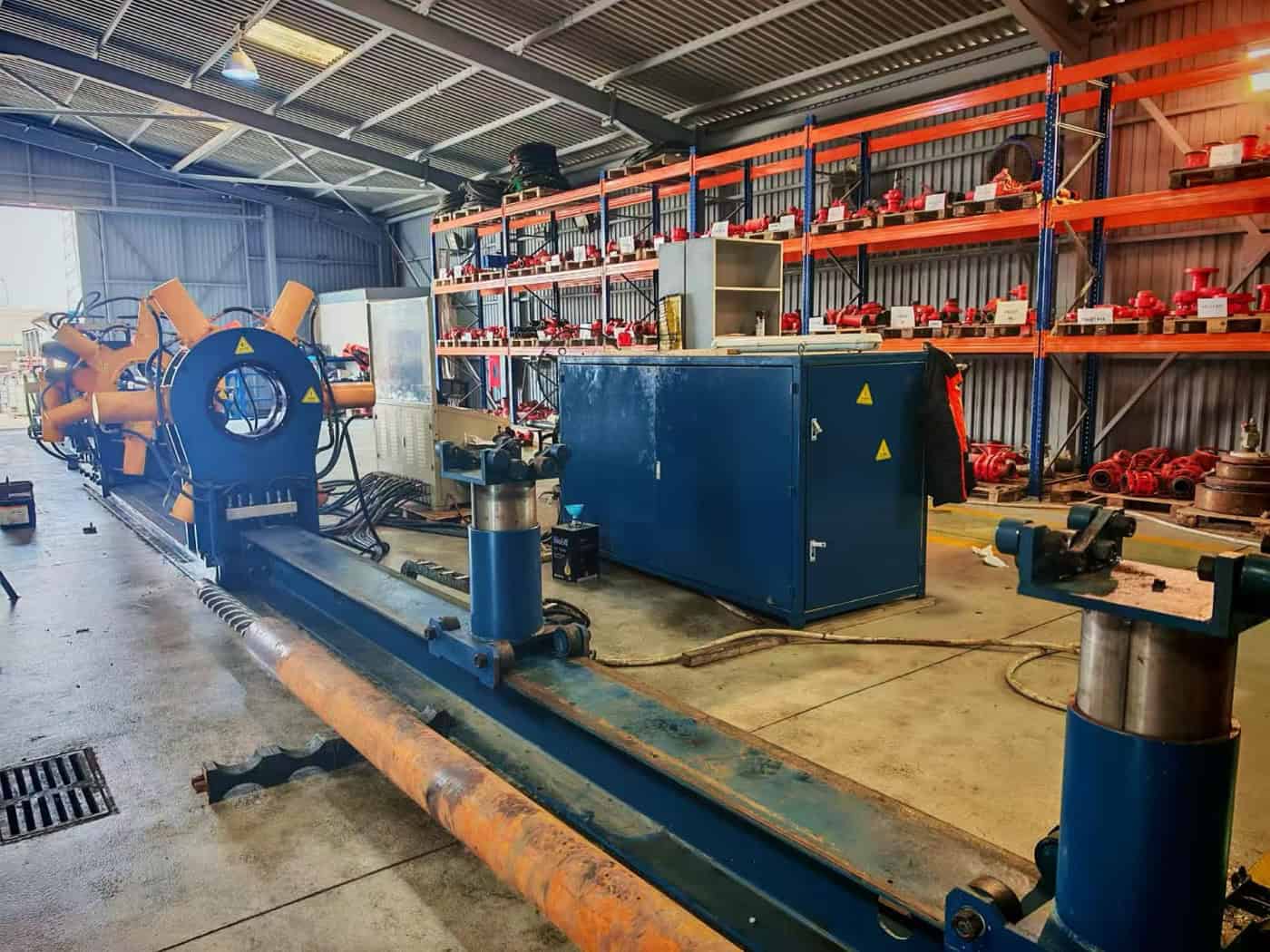
The machine at the centre of that sequence is a horizontal hydraulic bucking unit or, where the volume of used pipe is high, a dedicated breakout unit beside it. The bucking unit clamps the joint, grips the coupling and rotates it off, then, once the joint has passed inspection, spins the new coupling on to the manufacturer’s torque and records the trace. Two things distinguish a yard that reconditions workover tubing from a threading shop handling new pipe. The first is the break-out load, which sets the machine’s torque specification rather than the make-up torque. The second is the condition of the pipe: corroded, ovalised or damaged couplings need jaws and clamping that hold without crushing, and the jaw package is chosen for the worst joint in the rack.
Retrieved tools take a parallel path to a service centre. A packer that has been set for years comes out with its elements swollen and its slips scarred; it is stripped, inspected, rebuilt with new elements and seals, pressure tested and returned to stock, following the sequence in packer redress. Fishing tools, jars and motors get the same treatment in the same kind of cell. Every threaded joint on those tools is broken out during strip-down and made up again during rebuild, on the same class of machine that handles the tubing.
What goes back down: the shop-assembled string
The other half of a workover is what the rig runs back in, and much of it was assembled before the rig arrived. Replacement tubing was reconditioned or bought new, with its couplings already made up. The new completion, packer, nipples, sleeves, mandrels and pup joints, was made up to drawing in a completion shop, pressure tested and tagged. Rod pumps were rebuilt and bench tested. The rig floor’s tongs make up only the joint-to-joint connections as the string is run; everything inside a joint, and everything on a tool, was made up in a workshop to a recorded torque.
That is why a workover programme supports more workshop make-up than its rig count suggests. A field running a few workover rigs continuously feeds a pipe yard, a pump shop and a tool service centre, and each of those has a horizontal make-up machine somewhere in it. The comparison of rig-floor and workshop equipment in iron roughneck versus bucking unit applies as much to workover as to drilling, with the tubing tong standing in for the iron roughneck.
Where workover sits in the sector
Workover is upstream, inside the production phase, and the flow of pulled tubulars it generates is the main reason mature producing regions have so many pipe yards and service centres. The sector overview on this site, upstream, midstream and downstream oil and gas, puts the phase in context; the point for a workshop is that a field’s workover activity is a better predictor of reconditioning workload than its drilling activity. Drilling adds new wells; workover keeps existing ones alive, and it does so by pulling threaded steel out of the ground and sending it to a bench.
When another page is the better start
A reader specifying the rig itself, the mast rating, drawworks and tubing tongs, is in a different equipment category and this site does not cover it. A pipe yard that already knows its break-out load and tubular range should go to the bucking unit product page and its acceptance checklist, and should ask specifically about break-out torque and jaw options for damaged couplings. A tool service centre should read the downhole tool service centre guide, which sets out the make/break cell around the machine. And an operator deciding whether a job needs a workover or an intervention is making a well engineering decision that no equipment page should try to make for them.
The map has its usual soft edges. Some workover contractors run their own pipe yards; some operators do their own tool redress; some service companies do everything from the rig to the bench. Specify by what arrives on the rack, its size range, its condition and its break-out load, and the company structure takes care of itself.
Frequently asked questions
What is a workover rig?
A mobile rig, usually truck- or trailer-mounted, with a mast, drawworks, tubing tongs, slips and a small pump, used on a completed well to pull and run tubing, rods and downhole equipment. It is a drilling rig in miniature, sized to service the well rather than to drill it, and it carries no facilities for inspecting or repairing what it pulls.
What is the difference between a workover and a well intervention?
A workover kills the well, removes the tree and pulls the completion with a rig, giving full access to the wellbore. A well intervention, in the usual modern sense, works through the tree with the completion in place, by wireline, slickline or coiled tubing. Both are forms of well servicing; the workover is the heavy end of it.
What does a workover rig actually do?
It pulls and re-runs tubing, repairs or replaces artificial lift equipment such as rod pumps and electric submersible pumps, changes packers and completions, recompletes wells to new zones, fishes lost equipment, cleans out fill, and plugs and abandons wells at the end of their life. Each job sends tubing or tools to a workshop afterwards.
What happens to tubing pulled during a workover?
It goes to a pipe yard, where each joint is broken out from its coupling, cleaned, thread-gauged, inspected for wall loss and cracks, and drifted. Joints that pass are re-threaded if needed, fitted with a new coupling on a bucking unit to a recorded torque, and returned to stock. Joints that fail are scrapped.
Why does break-out torque matter more than make-up torque for a workover yard?
Because almost everything a workover sends to the yard arrives still made up and has spent years in a producing well. Corrosion, thread compound that has hardened and the load history of the string mean the torque to break a coupling out is routinely higher than the torque that made it up. A machine sized for make-up alone stalls on the first rack of pulled tubing.
Is a workover upstream or midstream?
Upstream. Workover belongs to the production phase of the exploration and production sector, after drilling and completion and before abandonment. It is the phase that generates most of the reconditioning workload in a producing region, because it is the one that repeatedly pulls threaded tubulars and tools out of wells and sends them to workshops.
Send the rack, not the rig count
A workover-driven enquiry is answered from the tubulars, not the rigs. The useful set for a bucking or breakout unit quotation is: the tubing and casing sizes that arrive at the yard, the connection types on them, the highest break-out torque seen on pulled couplings and the make-up torque for new ones, the condition of the pipe (corrosion, ovality, damaged couplings) and the jaw protection needed, the monthly volume of joints, whether a torque record per re-coupled joint is required, the site power supply, and a sketch of the bay. The Galip team quotes from that list and will say when a separate breakout unit is justified by the volume.
The workover checklist
- Separate intervention from workover: only a workover pulls the completion and sends tubing and tools to a workshop.
- List the six job types the field’s rigs actually perform, and what each sends to the yard or service centre.
- Size the yard’s machine from the break-out torque on pulled couplings; the make-up torque on new ones is the smaller number.
- Choose jaws and clamping for the worst joint in the rack: corroded, ovalised or damaged couplings.
- Decide whether a dedicated breakout unit is justified by the monthly volume of used pipe.
- Route pulled tools to a make/break cell with inspection and testing beside it; the pipe yard is for tubing.
- Make sure replacement strings and completions are assembled to a recorded torque before dispatch, so the rig floor only makes up joint-to-joint connections.
- Keep the torque records from the yard and the shop with the joint and tool serial numbers, because the next workover will ask for them.
Expert Consultation
Need more information on optimizing your equipment performance? Our engineering team is available for technical consultations.
Request a Quote
Tell us about your requirements and our engineering team will prepare a detailed proposal with specifications, pricing, and delivery timeline.
