
Drilling Rig Components and Types: The Five Systems, Land and Offshore Rigs, and the Yard Behind Every One of Them
A drilling rig is five machines working together: a hoist, a rotating system, a mud circulating system, a power plant and a well control stack. This page walks through the components of each, sorts the rig types on land and offshore, and follows the threaded parts of the rig to the yard where they are…
A drilling rig is five systems: hoisting, which lifts and lowers the string; rotating, which turns the bit; circulating, which pumps drilling fluid down the string and cleans it; power, which drives the other four; and well control, which seals the well if formation fluid enters it. Rigs come in land and offshore types. Their threaded tools are made up and serviced in a yard.
At a glance
| Hoisting | Mast or derrick, crown block, travelling block, drilling line and drawworks: the winch system that carries the weight of the string and raises and lowers it |
| Rotating | Top drive, or on older rigs a rotary table with a kelly, turning the drill string and the bit at its end |
| Circulating | Mud pumps, standpipe and hose, the fluid path down the string and up the annulus, then shale shakers, solids control and the pits |
| Power | Diesel engines driving generators, with drives feeding electric motors on the drawworks, pumps and top drive; mechanical drives on older rigs |
| Well control | The blowout preventer stack under the floor, its accumulator unit, the choke manifold and the mud-gas separator |
| Rig types | Land rigs from truck-mounted to pad-walking; offshore platform rigs, jackups, semi-submersibles, drillships and tender-assisted rigs; workover rigs for existing wells |
| Decision this page supports | Understanding what the rig’s components are, which of them are threaded, and why the contractor’s yard, with its make-up bench, is part of the rig even though it never leaves the base |
What a drilling rig is
A drilling rig is the plant that drills a well: it holds up a string of pipe that may weigh hundreds of tonnes, turns a bit at the bottom of it, pumps fluid through it, and keeps the well from flowing while it does so. The rig itself is a contractor’s asset, hired to the operator by the day along with its crew, and it is built from a small number of systems that every rig shares, whether it is a truck-mounted unit on a shallow gas field or a drillship holding position over two kilometres of water. The upstream oil and gas page places the rig in the sector; this page takes it apart.
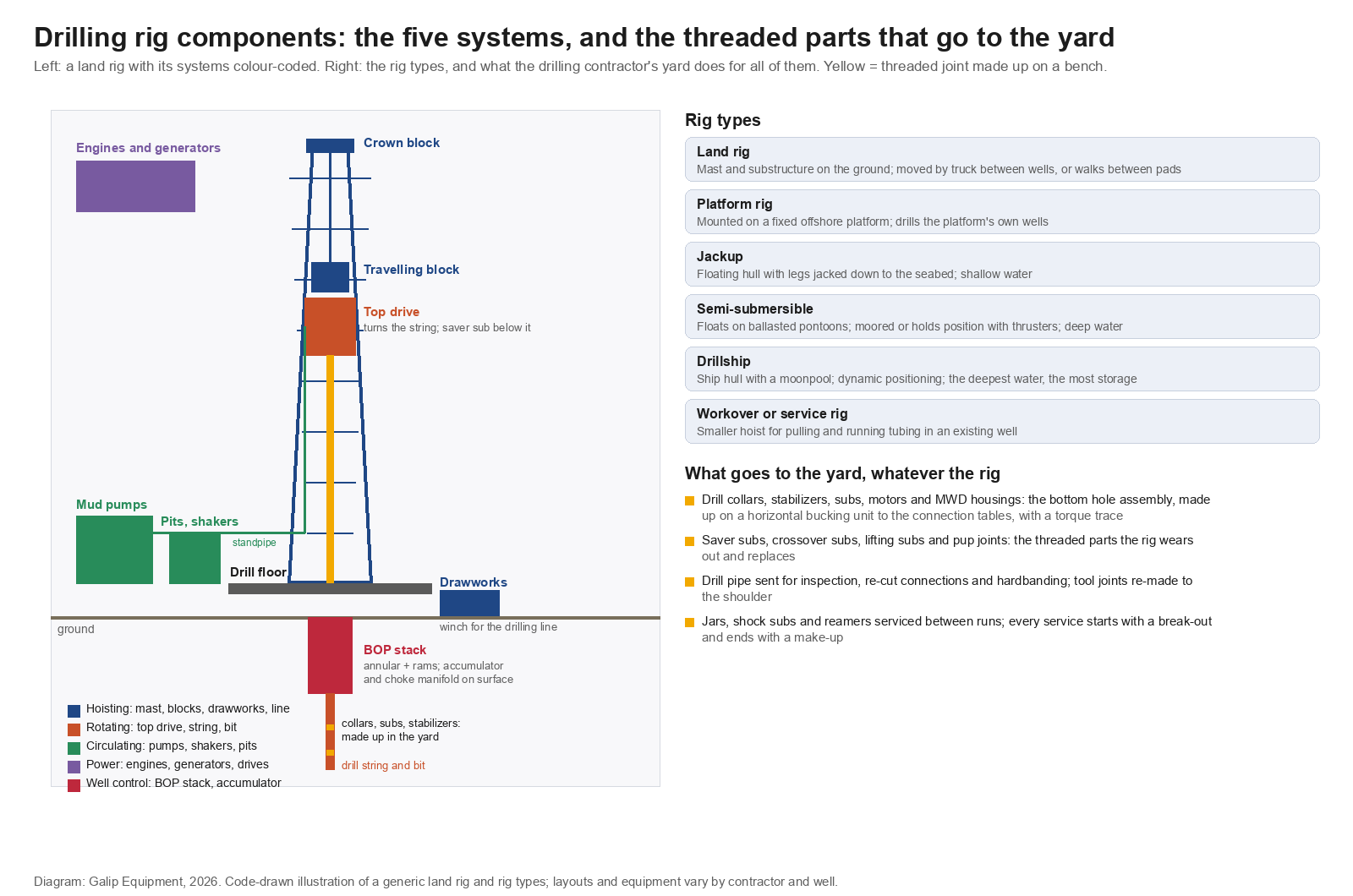
The usual way to describe a rig is by system, and the systems are five: hoisting, rotating, circulating, power and well control; an illustrated glossary of the parts is kept by Drilling Manual: drilling rig components. Each is a set of components with its own names, and the components are listed below in the order a visitor would meet them walking onto the location. One thing to keep in view while reading: a large share of what the rig runs into the hole is threaded, and those threaded parts have a second home, the contractor’s yard, which is where this page ends.
Hoisting system: mast, blocks and drawworks
The hoisting system carries the weight of everything in the hole and moves it up and down. Its tower is a mast, raised as a unit on a land rig, or a derrick, built in place and typical of offshore rigs; at its top sits the crown block, a set of sheaves. The drilling line, a wire rope, is reeved between the crown block and the travelling block below it, so that the travelling block hangs on several parts of line and the hook load is divided between them. The line is spooled on the drawworks, the winch on the drill floor whose motor raises the string and whose brake lowers it under control (SLB Energy Glossary: drawworks). Below the travelling block hangs the hook and, on a modern rig, the top drive.
The substructure under the drill floor sets the floor’s height and carries the setback load of the stands of pipe racked in the mast. The dead line, the end of the drilling line that is fixed rather than spooled, passes through a sensor that reads the hook load for the driller. All of it is sized from the heaviest string the rig will run, which is the string of casing, since drill pipe is lighter per foot and is never all in the hole at once.
Rotating system: top drive, rotary table and the string
The rotating system turns the bit. On a modern rig the turning is done by a top drive, a motor hung from the travelling block that screws onto the top of the string and rotates it while the hoist raises and lowers it (SLB Energy Glossary: top drive). Older rigs turn the string with a rotary table set in the drill floor, which grips a square or hexagonal pipe called the kelly through a kelly bushing; the kelly turns with the table and slides through it as the hole deepens. The top drive’s advantage is that it can drill with a full stand of three joints rather than a single joint, and can rotate and circulate while pulling out of the hole.
Below the top drive is a saver sub, a short threaded sub that takes the wear of every connection made and broken at the floor so that the top drive’s own thread does not. Below that is the drill string: drill pipe to the surface, heavy-weight drill pipe as a transition, and the bottom hole assembly of collars, stabilizers, subs, tools and bit. The string is the subject of drill string components; where the well is steered, the motor and measurement tools in the assembly are described in directional drilling explained. Every piece of that string from the saver sub down is a threaded connection, which is the fact the last section of this page turns on.
Circulating system: pumps, pits and shakers
The circulating system moves drilling fluid, the mud, in a loop. Mud pumps, usually large triplex piston pumps, push it up the standpipe, through the rotary hose, into the top drive and down the inside of the string to the bit, where it exits through nozzles, cools and cleans the bit and carries the cuttings up the annulus between the string and the hole wall. At surface the returning mud passes over the shale shakers, vibrating screens that drop the cuttings, then through desanders, desilters and a centrifuge that remove finer solids and a degasser that strips entrained gas, and back into the pits, the tanks from which the pumps draw. The mud’s density is what holds back the formation pressure, so the pits, the pumps and the mud engineer’s measurements are as much a well-control matter as the stack below the floor.
Power system
A rig’s power is almost always diesel. On an electric rig the engines drive generators, and the electrical power is sent through drives, silicon-controlled rectifiers on older rigs and variable-frequency drives on newer ones, to motors on the drawworks, the mud pumps and the top drive. On a mechanical rig the engines turn the drawworks and pumps through a compound of chains and clutches. The power system also feeds the camp, the lights and the control systems, and on a modern land rig it is sized so that one engine can be down for maintenance without stopping the well. Where grid power or gas is available, rigs are increasingly fitted to use it in place of diesel.
Well control system: the BOP stack
The blowout preventer stack sits under the drill floor on the wellhead. From the top down it is usually an annular preventer, which closes on any shape of pipe or on the open hole, and a set of ram preventers: pipe rams that close on the drill pipe, blind rams that close on an open hole, and shear rams that cut the pipe and seal. The stack is closed by hydraulic pressure stored in an accumulator unit, and the choke manifold beside the floor lets the crew circulate an influx out of the well under controlled back pressure, through the mud-gas separator and back to the pits. API Standard 53 sets how the stack is configured, tested and maintained. A rig’s well control system is the part of it that matters most and works least, which is why it is tested on a fixed schedule rather than when something happens.
Types of drilling rigs: land
Land rigs are sorted by how they move. Conventional land rigs are trucked between wells as loads and reassembled, a move that takes days. Pad rigs, built for the shale fields where a dozen wells are drilled from one site, walk or skid from well to well on hydraulic feet or rails with the mast up and the pipe racked. Truck-mounted and trailer-mounted rigs carry the mast on a carrier and set up in hours; they drill shallow wells and do workover and well-service jobs on existing ones, the rigs described in workover rig operations. Depth rating, hook load and the number of mud pumps are the numbers a contractor quotes, and they are the numbers that decide which rig can drill which well.
Types of drilling rigs: offshore
Offshore rigs are sorted by how they stand in the water. A platform rig is a rig package set on a fixed production platform to drill the platform’s own wells. A jackup is a hull with legs that are jacked down to the seabed in shallow water until the hull stands clear of the waves, the workhorse of shelf drilling (SLB Energy Glossary: jackup). A semi-submersible floats on ballasted pontoons below the wave zone, held in place by mooring lines or by thrusters under dynamic positioning, and drills in deep water through a riser connecting the floor to a subsea stack. A drillship is a ship hull with a moonpool in the middle, held on position by thrusters, carrying the most storage and drilling the deepest water (SLB Energy Glossary: drillship). A tender-assisted rig puts a small drilling package on a platform and the pumps, power and accommodation on a barge moored beside it. Inland and swamp wells are drilled from barge rigs that float to location and are sunk onto the bottom.
The floating rigs change one thing for this page: their blowout preventer stack is on the seabed, run on the riser, and it comes to the rig’s deck for maintenance between wells, where its connectors, ram blocks and bonnets are serviced in a yard-like shop on board. The threaded tools in the string are the same as on land.
The threaded parts of a rig, and the yard behind it
Walk the rig again and count the threads. The mast, the drawworks, the pumps and the stack are bolted, welded and flanged. The string is threaded from the saver sub to the bit: drill pipe tool joints, heavy-weight joints, the collars, stabilizers, subs, jars, motors and measurement housings of the bottom hole assembly, the bit sub and the bit. The rig floor makes up and breaks out the drill pipe stands with tongs or an iron roughneck, on every trip, and that is as far as its make-up goes. The rest happens in the contractor’s yard, on a bench, and it happens all the time.
| Threaded part | What the rig floor does with it | What the yard does with it |
|---|---|---|
| Drill pipe | Makes up and breaks out stands on every trip with tongs or an iron roughneck | Sends it for inspection to the DS-1 drill stem standard, re-cuts worn tool joints, applies hardbanding, and makes the repaired joints up again on a bench to the shoulder |
| Bottom hole assembly: collars, stabilizers, subs | Picks up the assembly already made up, or makes up the few joints that are broken for handling | Makes the assembly up on a horizontal bench to the connection tables with a torque trace, and breaks it out again when the section is drilled |
| Motors, MWD housings, jars, reamers | Runs them | Sends them to their owners’ service shops, where every service begins with a break-out and ends with a make-up |
| Saver subs, crossover subs, lifting subs, bit subs | Wears them out | Replaces and re-cuts them; makes new ones up to the joint or tool they will run with |
| Casing and tubing | Runs the string with the casing crew’s tongs | Sees them only as the accessories made up before the run, which belong to the threading shop |
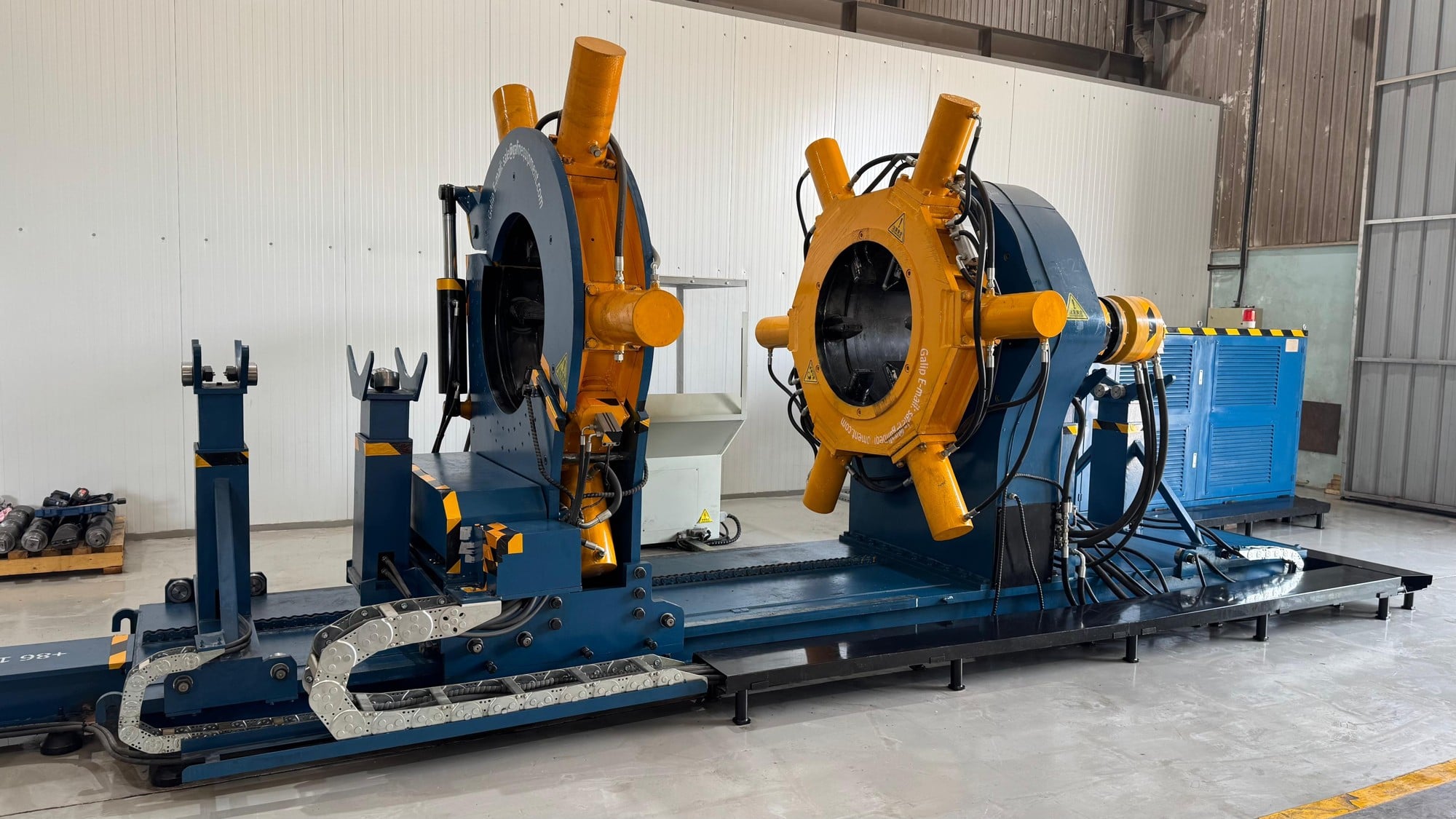
The yard’s bench is a horizontal hydraulic bucking unit: a clamp for the tool body, a rotational head for the connection, a torque-turn trace per joint, and jaws to suit the range of collar, sub and tool diameters the contractor runs. It is sized from the largest rotary shouldered connection in the fleet and from the break-out of tools returned from the hole, which is always the larger figure, and the same bench serves the handling and storage side of the yard described in OCTG handling and storage and pipe handling equipment for OCTG workshops. A drilling contractor who counts the rig’s components and stops at the drill floor has missed the machine that makes up most of what the rig runs.
Where rigs sit in the industry
Rigs belong to drilling contractors, who hire them to operators by the day; the largest contractors run fleets of dozens of land rigs or floating rigs, and each fleet has a base with a yard, a tool shop and a pipe inspection line behind it. The tools in the string belong partly to the contractor, collars and subs, and partly to the service companies that supply motors, measurement tools and jars, whose shops are described in downhole tools. The workover and well-service rigs that return to a well after it is completed are a trade of their own, with the same bench behind them.
When another page is the better start
A rig engineer choosing a rig for a well is working from hook load, depth rating, pump horsepower and the well’s casing programme, and this page adds nothing to that. A buyer of rig equipment should go to the rig manufacturers and the API specifications for drilling equipment. A reader whose question was the drill string should read drill string components first, and one whose question was the steering assembly should read directional drilling explained. A drilling contractor equipping a yard, who already knows the connection range and tool fleet, should go to the bucking unit product page and ask about jaws for the collar range, break-out capacity and trace export by tool serial.
The usual limit applies. Hook loads, depth ratings and testing intervals belong to the rig’s documents and to API; this page describes the components and where the threaded ones are made up, and leaves the numbers to the owners of them.
Frequently asked questions
What are the main components of a drilling rig?
They are grouped into five systems. Hoisting: mast or derrick, crown block, travelling block, drilling line and drawworks. Rotating: top drive or rotary table and kelly, and the drill string with its bit. Circulating: mud pumps, standpipe, shale shakers, solids control equipment and the pits. Power: engines, generators and drives. Well control: the blowout preventer stack, accumulator and choke manifold.
What are the types of drilling rigs?
On land: conventional rigs moved as truck loads, pad rigs that walk between wells, and truck- or trailer-mounted rigs for shallow wells and workovers. Offshore: platform rigs on fixed platforms, jackups standing on legs in shallow water, semi-submersibles floating on pontoons, drillships holding position by thrusters, tender-assisted rigs beside small platforms, and barge rigs for inland water.
What does the drawworks do?
The drawworks is the winch on the drill floor that spools the drilling line. Its motor raises the travelling block and the string hanging from it, and its brakes lower them under control. The line runs between the crown block at the top of the mast and the travelling block, so the load is shared across several parts of line.
What is the difference between a top drive and a rotary table?
Both turn the drill string. A rotary table is set in the drill floor and turns a square or hexagonal kelly that slides through it as the hole deepens, one joint at a time. A top drive is a motor hung from the travelling block that screws onto the string and turns it directly, drilling a full stand at a time and able to rotate and circulate while pulling out of the hole.
What is a BOP stack?
The blowout preventer stack mounted on the wellhead under the drill floor. It usually has an annular preventer that seals on any pipe or the open hole, pipe rams that close on the drill pipe, blind rams that close on the open hole, and shear rams that cut the pipe and seal. Hydraulic pressure from an accumulator closes it; API Standard 53 covers its configuration and testing.
Which parts of a drilling rig are made up in a yard?
The threaded tools the rig runs. The bottom hole assembly of drill collars, stabilizers and subs is made up on a horizontal bucking unit in the contractor’s yard to the connection tables, and broken out again after the section. Drill pipe goes to the yard for inspection and tool joint repair, and motors, measurement tools and jars go to their owners’ shops between runs.
Send the tool range with the enquiry
A drilling contractor’s yard is quoted from its fleet. The useful set for a bucking unit quotation is: the range of drill collar and sub outside diameters and connection types, the largest tool to be clamped, the highest make-up torque in the connection tables and the highest break-out expected on tools returned from the hole, how many rigs the yard serves and how often assemblies turn over, the record format the operators ask for, the site power supply and a sketch of the make-up cell. The Galip team quotes from that list and will say where a breakout unit belongs beside the bench.
The drilling rig components checklist
- Learn the rig by its five systems: hoisting, rotating, circulating, power and well control, and the components of each.
- Know the rig types by how they move on land and how they stand in the water offshore.
- Count the threads: the string from the saver sub to the bit is threaded, and the rig floor makes up only the drill pipe.
- Make up the bottom hole assembly in the yard on a horizontal bench, to the connection tables, with a torque trace.
- Inspect drill pipe to the DS-1 standard between wells, re-cut and hardband the tool joints, and re-make the repaired connections on a bench.
- Send motors, measurement tools and jars to their owners’ shops between runs; every service starts with a break-out.
- Size the yard’s bench from the largest connection in the fleet and from break-out, which is the larger figure.
- Treat the yard as part of the rig; it makes up most of what the rig runs.
Expert Consultation
Need more information on optimizing your equipment performance? Our engineering team is available for technical consultations.
Request a Quote
Tell us about your requirements and our engineering team will prepare a detailed proposal with specifications, pricing, and delivery timeline.
