
What Is a Drill String, and Which of Its Connections Are Made Up Before the Rig?
The drill string is a threaded column from the bit to the top drive. This page names its eight component groups, explains the rotary shouldered connection that joins them, and shows which joints are made up on the rig floor and which in the drilling contractor’s yard.
A drill string is the threaded column that connects the top drive to the bit: drill pipe from surface, heavy-weight drill pipe as a transition, then the bottom hole assembly of drill collars, stabilizers, jars, motors and measurement tools. Every joint is a rotary shouldered connection. The rig floor makes up the drill pipe as it is run; the bottom hole assembly is largely made up in the yard first.
At a glance
| What the string does | Transmits rotation and weight to the bit, carries drilling fluid down to it and cuttings back up the annulus, and provides the path for measurement tools to report |
| The eight component groups | Bit, bit sub and crossovers, drill collars, stabilizers and reamers, mud motor and MWD housings, drilling jar and shock sub, heavy-weight drill pipe, drill pipe; with the top drive or kelly at the surface end |
| The connection | Rotary shouldered: a tapered thread with a shoulder that takes the load, made up to a specified torque so the shoulder is preloaded and the joint does not work loose under rotation and bending |
| Where it is made up | Drill pipe stands on the rig floor, with an iron roughneck or tongs; the bottom hole assembly components in the drilling contractor’s or tool company’s yard, on a bucking unit, then picked up as sub-assemblies |
| Decision this page supports | Separating the yard’s connections from the rig’s, so a yard bench is specified for collars, subs and tools and not for a rig-floor job it will never do |

What a drill string is
Everything between the top drive and the bit is the drill string, and it has three jobs: to turn the bit and put weight on it, to carry drilling fluid down to the bit and bring cuttings back up the annulus, and, in a modern well, to carry measurement tools and their signals. The IADC’s drill string text opens with the same description, a string that transmits power by rotary motion from surface to the bit, conveys flushing media to the cutting face and carries cuttings out of the hole (IADC, Drill String and Components).
The string is not one kind of pipe. Near the bit it is heavy and stiff, so that weight on the bit comes from the string’s own mass and the hole stays straight; higher up it is lighter and more flexible, so that it can be handled and does not buckle in tension. The change happens in stages, and each stage is a different component with a different maker and, often, a different owner. What every stage shares is the joint between them.
The eight component groups, bottom to top
| Component | What it does | Where it is usually made up |
|---|---|---|
| Bit | Cuts the rock; roller cone or fixed cutter, threaded with a pin on top | Made up to the bit sub on the rig floor with a bit breaker, when the BHA is picked up |
| Bit sub and crossovers | Short subs that change connection size or type between components, and carry the float valve | In the yard, as part of the BHA sub-assembly; crossovers are also made up on the floor when a change is unplanned |
| Drill collars | Thick-walled, heavy joints that supply weight on bit and stiffness; steel, or non-magnetic where MWD sensors sit | In the yard, collar to collar and collar to sub, on a bucking unit; occasionally on the floor with tongs |
| Stabilizers and reamers | Full-gauge blades that centre the string in the hole and control deviation; reamers open or condition the hole | In the yard, into the collar string at planned positions; rebuilt and re-gauged between wells |
| Mud motor and MWD housings | The motor turns the bit with the drilling fluid’s energy; MWD and LWD tools measure direction and formation and report to surface | The motor and tool housings are made up and tested in the service company’s shop; the assembly is connected into the BHA in the yard or on the floor |
| Drilling jar and shock sub | The jar frees a stuck string by delivering an impact; the shock sub damps vibration | Serviced and tested in the tool shop; made into the BHA in the yard |
| Heavy-weight drill pipe | Thick-walled drill pipe with a central upset, the flexible transition between collars and pipe, and the weight in directional holes | Joints made up to each other on the rig floor; connections and hardfacing inspected and repaired in a pipe yard between wells |
| Drill pipe | The main length of the string, in stands, with tool joints welded to each end | On the rig floor, stand by stand, with an iron roughneck or tongs, as the string is run and pulled |
Above the drill pipe sits the top drive, or on an older rig the kelly and its valves, which are the surface end of the string and outside the scope of this page. The components from the bit up to and including the collars, stabilizers, jars and motors are the bottom hole assembly, and how they are combined for a given well is a design subject of its own, covered in bottom hole assembly design.
The rotary shouldered connection
Every joint in the string, from bit to top drive, is a rotary shouldered connection: a coarse tapered thread that draws the two members together and a flat shoulder that meets and takes the load. Made up to the right torque, the shoulder is preloaded in compression and the pin in tension, and the joint behaves like a solid bar under rotation, tension and bending. Made up too loose, the shoulder opens under bending and the joint fatigues or washes out; made up too tight, the pin or box yields. The torque is therefore specified, per connection size, type and material, in tables published by the connection’s owner and by API.
Two API documents divide the subject. API Specification 7-1 covers the drill stem elements themselves, kellys, subs, drill collars, heavy-weight drill pipe, stabilizers and bit connections, and says explicitly that it does not cover drill pipe and tool joints, connection design or gauging (API Spec 7-1, Rotary Drill Stem Elements); threading and gauging of the connections are in API Specification 7-2, and drill pipe has its own specification. Design and operating limits, including make-up torque guidance, are the business of API Recommended Practice 7G. For the tool joint on drill pipe in particular, what it is and why its make-up matters, see drill pipe tool joint, and for the checks a crew should make before trusting a make-up figure, drill pipe make-up torque.
The practical consequence is that a yard making up collars and subs is working to numbers it did not choose. The connection type is stamped on the component, the torque comes from the table, the thread compound is specified, and the record shows the torque was reached. Galip supplies the bench and the record; the torque belongs to the connection.
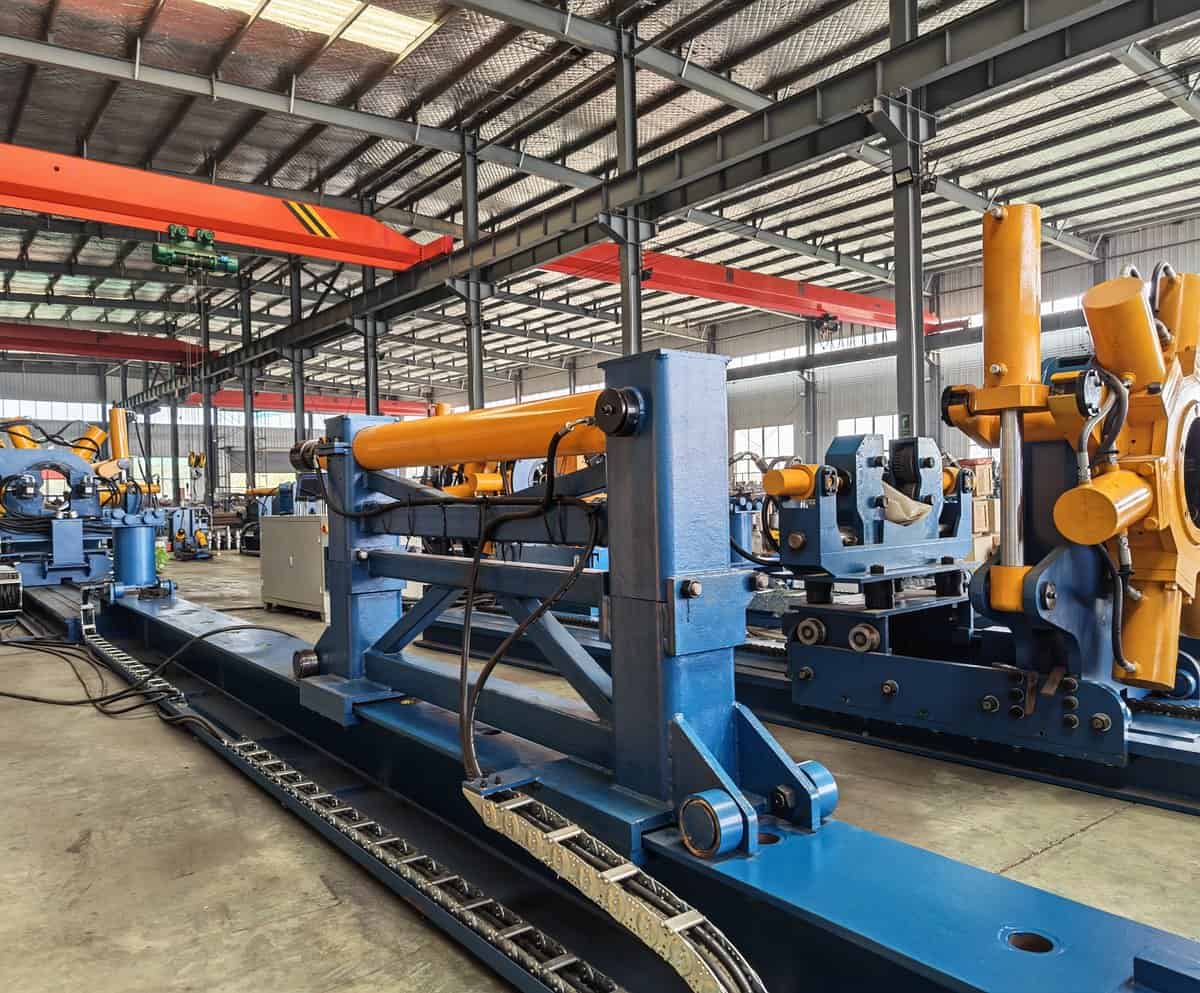
Yard and rig floor: who makes up which joint
The table above already shows the split, and it is worth stating why it exists. Drill pipe is run and pulled many times per well, stand by stand, vertically, with the string hanging in the slips; the only place to make it up is the rig floor, and the tools for that are the iron roughneck and the tong, described in the iron roughneck guide. The bottom hole assembly is different. Its components are short, heavy and stiff, they are combined to a design that is fixed before the well starts, and the same assembly may run for the whole section. Making them up on the floor costs rig time and puts a crew around heavy, awkward pieces; making them up in the yard beforehand, horizontally, on a bench, costs nothing at the rig and produces a torque-turn record for every joint.
That yard bench is a hydraulic bucking unit specified for BHA work: clamping that holds a thick collar without distortion, a spindle with the torque to preload a large rotary shouldered connection, jaws sized for collars and subs rather than for pipe, and enough break-out capacity to take the assembly apart again after the well for inspection. The comparison of the two machine categories in iron roughneck versus bucking unit is the fuller version of this paragraph; the short version is that a drilling contractor with a yard needs both, for different joints.
The components themselves come from, and go back to, several shops. Collars are sized and selected as described in drill collar weight and sizing, and non-magnetic collars around the MWD sensors are spaced by the rules in non-magnetic drill collar spacing. Stabilizers are gauged and rebuilt between wells, as set out in the drilling stabilizer guide. Jars and motors are serviced and tested by their owners’ tool shops. All of it arrives at the yard as components and leaves as a made-up assembly, and the yard’s bench is the point where those separate ownerships become one string.
After the well: breaking the string down
When the section is drilled the BHA is laid down and trucked back, and the yard breaks it out again. Every connection is opened, the threads are cleaned and inspected, the shoulders checked for damage, the collars and subs gauged, and the components sent on to their owners or back to the rack. The break-out is harder than the make-up was. The connection has been rotated, bent and heated for days, the compound has baked, and the shoulders have bedded in; the bench needs the torque to release that, and the reasons are set out in what is breakout force. A yard that specified its machine from the make-up table alone finds this out on its first lay-down.
Where the drill string sits in the industry
The drill string is drilling-phase equipment in the upstream sector, owned mostly by the drilling contractor for the pipe and by service companies for the tools; the phase view is in upstream oil and gas, and the wider map in upstream, midstream and downstream oil and gas explains why nothing like it exists beyond the well. The businesses that make up its connections off the rig, drilling contractors’ yards and tool service centres, are among the most demanding users of a bench, because the connections are large, the components heavy and the torque high.
When another page is the better start
A drilling engineer designing a BHA for a well, choosing collar sizes, stabilizer placement or motor configuration, should be in the BHA design page and in the connection owners’ tables, and should treat this page as orientation only. A yard that knows its collar range and connection types should go to the bucking unit product page and the acceptance checklist, and should ask about collar jaws, clamping pressure and break-out capacity. A rig crew looking for rig-floor make-up guidance is on the wrong page, since the bench does not go to the floor. And a buyer whose real question is about the pipe, its grades and inspection classes, should read drill pipe inspection classes before anything here.
One limit stands throughout: make-up torques, connection dimensions and inspection criteria belong to API and the connection owners. This page describes where the work is done, not what the numbers are.
Frequently asked questions
What is a drill string?
The threaded column that connects the top drive to the bit: drill pipe from surface, heavy-weight drill pipe as a transition, and a bottom hole assembly of drill collars, stabilizers, jars, motors and measurement tools near the bit. It transmits rotation and weight to the bit, carries drilling fluid down and cuttings up, and carries measurement signals to surface.
What are the main drill string components?
From the bottom: the bit, a bit sub and crossovers, drill collars, stabilizers and reamers, a mud motor and MWD or LWD housings where the well is directional, a drilling jar and shock sub, heavy-weight drill pipe, and drill pipe to surface. The components from the bit to the collars and tools are the bottom hole assembly. The steering part of that assembly is described in directional drilling explained.
What is a rotary shouldered connection?
The joint used throughout the drill string: a coarse tapered thread that draws the pin and box together and a flat shoulder that meets and carries the load. Made up to the specified torque, the shoulder is preloaded and the joint behaves like a solid bar under rotation, tension and bending. Torque values come from the connection owner’s and API tables.
Which drill string connections are made up in the yard?
The bottom hole assembly: collars to collars, subs, stabilizers, and the connections into serviced motors, jars and MWD housings. They are made up horizontally on a bucking unit in the drilling contractor’s or tool company’s yard, to a recorded torque, and trucked to the rig as sub-assemblies. Drill pipe stands are made up on the rig floor as the string is run.
Which API standards cover drill string components?
API Specification 7-1 covers drill stem elements such as kellys, subs, drill collars, heavy-weight drill pipe and stabilizers; API Specification 7-2 covers threading and gauging of rotary shouldered connections; drill pipe has its own product specification; and API Recommended Practice 7G covers drill stem design and operating limits, including make-up guidance.
Why is breaking out a used BHA harder than making it up?
Because the connections have been rotated, bent and heated for days, the thread compound has baked, and the shoulders have bedded in. The torque needed to release a connection after a drilled section is higher than the torque that made it up, so a yard bench is sized from break-out, and a machine specified from the make-up table alone stalls at the first lay-down.
Send the BHA list with the enquiry
A yard enquiry is answered from the components. The useful set for a bucking unit quotation is: the range of collar and sub outside diameters and lengths, the rotary shouldered connection types and sizes run, the highest make-up torque in the tables for those connections and the break-out expected after a section, whether motors, jars or MWD housings will also be handled and their dimensions, the record the drilling contractor or operator requires, the site power supply and a sketch of the yard bay. The Galip team quotes from that list and will say which jaw sets the collar range needs.
The drill string checklist
- List the string for the wells the yard serves, bottom to top, and mark each connection as yard-made-up or floor-made-up.
- Collect the connection types and the make-up torques from the connection owners’ and API tables; the yard applies them.
- Specify the bench for the largest collar and the shortest sub it will see, with jaws for thick, stiff bodies.
- Size the machine from break-out after a drilled section, which exceeds the make-up figure.
- Record the torque-turn trace for every yard connection against the assembly and the well.
- Route motors, jars and MWD tools to their owners’ shops for service and test; the yard makes up the string, it does not rebuild the tools.
- Inspect threads and shoulders at every break-out and gauge collars and stabilizers between wells.
- Keep rig-floor equipment and yard equipment as separate specifications; neither replaces the other.
{“@context”: “https://schema.org”, “@type”: “FAQPage”, “mainEntity”: [{“@type”: “Question”, “name”: “What is a drill string?”, “acceptedAnswer”: {“@type”: “Answer”, “text”: “The threaded column that connects the top drive to the bit: drill pipe from surface, heavy-weight drill pipe as a transition, and a bottom hole assembly of drill collars, stabilizers, jars, motors and measurement tools near the bit. It transmits rotation and weight to the bit, carries drilling fluid down and cuttings up, and carries measurement signals to surface.”}}, {“@type”: “Question”, “name”: “What are the main drill string components?”, “acceptedAnswer”: {“@type”: “Answer”, “text”: “From the bottom: the bit, a bit sub and crossovers, drill collars, stabilizers and reamers, a mud motor and MWD or LWD housings where the well is directional, a drilling jar and shock sub, heavy-weight drill pipe, and drill pipe to surface. The components from the bit to the collars and tools are the bottom hole assembly.”}}, {“@type”: “Question”, “name”: “What is a rotary shouldered connection?”, “acceptedAnswer”: {“@type”: “Answer”, “text”: “The joint used throughout the drill string: a coarse tapered thread that draws the pin and box together and a flat shoulder that meets and carries the load. Made up to the specified torque, the shoulder is preloaded and the joint behaves like a solid bar under rotation, tension and bending. Torque values come from the connection owner’s and API tables.”}}, {“@type”: “Question”, “name”: “Which drill string connections are made up in the yard?”, “acceptedAnswer”: {“@type”: “Answer”, “text”: “The bottom hole assembly: collars to collars, subs, stabilizers, and the connections into serviced motors, jars and MWD housings. They are made up horizontally on a bucking unit in the drilling contractor’s or tool company’s yard, to a recorded torque, and trucked to the rig as sub-assemblies. Drill pipe stands are made up on the rig floor as the string is run.”}}, {“@type”: “Question”, “name”: “Which API standards cover drill string components?”, “acceptedAnswer”: {“@type”: “Answer”, “text”: “API Specification 7-1 covers drill stem elements such as kellys, subs, drill collars, heavy-weight drill pipe and stabilizers; API Specification 7-2 covers threading and gauging of rotary shouldered connections; drill pipe has its own product specification; and API Recommended Practice 7G covers drill stem design and operating limits, including make-up guidance.”}}, {“@type”: “Question”, “name”: “Why is breaking out a used BHA harder than making it up?”, “acceptedAnswer”: {“@type”: “Answer”, “text”: “Because the connections have been rotated, bent and heated for days, the thread compound has baked, and the shoulders have bedded in. The torque needed to release a connection after a drilled section is higher than the torque that made it up, so a yard bench is sized from break-out, and a machine specified from the make-up table alone stalls at the first lay-down.”}}]}
Expert Consultation
Need more information on optimizing your equipment performance? Our engineering team is available for technical consultations.
Request a Quote
Tell us about your requirements and our engineering team will prepare a detailed proposal with specifications, pricing, and delivery timeline.
