
Iron Roughneck vs Bucking Unit: 7 Essential Differences
Iron roughneck vs bucking unit guide: compare rig-floor connection equipment with controlled workshop make-up, torque-turn records, and Galip fit.
Which Machine Fits Rig-Floor Connection Work and Which Fits a Controlled Workshop?
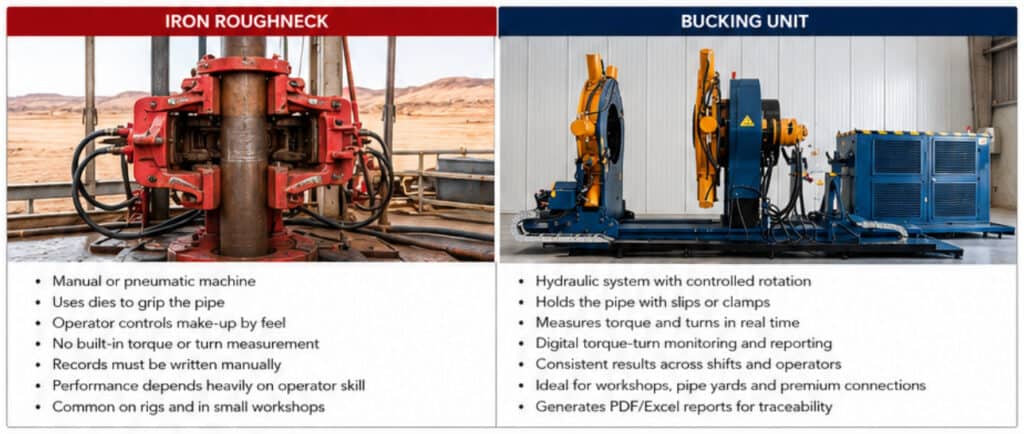
Workflow comparison of rig-floor iron roughneck work and controlled workshop bucking-unit make-up.
Iron roughneck vs bucking unit is not just a comparison of maximum torque. An iron roughneck is primarily rig-floor equipment built around the drilling cycle, while a hydraulic bucking unit is primarily a controlled workshop machine built around support, repeatability, inspection, torque-turn monitoring, and records.
That distinction matters because a buyer can choose a machine with enough torque and still choose the wrong equipment category. A land-rig contractor may need a unit that moves to well center and keeps the connection cycle moving. An OCTG threading shop may need a stable horizontal work cell that controls alignment and produces a report for every joint. A mud-motor service company may need both field-side handling equipment and a shop-based make/break system.
This guide compares iron roughnecks and bucking units by the work they are designed to perform: location, pipe orientation, mounting, support, torque delivery, speed, data, wear parts, calibration, maintenance, price drivers, and customer documentation. It also explains where a Galip hydraulic bucking unit fits—and where an iron roughneck remains the more appropriate choice.
Quick answer:
- Choose an iron roughneck when the main job is making and breaking tubular connections on the drill floor, close to well center, with rig-cycle efficiency and reduced manual handling as the priority.
- Choose a bucking unit when the main job is controlled horizontal make-up or break-out in a workshop, service base, threading line, or repair cell, especially when alignment, repeatability, torque-turn monitoring, and traceable reports matter.
- Do not choose by maximum torque alone. The decisive question is where the job happens and what evidence must remain after the connection is complete.
What is an iron roughneck?
An iron roughneck is mechanized rig-floor equipment used to make and break tubular connections during drilling operations. It is positioned at or near well center and is normally integrated into the drill-floor arrangement through a pedestal, track, or another positioning system. Its purpose is to bring gripping, spinning, and torque functions to the connection while reducing the amount of direct manual tong work around the pipe.
NOV, one of the established manufacturers in this category, describes iron roughnecks as drill-floor equipment that streamlines the make-and-break process and reduces rig-floor hazards. Its public product range includes pedestal-mounted, track-mounted, and trackless models. That variety reveals an important design priority: an iron roughneck must reach, position, and work around the rig-floor connection point rather than organize the job around a fixed workshop bed.
The iron roughneck is therefore evaluated as part of the rig system. Buyers look at reach, mounting, well-center coverage, pipe and tool-joint range, make-up and break-out torque, spinning performance, control position, collision risks, integration with other rig-floor equipment, and the effect on connection-cycle time.
Its strongest value is not that it can produce torque in isolation. Its strongest value is that it can perform the connection task where drilling operations need it, repeatedly, while the tubular is being run or pulled.
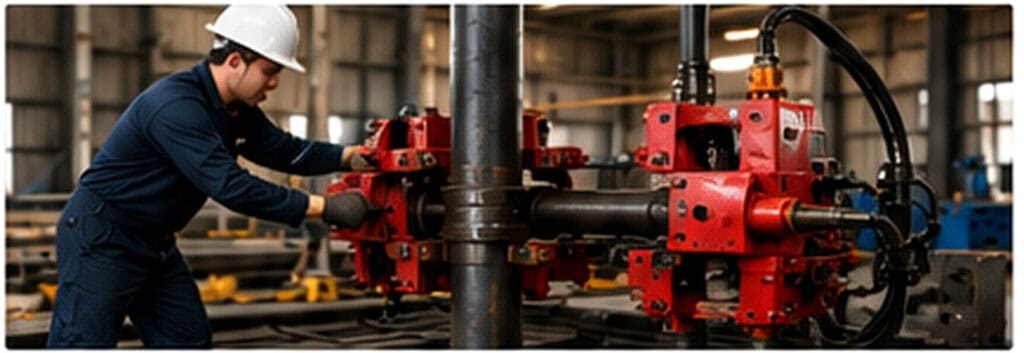
Rig-floor connection equipment is selected around reach, positioning, and drilling-cycle efficiency.
What is a bucking unit?
A hydraulic bucking unit is a make/break machine normally installed in a workshop, service center, manufacturing line, OCTG facility, or repair base. The tubular or tool is loaded horizontally, supported along its length, aligned with the machine centerline, clamped in controlled positions, and rotated under a defined procedure.
In this environment, the objective is wider than completing the connection quickly. The workshop may need to protect a premium thread, control low-speed shoulder approach, repeat the same job across shifts, review a torque-turn curve, retain a serial-numbered record, or provide evidence during a customer witness review. The machine becomes the center of a controlled work cell rather than an attachment serving the drilling cycle.
Galip’s public bucking-unit specification emphasizes 360-degree continuous rotation, independent clamping, rigid support and roller jacks, real-time torque-turn display, saved parameter profiles, and PDF/Excel report output. Those features are aimed at premium connections, API casing and tubing, CRA or chrome tubulars, drill pipe and BHA components, casing couplings, and service-center repair work.
A bucking unit can also support break-out work when configured for it, but its defining advantage remains the controlled horizontal workflow around the workpiece: support, alignment, clamping, rotation, monitoring, review, and release.
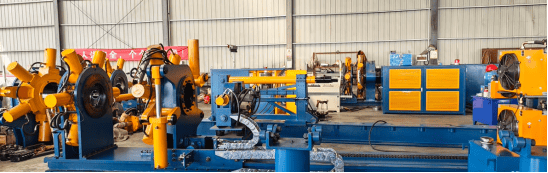
A workshop bucking unit is selected around horizontal support, controlled make-up, torque-turn review, and traceable records.
The fundamental difference: rig cycle vs workshop process
The simplest comparison is this: an iron roughneck brings the machine to the drill-floor connection; a bucking unit brings the connection into a controlled workshop machine cell.
That difference changes almost every design and buying decision. The iron roughneck must fit into a crowded, dynamic rig floor and work with vertical tubular movement. The bucking unit must fit a horizontal material-flow process and support long or heavy components before torque is applied. The iron roughneck is judged partly by how it affects the rig cycle. The bucking unit is judged partly by how reliably the workshop can repeat and document the job.
Neither approach is automatically more advanced. They are advanced in different directions. Rig-floor automation is valuable when speed, positioning, and distance from manual handling are the main priorities. Workshop process control is valuable when connection quality, setup repeatability, surface protection, report retention, and customer acceptance are the main priorities.
Iron roughneck vs bucking unit: comparison at a glance
The comparison table below is deliberately based on workflow rather than marketing claims. Individual models and options vary, so buyers should verify every technical point with the relevant manufacturer.
| Decision factor | Iron roughneck | Bucking unit |
| Operating environment | Drill floor, near well center | Workshop, service base, threading line, repair cell |
| Typical pipe orientation | Vertical or rig-floor connection position | Horizontal workpiece on supports or roller jacks |
| Primary objective | Efficient rig-floor make/break and reduced manual tong handling | Controlled, repeatable make/break with support and records |
| Mounting / positioning | Pedestal, track, or trackless system depending on model | Fixed frame, rails, supports, loading and handling cell |
| Workflow priority | Rig connection cycle and equipment coordination | Connection quality, repeatability, QA review, release package |
| Torque capability | Model-specific; substantial make-up and break-out ratings are available | Model-specific; substantial make-up and break-out ratings are available |
| Data and reporting | Varies by OEM, model, control package, and rig integration | Varies by manufacturer; Galip offers torque-turn display and PDF/Excel output |
| Wear interface | Dies / gripping elements | Jaws, inserts, soft-contact or non-marking options |
| Calibration focus | OEM torque system, controls, gripping and positioning condition | Torque/turn channels, control response, clamping, supports and reports |
| Best fit | Drilling operations that need connection equipment at well center | Premium/OCTG/service work that belongs in a controlled shop cell |
| Main buyer question | Can it serve the rig floor safely and efficiently? | Can the shop repeat, review, and prove the job? |
Why maximum torque alone is a poor buying rule
Maximum torque is the first number many procurement teams compare, but it is often the least useful place to begin. Current public NOV iron-roughneck models cover multiple make-up and break-out ratings and several mounting types. Galip’s current bucking-unit range also covers multiple frame sizes and model-dependent torque ranges. In other words, both categories can reach serious oilfield torque levels.
The more useful questions are: Where must the torque be applied? How is the workpiece supported? What connection family is being handled? Is the normal workload close to the peak rating or far below it? Does the process need a detailed curve or only a verified final result? What happens when the connection is rejected and must be reworked?
A machine selected around a headline maximum can be expensive and still perform poorly in the real workflow. A rig-floor unit may have the torque but lack the horizontal support and report workflow a service shop needs. A workshop unit may have the control and data but be completely wrong for moving to well center during tripping.
Pipe orientation and machine layout
Pipe orientation is not a small difference. It determines how the connection approaches, how side load is controlled, where operators stand, how handling equipment moves, and how the machine is installed.
Iron roughnecks typically work around vertical tubulars on the drill floor. Their positioning system must bring the machine into the connection zone and retract it when other operations need the space. The rig’s elevators, slips, top drive, pipe-handling equipment, setback area, and well-center geometry all influence the installation.
Bucking units normally work with horizontal components. Roller jacks, support stands, overhead cranes, forklifts, loading tables, and extension beams become part of the job. Long tools and heavy BHA assemblies must be supported so the threaded connection enters naturally instead of being forced into line by the clamp.
This is why a buyer should sketch the material path before comparing quotations. The best torque head cannot correct a layout that makes every load awkward or introduces side load before make-up begins.
Speed and throughput mean different things
An iron roughneck is usually chosen to support the drilling cycle. Its value is closely connected to how efficiently the rig can spin, torque, break, reposition, and continue the operation. Delays repeat across every connection, so reach, positioning, control response, and coordination with the crew matter.
A bucking unit supports a different kind of throughput. The workshop cycle includes receiving the item, confirming identity, cleaning and inspecting the connection, selecting jaws, loading, supporting, aligning, running the approved procedure, saving the record, reviewing exceptions, unloading, and staging the next item.
A workshop can therefore have a fast machine and a slow process. Report naming, jaw changes, crane availability, unclear hold points, or poor shift handover may consume more time than the rotation itself. Bucking-unit buyers should measure total job time, not only rpm. Iron-roughneck buyers should measure the effect on the rig connection cycle, not only maximum torque.
Torque data, monitoring, and report expectations
Data capability is another area where broad assumptions create bad decisions. Modern iron roughnecks can be supplied with torque verification, control, and automation options, but the exact measurement and reporting package varies by manufacturer, model, rig integration, and upgrade level. A buyer should not assume that every iron roughneck produces the same type of record.
The same caution applies to bucking units. Some are simple hydraulic make/break machines. Others are built around a full torque-turn and report workflow. Galip’s current public configuration includes real-time torque-turn display plus PDF and Excel output, but the customer still needs to define which job fields, acceptance limits, naming rules, witness templates, and retention practices are required.
For a drill-floor connection, the required record may be part of the rig’s operating and tubular-running system. For a premium-connection workshop or service center, the report may be a deliverable attached to the serial number, work order, inspection package, or customer release record.
The buyer’s question should therefore be specific: What can the operator see during the job, what is saved afterward, how is the record identified, and can QA find it months later?
Iron roughneck calibration and bucking-unit verification
Searches for iron roughneck calibration often come from owners who have learned that a displayed torque value is not enough by itself. Any torque-producing system used for controlled connection work needs an approved verification and maintenance regime. The required method and interval should come from the OEM documentation, the operator’s quality system, applicable contract requirements, and the risk of the connection program.
For an iron roughneck, the review may include the torque system, controls, mechanical condition, gripping components, positioning, and functional response under the manufacturer’s procedure. For a bucking unit, the review may include the torque and turn channels, clamp and support condition, control response, report output, and a witnessed functional or load test.
Do not publish a universal calibration interval unless it is supported by the exact machine manual and customer requirement. Duty cycle, repair history, criticality, transport, environment, and local QA rules can all change the schedule. The useful commercial question is whether the supplier can provide the verification procedure, acceptance criteria, records, and support needed to keep the machine inside the owner’s quality system.
Iron roughneck dies vs bucking-unit jaws and inserts
Iron roughneck dies and bucking-unit jaws or inserts are not minor spare parts. They are the interface between a high-force machine and a valuable tubular or tool body. Their profile, size, material, condition, and suitability for the surface affect grip stability and marking risk.
An iron-roughneck owner should confirm the die range for the expected tool-joint diameters, changeover method, wear limits, storage, availability, and whether the selected dies match the OEM’s intended use. A bucking-unit buyer should define standard jaws, soft-contact or non-marking options, protected grip areas, changeover time, spare sets, cleaning practices, and customer marking limits.
The cheapest machine can become expensive if normal wear items are difficult to identify or source. Before purchase, request a recommended two-year spares list, part-numbered illustrations, expected wear items, storage guidance, and a clear path for reordering.
Safety: different environments, different controls
Both equipment categories are intended to reduce risky manual work, but their hazard profiles are different. An iron roughneck operates in a busy drill-floor environment where tubular movement, suspended loads, well-center activity, and adjacent machines must be coordinated. Positioning, collision management, exclusion zones, remote controls, and crew communication are central.
A bucking unit operates in a workshop cell where stored hydraulic energy, rotating components, clamping zones, long workpieces, crane movement, hoses, supports, and maintenance access must be controlled. The fixed layout gives the owner more opportunity to engineer barriers, marked zones, lighting, housekeeping, and a stable operator position—but only if the cell is planned properly.
Safety should never be reduced to a statement that one category is safer. The correct question is whether the equipment reduces exposure in its intended environment and whether the full work system—handling, procedures, guarding, training, maintenance, and emergency response—supports that result.
Iron roughneck price vs bucking-unit price
The phrase iron roughneck price sounds simple, but a useful quotation depends on much more than the machine name. Iron-roughneck cost drivers can include connection range, torque rating, pedestal or track system, reach, offshore or land-rig requirements, control package, rig integration, hazardous-area requirements, spare dies, installation, commissioning, upgrades, and service support.
Bucking-unit price drivers include frame and OD range, normal and peak torque, make-up and break-out duties, jaw packages, surface-protection requirements, workpiece supports, headstock travel, controls, torque-turn reporting, report customization, voltage, hydraulic power unit, guarding, factory acceptance testing, shipping, commissioning, and spare parts.
A lower purchase price is not automatically lower total cost. Buyers should compare the complete delivered scope, installation work, training, wear parts, calibration support, downtime risk, local service options, and the revenue or rig time affected by the machine. The correct commercial comparison is cost per reliable connection or cost per supported operating hour—not equipment price alone.
When an iron roughneck is the better fit
An iron roughneck is generally the stronger choice when most of the following are true:
- The connection work happens on the drill floor at or near well center.
- The equipment must follow the drilling sequence rather than receive components in a fixed workshop cell.
- Vertical pipe handling and integration with rig equipment are central.
- Reducing manual tong work and keeping the rig connection cycle moving are major objectives.
- The buyer needs a pedestal, track-mounted, or trackless positioning solution suited to the rig layout.
- The required torque and connection range fit an available iron-roughneck model.
- The owner has the maintenance, calibration, dies, controls, and service support required for rig operations.
In this case, choosing a bucking unit simply because it offers detailed workshop reporting would misunderstand the job. The equipment has to serve the rig floor first.
When a bucking unit is the better fit
A bucking unit is generally the stronger choice when most of the following are true:
- The work happens in a workshop, pipe yard, threading line, manufacturing cell, or service base.
- Components can be loaded horizontally and supported before torque is applied.
- The job includes premium connections, OCTG, casing couplings, BHA tools, crossovers, drill pipe, mud motors, jars, or repaired downhole assemblies.
- The customer expects torque-turn records, witness documentation, serial-number traceability, or a defined release package.
- The shop wants the same setup discipline across operators and shifts.
- Surface protection, jaw selection, and alignment are part of the acceptance process.
- The machine must support repeat jobs, re-makes, inspection holds, and report retrieval.
In that environment, a rig-floor iron roughneck may be capable of torque but still be the wrong process architecture. The workshop needs a controlled cell around the connection.
When an operation may need both
Many serious operations need both equipment categories. A drilling contractor may use an iron roughneck on the rig and a bucking unit at the maintenance base. A rental company may support mobile operations while rebuilding and documenting tools in a central workshop. A mud-motor service business may use a breakout unit for stubborn teardown, a bucking unit for controlled rebuild, and test equipment for final release. The wider picture, which part of the oil and gas value chain each machine serves, is in where a bucking unit works across upstream, midstream and downstream.
Thinking in terms of the equipment lifecycle is more useful than forcing an either-or decision. The iron roughneck supports the connection during drilling. The workshop bucking unit supports assembly, repair, qualification, rework, and documentation before or after the field run. Each machine is strongest when it is placed in the process it was designed to control.
Eight buying mistakes to avoid
- Comparing only maximum torque. Torque does not describe location, orientation, support, reach, data, or workflow.
- Treating an iron roughneck as a workshop QA system without checking the reporting and handling package.
- Treating a bucking unit as a direct replacement for rig-floor automation. A fixed horizontal cell does not perform the same positioning role at well center.
- Ignoring the normal connection range. The machine should be comfortable on daily work, not merely capable at the extremes.
- Leaving calibration and verification until after delivery. The owner needs a defined method, records, and responsibilities before production starts.
- Forgetting dies, jaws, inserts, and surface protection. The gripping interface is part of connection quality and operating cost.
- Buying software language instead of a report workflow. Ask to see a sample record and test how jobs are named, saved, exported, and found.
- Failing to map the complete work area. Crane access, well-center reach, collision envelopes, operator visibility, support stands, and maintenance clearance can decide whether the machine succeeds.
Where Galip fits in this comparison
Galip manufactures hydraulic bucking units for controlled workshop make-up and make/break work; it does not position its current product range as a replacement for a rig-floor iron roughneck. That distinction is important for trust.
If your primary requirement is drill-floor connection handling during tripping, an iron roughneck is the equipment category to investigate. If your requirement is a horizontal workshop cell for premium connections, API tubulars, casing couplings, BHA components, service tools, or repaired assemblies, a Galip bucking unit may be the appropriate fit.
For current public specifications, see the Galip hydraulic bucking unit product page. Galip’s current public range includes multiple frame sizes, model-dependent OD and torque ranges, 360-degree continuous rotation, independent hydraulic clamping, roller support, real-time torque-turn display, saved programs, and PDF/Excel report output. Configurations are built around the buyer’s actual product family, OD range, normal and peak torque, connection procedure, jaw requirements, daily output, report format, power supply, lifting method, and workshop layout.
The safest conclusion is not that a bucking unit is better than an iron roughneck. It is that a Galip hydraulic bucking unit is designed for buyers whose make/break work belongs in a controlled, traceable workshop process.
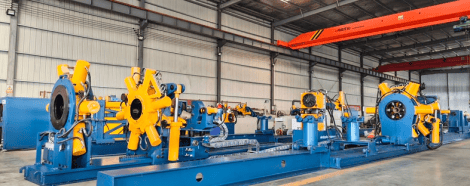
Galip hydraulic bucking units are configured around the buyer’s OD range, torque requirement, jaw package, reporting needs, and workshop layout.
| Safe product conclusion for the articleGalip hydraulic bucking units are designed for buyers whose make/break work belongs in a controlled, traceable workshop process.If the primary requirement is rig-floor connection handling at well center, investigate an iron roughneck. If the requirement is horizontal workshop make-up with torque-turn monitoring and report output, discuss a bucking-unit configuration. |
RFQ checklist: what to send before asking for a price
Before requesting a quotation, prepare the following information:
For an iron roughneck: rig type, land or offshore environment, well-center layout, mounting preference, reach and coverage, tool-joint OD range, make-up and break-out torque, control and automation requirements, hazardous-area requirements, interfaces with other rig-floor equipment, die package, service location, and commissioning expectations.
For a bucking unit: product families, minimum and maximum OD, component length and weight, typical and peak make-up torque, expected break-out torque, connection families, approved procedures, surface-protection rules, jaws and inserts, workpiece supports, jobs per shift, report fields and file formats, witness requirements, workshop dimensions, crane or forklift access, voltage and frequency, destination, training, FAT, and spares.
A good supplier should respond with more than a maximum torque and price. The proposal should show the operating envelope, exclusions, included accessories, control and report scope, acceptance test, documentation, commissioning, and the responsibilities of both supplier and buyer.
Frequently asked questions
Is an iron roughneck the same as a bucking unit?
No. Both apply torque to tubular connections, but an iron roughneck is primarily rig-floor equipment serving vertical drilling operations, while a bucking unit is primarily a horizontal workshop make/break and process-control machine.
Can an iron roughneck be used in a workshop?
It may be possible in a suitable engineered setup, but buyers should verify mounting, component handling, horizontal support, connection range, data output, guarding, and the total workflow. Capability to apply torque does not automatically make it the best workshop system.
Can a bucking unit be used on a rig floor?
Standard workshop bucking units are not direct replacements for rig-integrated iron roughnecks. Any field or rig-floor application needs a purpose-designed layout, handling plan, environmental review, and safety assessment.
Does every iron roughneck record torque?
Data and verification capabilities vary by model, OEM, control package, and upgrade level. Ask for the exact measurement, display, storage, export, calibration, and integration scope in writing.
What are iron roughneck dies?
Dies are replaceable gripping elements selected for the relevant pipe or tool-joint range. Their correct selection, condition, installation, and availability affect grip stability, maintenance, and marking risk.
What is the main advantage of a bucking unit?
In a workshop, the main advantage is the controlled work cell around the connection: horizontal support, alignment, clamping, rotation, torque-turn review, repeatability, and report retention.
Which machine is better for premium connections?
The answer depends on where the work occurs and the connection owner’s approved procedure. For controlled workshop make-up with detailed torque-turn review and records, a properly configured bucking unit is often the stronger fit. On the rig floor, the tubular-running system and approved iron-roughneck or tong package must be evaluated as a complete operation.
How often should an iron roughneck or bucking unit be calibrated?
There is no responsible universal interval. Follow the exact OEM procedure, the owner’s quality system, customer requirements, duty cycle, repair history, and applicable regulations or standards.
What should buyers compare besides price?
Compare the operating envelope, mounting or layout, support, reach, connection range, normal and peak torque, controls, data, report workflow, wear parts, calibration support, guarding, installation, commissioning, spares, and lifecycle service.
Is a hydraulic bucking unit better than an iron roughneck for workshop make-up?
For controlled workshop make-up, a hydraulic bucking unit is usually the better fit because it supports horizontal loading, alignment, clamping, torque-turn review, and traceable job records. An iron roughneck is normally selected for rig-floor connection work near well center.
What information should I send for a Galip bucking unit configuration?
Send the product family, OD range, component length and weight, normal and peak make-up torque, expected break-out torque, connection type, jaw requirements, report format, power supply, lifting method, and workshop layout.
Final recommendation
The iron roughneck vs bucking unit decision is not a contest between an old tool and a new tool. It is a decision between two different process architectures.
The iron roughneck belongs where the connection is part of the drilling cycle and the machine must work at well center. The bucking unit belongs where the connection can be brought into a horizontal work cell and controlled as a repeatable, reviewable, documented workshop process.
Start with the operating environment, not the torque number. Define the pipe orientation, workflow, connection family, data requirement, wear parts, calibration plan, safety zones, and customer deliverable. Once those are clear, the correct machine category is usually clear as well.
For workshops that need controlled make-up, torque-turn monitoring, and traceable report output, Galip can configure a hydraulic bucking unit around the actual job envelope rather than a generic catalog rating.
| Need a workshop torque system rather than rig-floor connection equipment?Send Galip your product type, OD range, normal and peak torque, connection family, report requirements, daily workload, power supply, and workshop layout. The engineering team can recommend a bucking-unit configuration matched to the actual job envelope.Request a Bucking Unit Configuration |
Expert Consultation
Need more information on optimizing your equipment performance? Our engineering team is available for technical consultations.
Request a Quote
Tell us about your requirements and our engineering team will prepare a detailed proposal with specifications, pricing, and delivery timeline.
