
Completion Tool Service Shops: Build a Safer Make/Break Cell
A practical guide for completion-tool service shops on building a controlled make/break cell for packers, liner hangers, fishing tools, and crossovers.
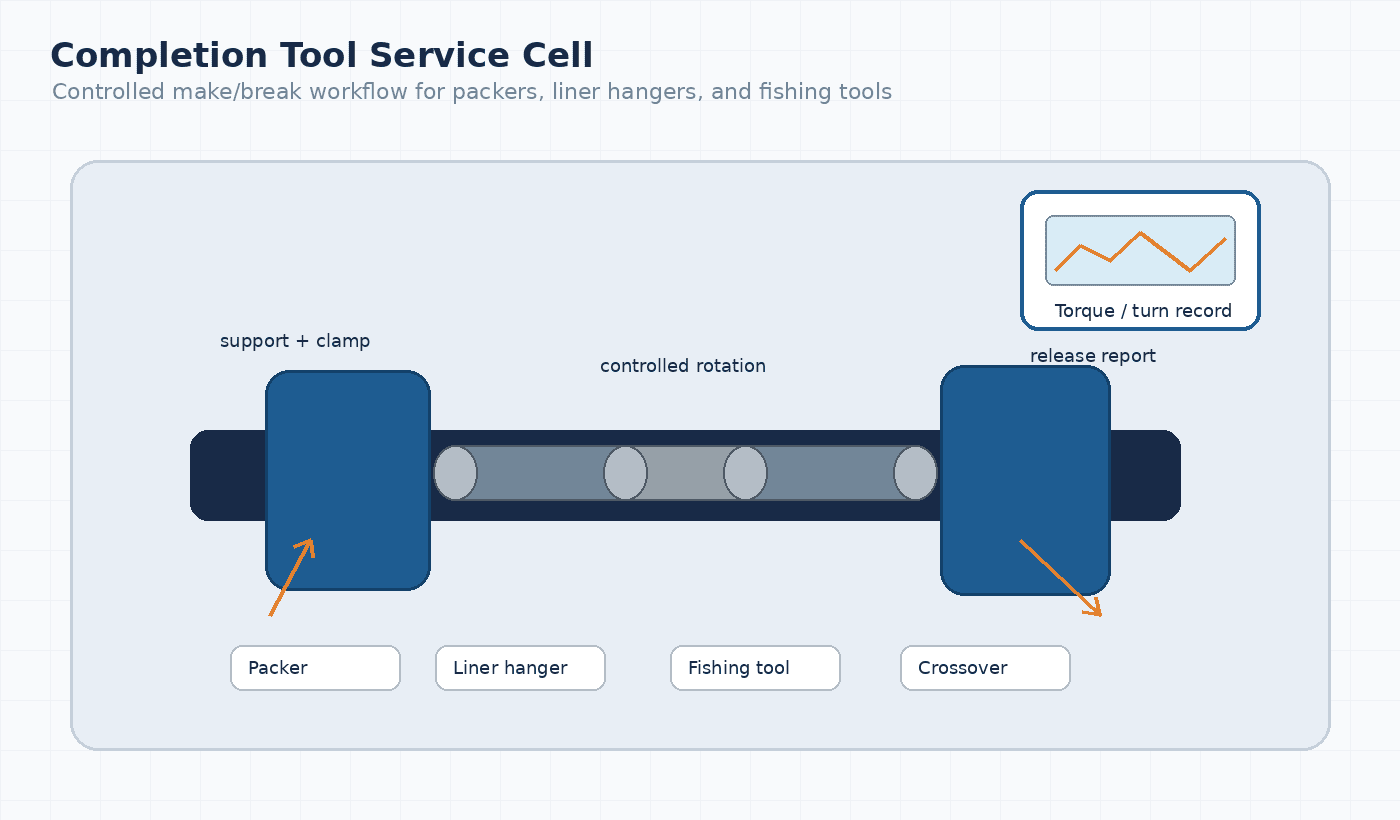
Completion-tool service is one of those workshop jobs that looks simple from the outside and becomes complicated the moment a real tool lands on the bench. A packer comes back from a job with questionable marks on the body. A liner-hanger assembly needs to be opened for inspection. A fishing tool has been through a rough run and the customer wants it turned around quickly. The paperwork says one thing, the tool condition says another, and the shop floor has to make a decision without turning the tool into scrap. The string those tools go into is described part by part in well completion explained.
That is why a good make/break cell is not a luxury for a completion-tool shop. It is the place where messy returned equipment becomes a controlled service job.
The mistake many shops make is treating threaded completion tools like ordinary threaded parts. They are not ordinary parts. They may have sealing shoulders, polished areas, anti-rotation features, pinned components, locking sleeves, gauges, elastomer sections, and tight internal tolerances. If the crew grabs the wrong area, supports the body poorly, or fights the joint with too much sudden force, the tool may open, but the part may not be trustworthy afterward.
A customer does not only pay you to get a connection loose. They pay you to return equipment with a defensible service history. That is the difference between a busy shop and a serious service operation.
Why completion tools are easy to damage during service
The problem starts with the shape of the work. Completion tools are not always balanced, straight, or friendly to handle. Some have long mandrels and short threaded sections. Some have large OD changes. Some carry thin sleeves or expensive coatings. Some have areas that look strong but were never meant to take clamp load. If the tool has been exposed to sand, scale, corrosion, or high temperature, the release torque can also change from what the shop expected.
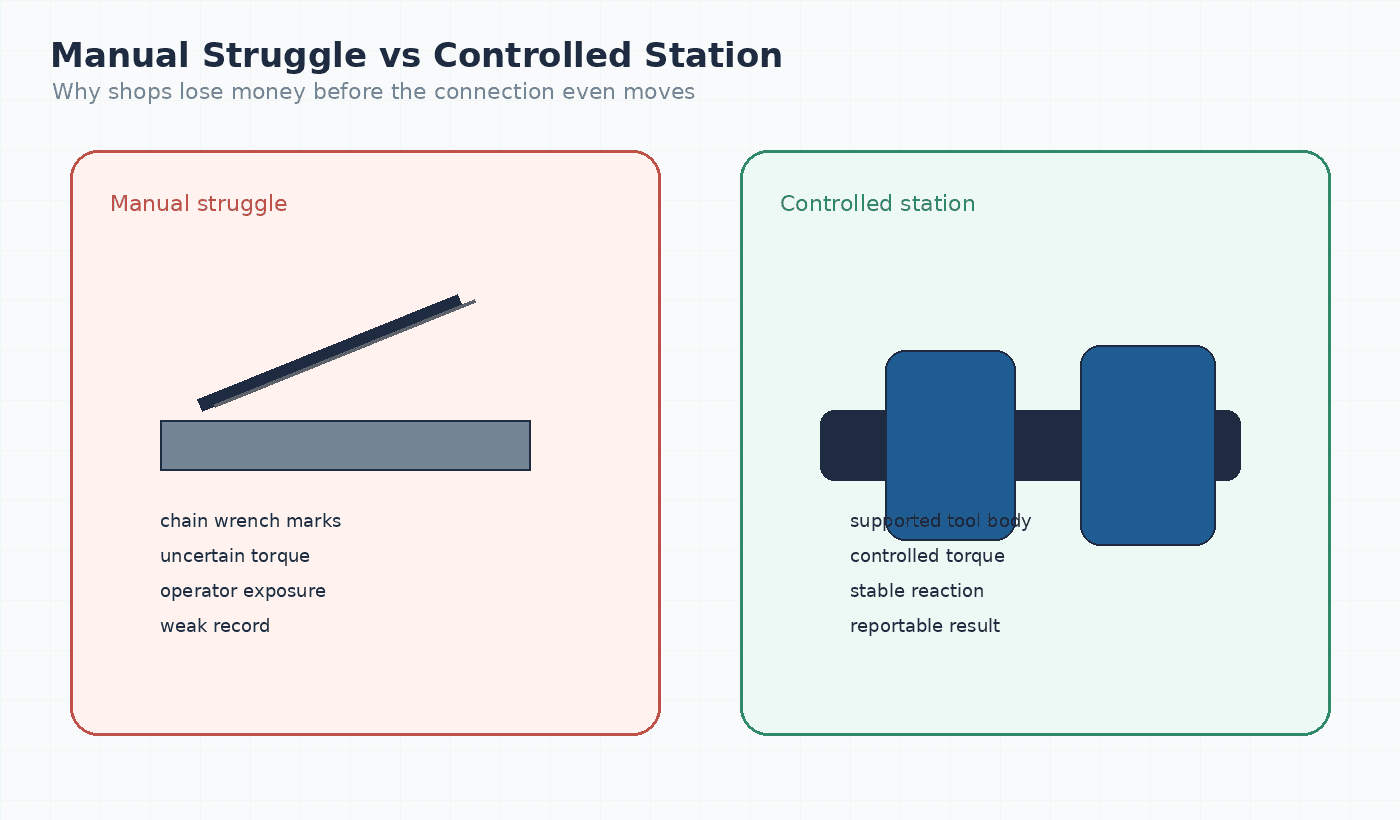
In a rushed shop, the crew often tries to solve that problem with muscle. Add a bigger wrench. Add more heat. Add a longer handle. Hit the joint harder. None of those methods automatically makes the job safer. They can move the risk from the connection to the tool body, the sealing area, the operator, or the customer relationship. The same logic shows up in safety standards covering controlled energy release, such as OSHA’s Control of Hazardous Energy guidance: when force is unavoidable, it must be supported, controlled, and recorded.
The real issue is not that a shop needs force. Force is part of the job. The issue is whether the force is supported, controlled, and recorded.
A packer mandrel with jaw marks in the wrong place creates an argument. A liner hanger with a distorted sleeve creates rework. A fishing tool that opened after heavy manual struggle may hide thread damage until the next assembly. These are the small losses that do not always appear in the equipment quote, but they show up in warranty, inspection hours, and customer trust.
Build the cell around the tool, not the other way around
A strong make/break cell starts by admitting that not every completion tool can be treated the same. A shop that services packers, plugs, anchors, crossovers, fishing tools, and liner-hanger components needs a process that adapts to geometry without turning every job into improvisation. The tool-side counterpart of this cell discipline is the packer redress workflow itself.
The first decision is support. Where will the tool sit? Where will the reaction force go? Which surfaces can be clamped safely? Which surfaces must never be touched? A tool should not be held only where it is convenient. It should be held where the drawing, the service history, and the part geometry allow it.
The second decision is documentation. Before a stubborn connection is attacked, the shop should capture the starting condition. Take photos. Note exposed corrosion. Record missing protectors, damaged wrench flats, previous punch marks, and any customer instruction. This is not paperwork for the sake of paperwork. It protects the shop when someone later asks whether the damage was present before service.
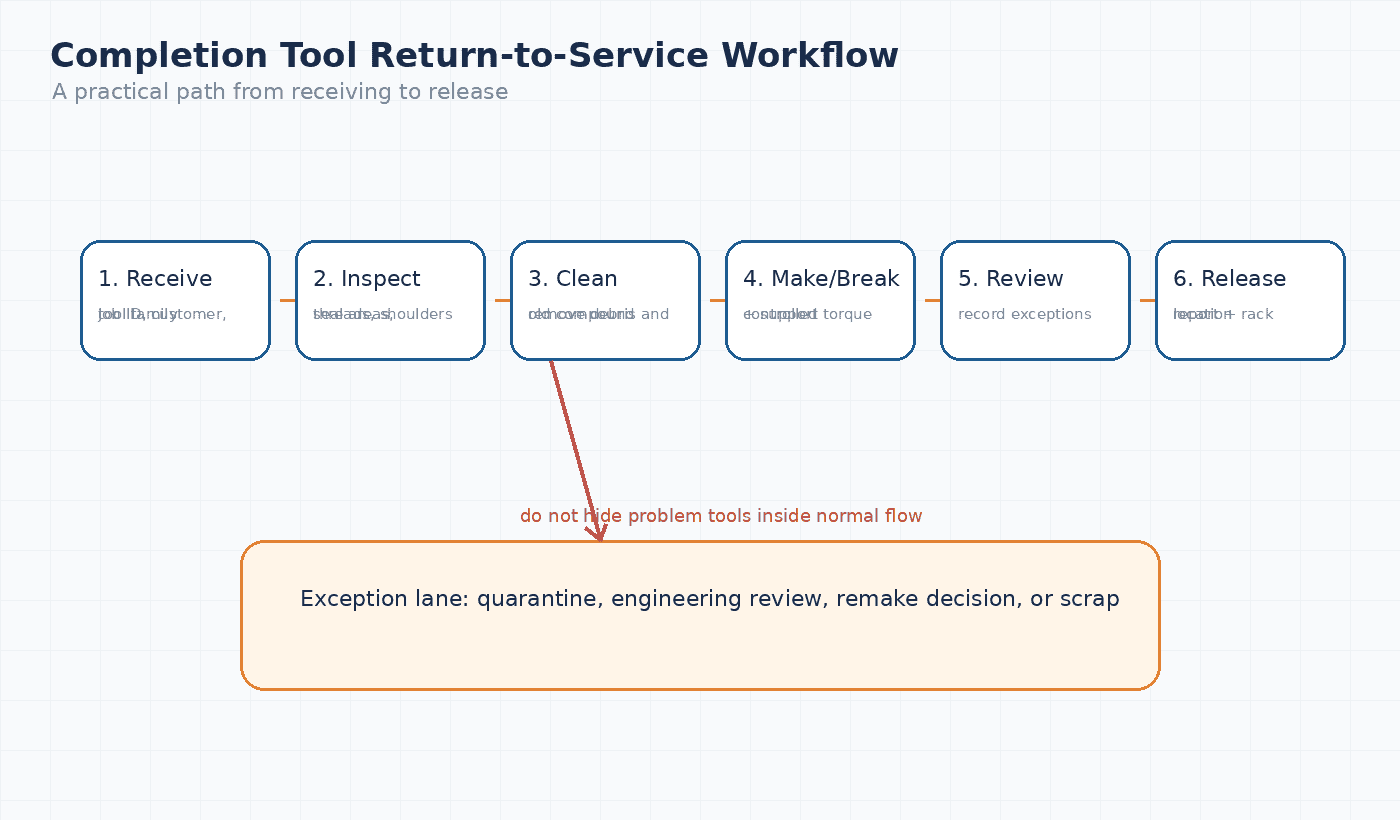
The third decision is workflow. Receiving, initial inspection, cleaning, controlled make/break, detailed inspection, rebuild, final test, and release should not be mixed together casually. When tools bounce between benches without status control, the shop loses time and confidence. A tool that is waiting for engineering review should not sit beside tools ready for assembly. A tool that needs special support should not be handed to the next shift with only a verbal warning.
What goes wrong when the job has no controlled station
Most waste in completion-tool service does not come from one spectacular accident. It comes from small uncontrolled choices repeated every week.
A threaded section is opened on a general bench because the proper fixture is occupied. A body is clamped at the easiest OD instead of the safest OD. A tool is turned by feel because the required torque is not known. An operator knows something felt strange, but nothing was written down. The job still moves forward because nobody wants to stop the schedule.
That style of work may survive when the customer is not looking closely. It does not survive when customers begin asking for proof, faster turnaround, and fewer disputes.
A controlled cell changes the behavior of the shop. It gives the crew a defined place to receive difficult make/break jobs. It gives supervisors better visibility. It gives engineering a point where special instructions can be applied before damage happens. It also gives sales and service teams a stronger story: we do not only open your tools; we service them with controlled handling and traceable decisions.
The inspection questions that deserve a checklist
Completion-tool service should have a plain checklist that people actually use. It does not need to be complicated, but it should answer the questions that prevent expensive mistakes.
Can the tool family and job number be confirmed? Are the critical sealing or polished areas visible and protected? Is there corrosion, galling, or impact damage near the connection? Is there evidence of previous field repair or uncontrolled tool marks? Which surfaces are approved for clamping? Is the required make-up or breakout torque known? Does the customer require a final report or photos? Should the tool go through normal service, engineering review, or quarantine?
The checklist matters because it slows the crew down at the right moment. Not every tool should enter the same workflow. Some tools can be opened normally. Some should be held until the drawing is reviewed. Some need custom support. Some should be photographed before the first wrench touches them. When a shop makes these calls early, the whole job feels calmer.
Where Galip equipment fits in the process
A Galip Bucking Unit can be relevant when the completion-tool shop needs controlled make-up and torque-turn recording, controlled rotation, and a repeatable record for threaded assemblies. This is especially useful when the tool family, connection type, or customer requirement makes final assembly quality important enough to document. Measurement traceability — the kind described in NIST’s metrological traceability framework — becomes commercially relevant once a customer asks for proof, not just paperwork.
A Galip Breakout Unit may be the better fit when the work is mainly high-force teardown and workshop make/break handling, repeated teardown, or general workshop work where speed, stable gripping, and safe release are the main concerns. The practical buying question is not “which machine sounds stronger?” The right question is “what does our shop need to prove, and what kind of tools do we service every week?”
For some completion-tool service centers, the answer is a dedicated breakout workflow. For others, it is a bucking-style controlled make-up cell. For larger shops, it may be both: breakout for teardown, bucking for controlled assembly and reportable acceptance.
Where the same tools are built up in repeated batches, our guide to running a bucking unit for high-volume shale completion work explains how hold points, job naming and report handling keep a long run under control.
How to size the conversation before asking for a quote
Before buying equipment, a service center should collect the information that helps a manufacturer give a useful answer. That includes the tool families being serviced, OD range, expected torque range, longest and shortest assembly length, clamp-sensitive surfaces, preferred support style, daily job volume, available floor space, power supply, reporting expectations, and any customer-mandated documentation. If you want a useful response, send OD range, torque range, and tool family for review before asking for a price.
This step sounds basic, but it prevents the most common equipment mistake: buying a machine around a headline torque number while ignoring the tool geometry. A machine can have enough torque and still be awkward if the support span is wrong, the clamp arrangement does not suit the tool bodies, or the operator has poor access to the connection.
A serious quote should feel like a workshop conversation, not a catalog page. It should ask what comes through the door, what fails most often, what customers complain about, and what the team wants to improve first. That kind of manufacturer background and quality-management support matters more than a spec sheet.
What buyers should ask internally
The best way to justify a make/break cell is to ask where money is already leaking out. How many tools are delayed because the shop cannot open them cleanly? How often does manual handling leave marks that need to be explained? How often does the team remake a connection because the first assembly was not documented well enough? How much customer confidence is lost when release records are vague?
When the answers are honest, the investment case becomes clearer. The machine is not only there to apply torque. It is there to reduce arguments, reduce damage, shorten handoffs, and make the service process easier to defend.
A better service cell protects the shop culture too
There is one more benefit that does not always appear on the quote sheet. A good make/break cell changes the way people think about the job. Operators stop seeing difficult tools as wrestling matches. Supervisors stop relying on memory. QA has better evidence. Sales has a stronger answer when customers ask how the shop controls risk.
That shift matters. In a real shop, people follow the process that makes their day easier. If the controlled cell is faster, safer, and easier to explain than the old manual approach, the crew will use it. If it creates clean photos, cleaner records, and fewer customer arguments, management will feel the value quickly.
Conclusion
Completion-tool service is not just disassembly and reassembly. It is a decision-making process around expensive, damage-sensitive equipment.
A make/break cell gives that process a home. It helps the shop support the tool properly, apply force with control, document what happened, and separate normal work from exception work. For packers, liner hangers, fishing tools, crossovers, and other threaded assemblies, that discipline can be the difference between a fast service job and a costly dispute.
If your shop is still opening difficult tools wherever space is available, start by mapping the work that gives you the most trouble. Then build the equipment discussion around that reality. The best machine is not the one that looks impressive in isolation. It is the one that makes your service process calmer, cleaner, and easier to defend.
Expert Consultation
Need more information on optimizing your equipment performance? Our engineering team is available for technical consultations.
Request a Quote
Tell us about your requirements and our engineering team will prepare a detailed proposal with specifications, pricing, and delivery timeline.
