
Buttress Thread and OCTG Connection Types Explained
A buttress thread carries tension along the pipe instead of wedging the box open. How API round, buttress and premium connections differ, and where each one seals.
A buttress thread is an asymmetric thread form whose load flank sits almost square to the pipe axis, so tension is carried along the pipe instead of wedging the box open. On OCTG it appears as API Buttress, or BTC. It holds far more tension than a round thread of the same size, and like every API form it still seals on thread compound rather than on metal.
At a glance
| Question | Short answer |
|---|---|
| What makes a buttress thread different? | Asymmetric flanks: one near-vertical to take load, one sloped to help stabbing |
| Where is it used on OCTG? | API Buttress casing, and as the base form under many premium connections |
| Main advantage | Joint strength approaching the pipe body, rather than well below it |
| Main limitation | It is not a seal. Compound still does the sealing |
| When to go past it | Gas, sour service, high pressure, or anywhere a leak path is unacceptable |
| What it needs at make-up | Recorded torque, because there is no positive stop to tell the operator to halt |
Three families, one decision
Almost every casing or tubing connection in service falls into one of three groups, and the differences are geometric rather than commercial.
- API round thread, short or long coupling. A symmetrical 60° form with rounded crests and roots, cut eight threads to the inch on casing.
- API buttress thread, or BTC. Five threads to the inch, flat crests and roots, and two different flank angles.
- Premium and semi-premium. Proprietary designs that keep a thread for grip and add a separate metal-to-metal seal and a torque shoulder.
Reading them as a ladder of cost is the common mistake. They are three answers to different questions, and the right one depends on what the string has to survive rather than on what the budget allows.
One practical note on coupled versus integral. Both API forms put the thread on a separate coupling, which means the outside diameter at every joint is larger than the pipe body. In a tight hole that clearance can decide the whole design, and it is the usual reason a shop meets flush and semi-flush integral connections, where the thread is cut directly into an upset pipe end and there is no coupling at all.
What the buttress thread form actually does
Put the two API forms side by side in cross-section and the reason for the buttress thread becomes obvious.
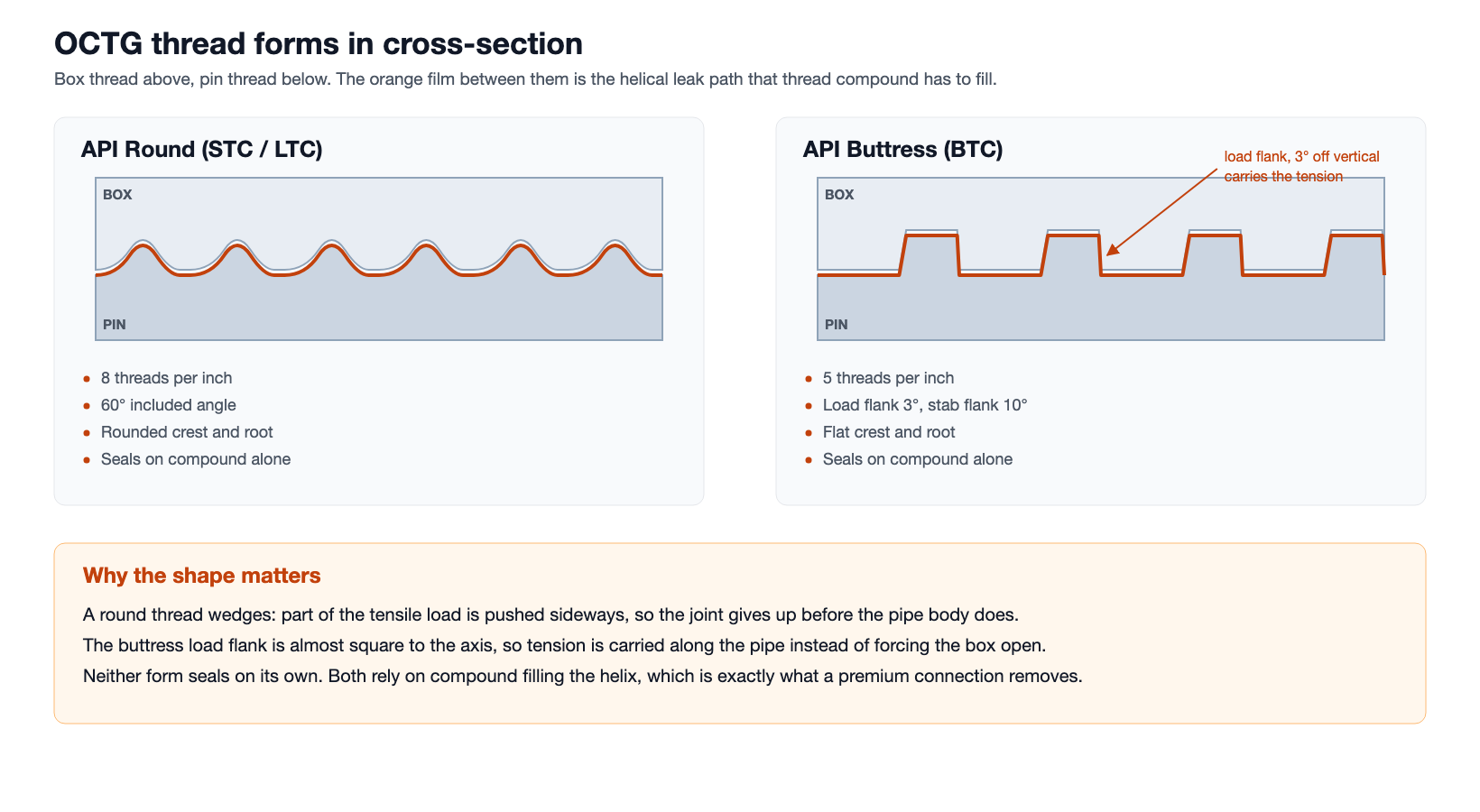
A round thread has symmetrical flanks at 30° either side of the perpendicular. When the string hangs in tension, that slope turns some of the pull into a sideways force. The pin tries to pull out of the box, the box tries to open, and the joint reaches its limit while the pipe body still has capacity left. Engineers call it jump-out, and it is why a round-thread joint is rated below the pipe it is cut into.
The buttress thread removes most of that geometry. Its load flank is angled only about 3° from perpendicular to the axis, so tension is carried almost straight along the pipe. The opposite flank, the stab flank, is left at around 10° because a thread with two vertical faces would be difficult to enter and easy to cross-thread. That asymmetry is the entire trick: one face optimised to hold, the other optimised to start.
| Feature | API round | API buttress |
|---|---|---|
| Threads per inch (casing) | 8 | 5 |
| Flank geometry | Symmetrical, 60° included | Asymmetric, roughly 3° and 10° |
| Crest and root | Rounded | Flat |
| Joint strength vs pipe body | Noticeably lower | Approaches the pipe body |
| Sealing mechanism | Thread compound | Thread compound |
| Tolerance of stabbing damage | Moderate | Moderate, but flat crests bruise visibly |
The flat crest is worth a moment. It gives the buttress thread a larger bearing area, and it also means damage shows up as a flat bruise rather than a rolled-over point. That is genuinely useful during inspection, because a bruised crest is easy to see and easy to argue about with a customer.
Why neither API form seals
Both API forms leave a continuous helical gap running from the bore to the outside world. Thread compound fills that gap, and compound is the barrier. Nothing else is doing the job.
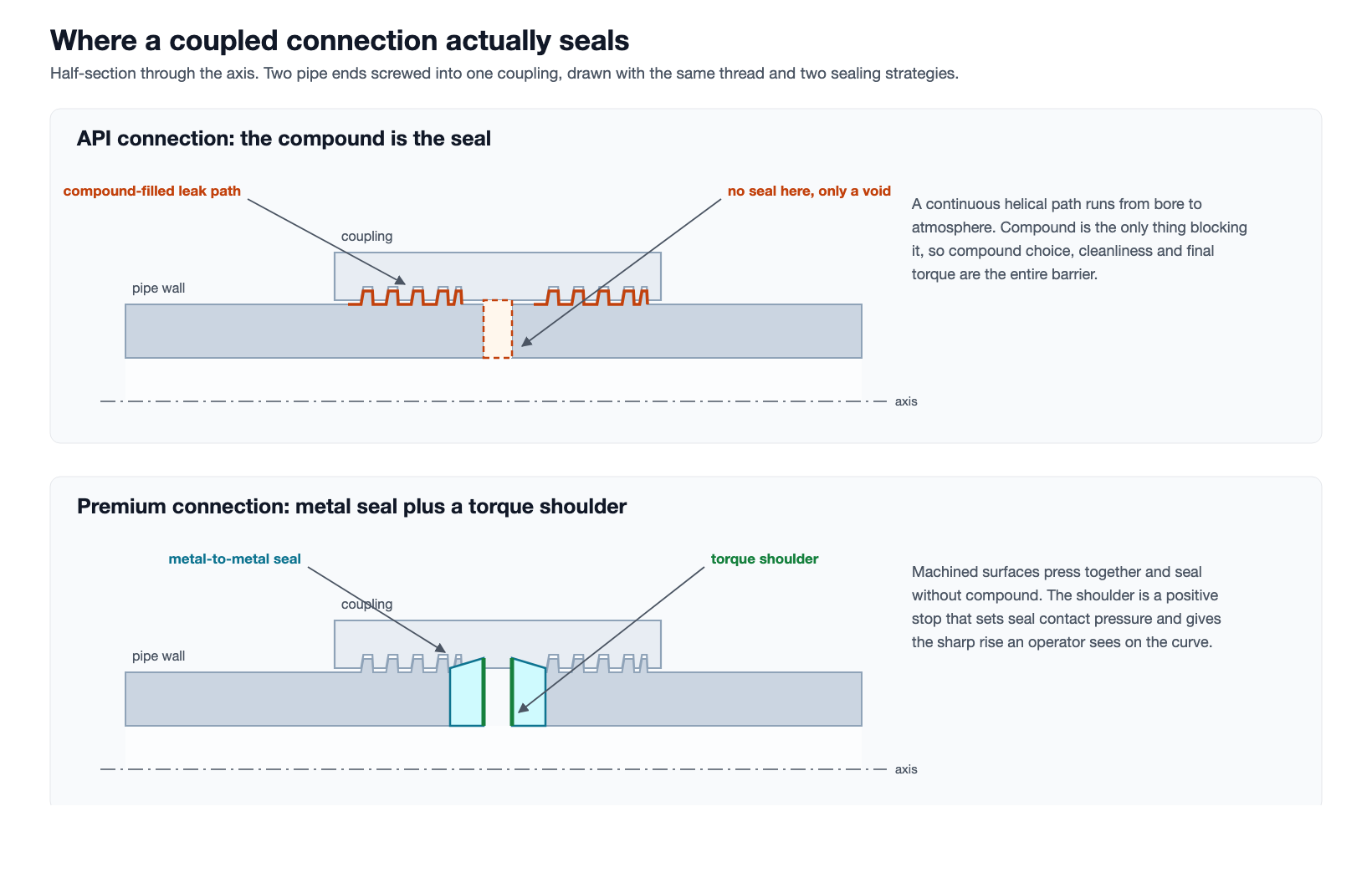
This is why the same connection can pass on one string and weep on the next with no change of grade or torque. Compound applied thin, applied to a cold thread, contaminated with mud, or simply the wrong product for the service will leave that helix open. A premium connection removes the argument by adding a machined metal-to-metal seal, so sealing no longer depends on a substance applied by hand in a pipe yard.
The second premium feature matters just as much. A torque shoulder is a positive stop: the pin nose lands against a face inside the box and further rotation loads the seal rather than driving the pin deeper. It sets seal contact pressure, and it gives the operator something unmistakable to look for.
What it looks like during make-up
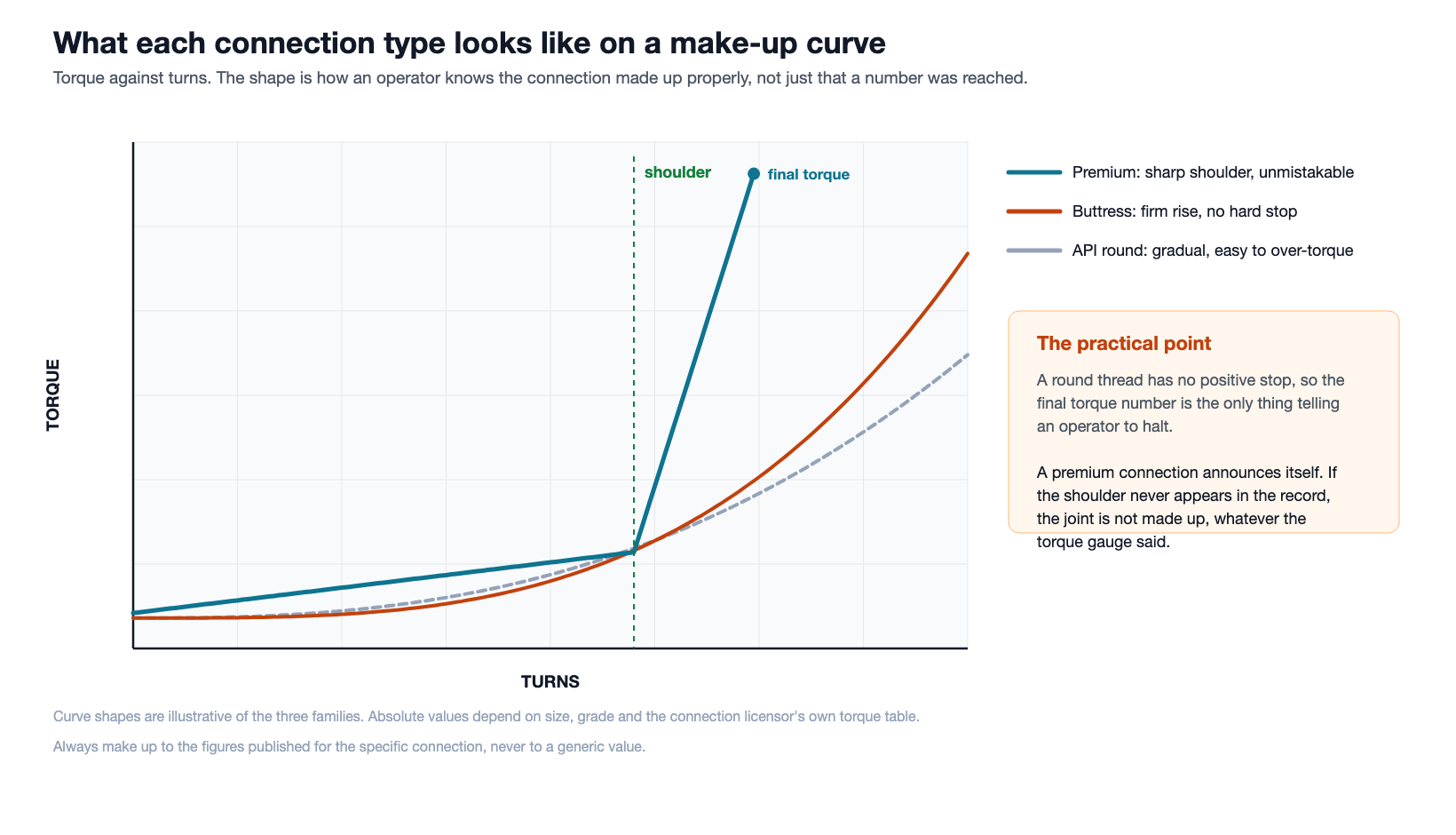
Torque plotted against turns tells you which family is on the machine before anyone reads the pipe stencil. A round thread rises gently the whole way, because the interference builds slowly and nothing ever stops it. A buttress thread rises more firmly as the flanks engage, but it also has no hard stop. A premium connection stays low, then breaks sharply upward the moment the shoulder lands.
The operational consequence is direct. On an API connection, including a buttress thread, the only thing telling an operator to stop is the torque number itself. Keep turning and the joint will keep accepting torque until something yields. That is the argument for recorded torque monitoring rather than a tong and judgement, and it is covered in detail in the guide to reading a make-up curve.
| Observation on the curve | Likely meaning | What to do |
|---|---|---|
| Torque climbs early, well before expected turns | Contamination, damage, or misalignment at stab | Stop, back out, inspect both members |
| Curve stays flat then rises very late | Under-doped or loose fit | Break out and check the compound and gauging |
| Shoulder never appears on a premium connection | The joint is not made up, whatever the gauge reads | Do not accept it on final torque alone |
| Ragged, stepped rise | Galling in progress | Stop immediately; see galling causes |
| Smooth rise to target with no shoulder, on BTC | Normal for a buttress thread | Accept against the published torque, and record it |
How a buttress connection is gauged and checked
Thread forms are cut on a taper, not parallel to the axis, and the taper is what pulls the flanks into contact as the joint turns. On casing, the standard taper is three quarters of an inch per foot on diameter for the common sizes, opening out to one inch per foot on the largest. That taper is also how the thread gets gauged: a ring gauge is run onto the pin, and the distance it stands off from the pipe end tells the inspector whether the thread was cut in the right place. Too much standoff or too little and the connection will not make up where it should.
Buttress casing carries a second check that costs nothing and is often ignored. A triangle is stamped on the pipe a short distance back from the thread. At correct make-up the coupling face should sit level with the base of that triangle. If the coupling has run past it, the joint is over-made; if it stops well short, it is under-made. One glance settles a question that otherwise needs a gauge.
| Check | What it confirms | When to do it |
|---|---|---|
| Ring gauge standoff | The thread was cut in the correct position on the taper | At the threading shop, and on receipt if the history is unknown |
| Triangle stamp against coupling face | The joint made up to the intended position | Immediately after every make-up |
| Visual check of crests and roots | No bruising, no rolled or torn flanks | Before doping, every joint |
| Recorded final torque | The joint reached its window and stopped there | Every joint, kept with the batch |
Used together these four give a defensible position. The gauge covers the machining, the triangle covers the position, the visual covers handling, and the torque record covers the make-up. Drop any one and there is a gap in the story that somebody will eventually ask about.
When a buttress thread is not the right choice
BTC is the default for a reason, and it is still wrong in specific conditions. Being straight about that is more useful than selling it everywhere.
| Situation | Why buttress struggles | Usual answer |
|---|---|---|
| Gas or gas-lift service | Gas finds any compound-filled path | Premium connection with a metal seal |
| Sour service | Leak paths plus H₂S is an integrity problem, not a rate problem | Premium, with the grade’s hardness limits respected |
| High bending or deviated wells | Thread-only joints see uneven flank loading | Premium with a shoulder to control preload |
| Very high pressure | Compound is not a pressure barrier you can qualify | Qualified premium connection |
| Tight annular clearance | The coupling adds outside diameter | Flush or semi-flush integral connection |
| Repeated make and break | Flanks wear, and every cycle risks galling | Premium designed for multiple cycles |
The reverse case deserves saying too. Specifying an expensive premium connection for straightforward low-pressure casing, then making it up on uncontrolled equipment, buys nothing. A buttress thread made up properly and recorded will outperform a premium connection made up badly, every time.
What a workshop needs to handle them
Connection family drives shop equipment more than pipe size does. Three requirements change as you move up the ladder.
- Torque accuracy and repeatability. A buttress thread has a torque window, not a stop, so the machine has to hit a number and prove it did.
- Speed control near the end of make-up. Premium seals are ruined by hitting the shoulder fast. Final rotation has to be slow and controlled.
- Alignment at stab. Most galling starts in the first turn, before torque means anything. See the stabbing and alignment guide.
A shop that only ever runs BTC casing can work to a torque window. A shop that takes in premium work needs the curve as well as the number, because the shoulder is the acceptance criterion and it exists only in the record. This is where a bucking unit earns its place over a power tong, and the comparison is set out in bucking unit versus power tong.
Selection checklist
- Establish the service first: gas, sour, pressure, deviation. That decides thread-only versus metal seal.
- Check annular clearance before assuming a coupled connection fits.
- Confirm the joint strength you need against the pipe body rating, not against another connection.
- Ask how many make-and-break cycles the joint will see in its life.
- Get the licensor’s own torque table for the exact size, weight and grade. Generic values are not acceptable.
- Agree the compound and stick to it. Changing compound changes the torque behaviour.
- Decide what record the customer or auditor needs before the first joint is made up.
- Confirm the shop’s equipment can hit the window and capture the curve.
Proof and documentation
Connection choice is a design decision, but connection performance is a make-up decision, and only one of those leaves evidence. A torque-turn record with the final torque, the turns and the shape of the rise is what lets anyone say later that a joint was made up correctly. Without it, a leak becomes an argument between the mill, the threading shop and the crew, and nobody can settle it.
Galip builds the make-up and break-out equipment that produces that record. The wider category and the grade system it sits inside are covered in OCTG explained, and the checks that follow the mill in OCTG connection integrity. For the thread specifications themselves, the American Petroleum Institute publishes the governing documents.
Frequently asked questions
What does a buttress thread do that a round thread cannot?
It carries far more tension for the same pipe size. The near-vertical load flank keeps the pull along the axis instead of converting part of it into a force trying to separate pin from box.
Is BTC the same as a buttress thread?
BTC is API Buttress Casing, the oilfield application of the buttress thread form. The general form is also used in vices, presses and lead screws wherever load runs mainly one way.
Does a buttress thread seal against gas?
Not on its own. The helical path between the flanks is filled with compound, and gas is very good at finding a compound-filled path. Gas service normally calls for a metal-to-metal seal.
Why are the two flank angles different?
The load flank is near vertical because that is what holds tension. The stab flank is sloped so the connection can be entered and started without cross-threading. Making both vertical would be stronger in theory and unusable in practice.
Can I use a generic torque value for a buttress thread connection?
No. Torque depends on size, weight, grade and the compound in use. Work from the published table for that exact combination, and record what was actually achieved.
How do I tell a buttress connection from a round one on the rack?
Count the threads and look at the crests. Buttress is coarser, five to the inch on casing, with flat crests and roots. Round thread is finer and visibly rounded. The coupling stencil should confirm it.
Do premium connections still use a buttress form?
Many do, in modified or hooked variants, because the load-carrying behaviour is good. The difference is that the thread grips and the separate metal seal does the sealing, rather than asking one feature to do both.
Does connection type change the machine a shop needs?
Yes. Thread-only connections need accurate final torque. Shouldered premium connections also need controlled speed into the shoulder and a captured curve, because the shoulder itself is the acceptance criterion.
What is the triangle stamped on buttress casing for?
It marks the intended make-up position. When the connection is made up correctly the coupling face lines up with the base of the triangle, giving a visual check that needs no instrument. Past the triangle means over-made; well short of it means under-made.
Specifying equipment for the connections you run
If the reason you are comparing thread forms is that a shop has to make them up, send the job envelope rather than a model number:
- OD range, smallest and largest
- Make-up and break-out torque required
- Connection families handled: API round, buttress thread, premium, or a mix
- Surface and jaw type, including coated or chrome material
- Daily workload and shift pattern
- Report format your customers or auditors expect
- Workshop layout and available power
Those seven answers are enough to size a machine and to say plainly what it will and will not handle.
Drill string connections work the other way round: a rotary shouldered tool joint seals on the shoulder rather than on the thread helix.
Short checklist
- A buttress thread trades symmetry for strength: load flank near vertical, stab flank sloped
- Five threads per inch on casing, flat crests and roots
- Joint strength approaches the pipe body, unlike round thread
- It grips; it does not seal. Compound is still the barrier
- Gas, sour, high pressure and deviated wells call for a metal-to-metal seal
- No shoulder means no positive stop, so the torque record is the acceptance evidence
- Use the licensor’s torque table for the exact size, weight and grade
Buttress sits inside a wider standard: what API 5CT covers, and what it leaves to the licensor explains where the API forms end and premium connections begin.
How the thread itself is measured and accepted is set out in API 5B, the gauging and thread inspection specification, where standoff is the reading that decides whether a cut thread passes.
Expert Consultation
Need more information on optimizing your equipment performance? Our engineering team is available for technical consultations.
Request a Quote
Tell us about your requirements and our engineering team will prepare a detailed proposal with specifications, pricing, and delivery timeline.
