
Pipe Stabbing Alignment: 3 Critical Seconds That Decide Every Make-Up Job
Learn how better stabbing alignment, cleaner starts, and operator discipline reduce thread damage and unstable make-up behavior.
Learn how better stabbing alignment, cleaner starts, and operator discipline reduce thread damage and unstable make-up behavior.
Pipe stabbing alignment is the single habit that separates calm make-up jobs from expensive ones.
Why the job really starts before torque
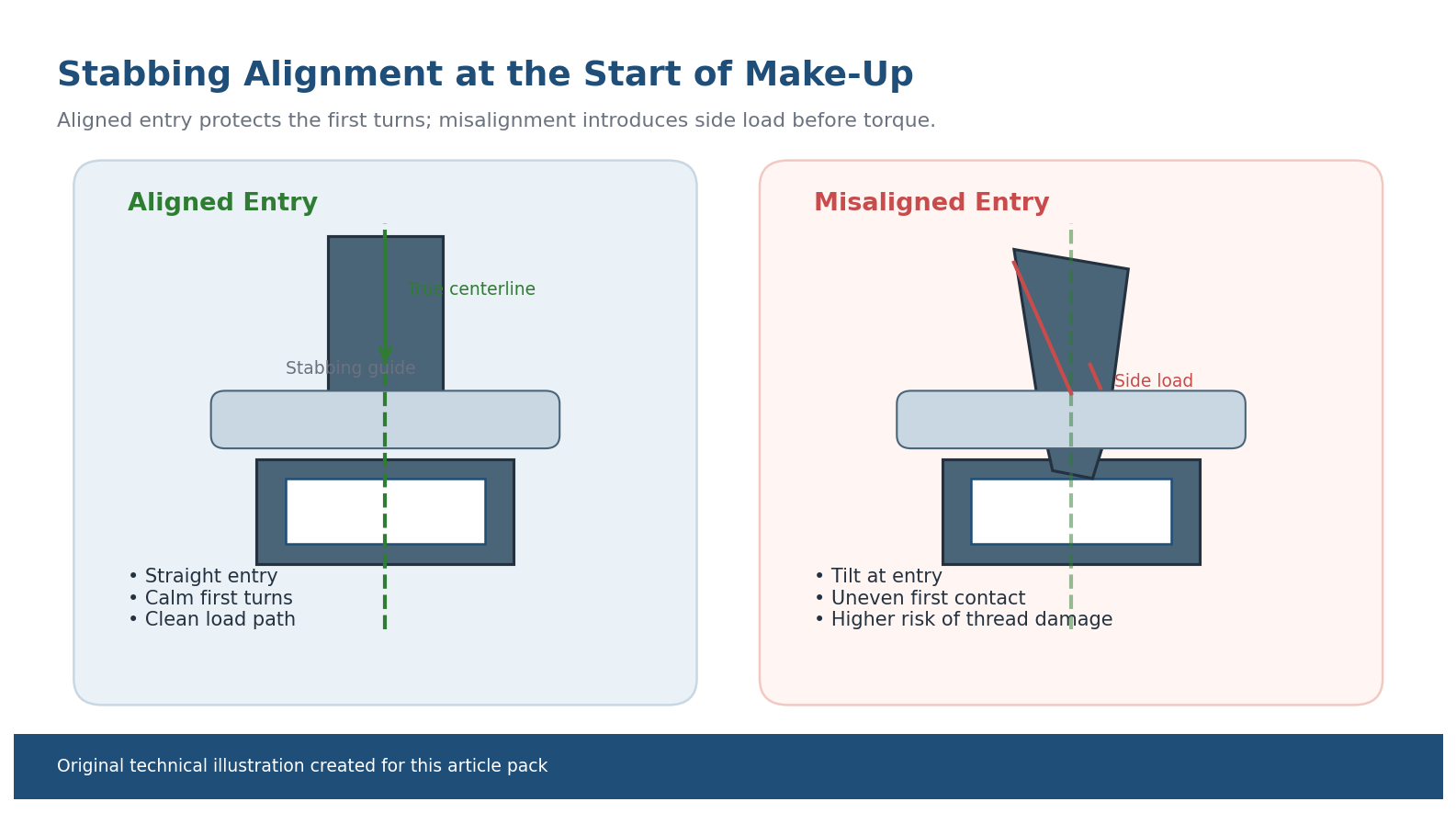
Most make-up problems begin before the graph shows anything unusual. They start in the quiet moment when the pin is lowered toward the box and the crew assumes the difficult part has not started yet. That assumption costs money. A connection can be damaged long before final torque if the entry is tilted, the centerlines are not honest, or the first turn begins with grit, rushed handling, or side load. Operators who spend enough time around premium threads know this from feel. A clean job usually begins with a clean, boring entry.
A bad one often announces itself early with hesitation, lean, bounce, or a start that needs to be “helped.” The moment a connection has to be helped, the crew should already be suspicious.
Related reading: bucking unit 101 workflow.
The reason is simple. Threads are meant to find each other on axis. When they do, the start feels calm. The pipe settles into the guide, the pin enters cleanly, and the first turns do not fight the machine. When they do not, the joint starts acting like two parts that are being pushed together instead of naturally engaging. That changes friction, changes how load enters the connection, and often changes the torque curve later in a way that operators then have to interpret. In many cases, the smarter move is not to interpret anything. It is to stop before the connection gets any deeper and restart the job correctly.
Pipe stabbing alignment: where bad starts usually come from
Misalignment at the start of make-up rarely has one dramatic cause. More often it comes from several small shortcuts stacking on top of each other. One member is not properly supported. The stabbing guide is present but not truly controlling the entry. The protector comes off too early, so the threads are exposed while the crew is still moving the pipe into position. Someone assumes the thread compound is fine without checking whether dirt, metal fines, or old grease are hiding in the roots. The machine is ready, but the connection itself is not.
In shop work, long or stepped assemblies make the problem worse because sag and poor support can create a false centerline. The operator may think the pipe is centered because it looks close from one angle, yet the pin is still arriving slightly low, high, or off to one side. That is enough to create a rough start. This is why experienced operators pay attention to the “body language” of the joint. If the entry point looks tense, if the pin drifts instead of settling, or if the box seems to catch one side first, the setup is already telling the story. The right response is not more confidence.
It is more control.
Related reading: torque-control discipline.
Contamination is the other common thief. A connection that looks fine from a distance can still contain grit, fluid, shop dust, or damaged compound. On the floor, contamination often disguises itself as a minor hesitation that crews are tempted to ignore. That is risky. A dirty connection can feel only slightly rough at first and still become an expensive problem once it is fully made up.
What good operators do before the first powered turn
The best operators treat stabbing as part of make-up, not as the step before make-up. They keep the protector on until the connection is truly ready. They make sure both members are supported so the pin is not trying to climb uphill into the box. They use the guide to control entry, not merely to satisfy procedure. They look for a straight, relaxed start instead of trying to correct a bad position halfway down.
This is also where patience matters. A good start does not need speed. It needs visibility, clean threads, honest alignment, and a crew that is willing to pick the joint back up if something feels wrong. On the best shifts, operators do not brag about “saving” a bad start. They avoid getting into one. They know that the fastest way through the job is often a restart made early, before the threads are asked to carry side load.
Related reading: premium connection QA criteria.
If the workshop handles different thread forms, materials, or connection families, the starting discipline should still stay the same. Confirm the connection is clean. Confirm the centerline is real, not guessed. Let the pin settle into the box without forcing it. Watch the first turns carefully. The goal is not simply to avoid visible damage. The goal is to let the connection begin under conditions that make the later torque reading believable.
What the first turns should look and feel like
A clean start has a certain calm to it. The joint does not wobble. The entry does not lurch. The operator does not need to correct the pipe every second. The machine sounds steady rather than strained. Even when the connection is heavy, the engagement should still look controlled. A rough start, by contrast, often looks busy. The pipe leans, the crew keeps touching the position, rotation feels uneven, or the connection seems to grab before it should.
One of the worst habits on the floor is pushing through that first warning sign because the connection appears to be “taking.” Taking is not the same as taking correctly. A joint can move downward and still be entering badly. That is why operators should be ready to stop the moment the first powered turn feels abnormal. Back the joint out, clean it again, inspect the threads and seals, and start over with better alignment. That few-minute pause is almost always cheaper than continuing into a doubtful make-up and then debating what the graph means after the fact.
This is especially important for premium work and any connection that will later be inspected, rerun, or handed back to a customer with a quality record. A clean graph is more valuable when the start was clean. If the first turns were compromised, the graph becomes harder to trust even if the final number lands in range.
How to turn this into a repeatable shop habit
The strongest shops make good starts routine rather than heroic. They standardize protector handling, lighting, cleaning tools, thread inspection, and support placement around the machine. They make sure operators can clearly see the entry point instead of guessing from a poor angle. They train crews to treat hesitation as a valid stop signal rather than a sign of weakness. Most importantly, they remove the cultural pressure to “make it work” once a connection starts badly.
That kind of discipline does not slow a workshop down. It usually speeds it up over the course of a week because fewer joints need to be backed out after deeper engagement, fewer threads get marked, and fewer quality questions have to be explained later. One calm minute at the beginning of the connection protects every stage that follows.
End users and operators tend to judge a bucking unit by torque capacity, controls, or brand reputation. Those things matter, but the practical value of the machine shows up much earlier. A good bucking setup gives the crew a stable, visible, repeatable way to start the job right. In real use, that is not a small detail. It is the difference between a connection that was guided into make-up and a connection that had to be wrestled there.
Key takeaways
- Treat stabbing as part of make-up, not as a separate pre-step.
- Keep protectors on until the connection is genuinely ready to enter.
- Stop early when the first turns feel wrong; restarting is cheaper than arguing with a bad graph.
- Build visibility, support, cleaning, and guide control into the standard setup.
Related Products
- Explore our Bucking Unit and Breakout Unit product pages.
- Read more on bucking unit 101 workflow and torque-control discipline.
- Ready to discuss your setup? contact our team.
Frequently asked questions about pipe stabbing alignment
What is pipe stabbing alignment and why does it matter?
Pipe stabbing alignment is the act of bringing the pin and box onto a true, shared centerline before powered rotation begins. It matters because a tilted or off-axis entry damages threads long before final torque is ever reached, and that damage rarely shows up in the graph until it is too late to save the connection.
How do you check stabbing alignment before powered make-up?
Keep protectors on until the moment of entry, support both members so the pin is not climbing uphill, use a stabbing guide that actually controls the entry rather than just satisfying procedure, and watch the first hand turns from an angle that shows real centerline — not an angle that flatters it.
What are the most common causes of misalignment during stabbing?
Poor support on long or stepped assemblies, protectors removed too early, contaminated compound or threads, a guide that is present but not truly constraining entry, and crew habits that treat stabbing as a step before make-up rather than as part of make-up itself.
When should an operator stop and restart a connection?
Stop the moment the first powered turn feels wrong — hesitation, lean, bounce, or a start that needs to be "helped." A restart made early is almost always cheaper than continuing into a doubtful make-up and then trying to argue with the torque graph afterwards.
How does pipe stabbing alignment affect final torque-turn readings?
A clean start produces a graph you can trust. When the connection entered under side load, the torque curve records friction and engagement behavior that are not representative of the intended design — so even a "passing" number becomes harder to defend during audit or rerun decisions.
Talk to our team
Invite readers to request a bucking unit setup review for their thread type, joint length, and workshop handling conditions. For broader context on threaded-connection care, see API standards for oilfield threaded connections. When you are ready to specify or upgrade, review our Bucking Unit options or contact our team.
Expert Consultation
Need more information on optimizing your equipment performance? Our engineering team is available for technical consultations.
Request a Quote
Tell us about your requirements and our engineering team will prepare a detailed proposal with specifications, pricing, and delivery timeline.
