
Rotor Stator Fit: Why Mud Motors Test Looser on a Bench
Rotor stator fit is the interference between rotor and stator after assembly. It is sized for downhole temperature, which is why a power section tests looser on an ambient bench.
A power section that passes on the bench can still disappoint downhole, and one that looks weak on the bench can be perfectly serviceable. Both outcomes usually trace back to the same thing: fit is specified for the temperature the motor will actually see, and your bench is not that temperature.
What is rotor stator fit?
Rotor stator fit is the amount of interference or clearance between the rotor and the elastomer stator once the power section is assembled. Positive interference means the rotor presses into the elastomer and seals the cavities. The right amount limits fluid slip without overstressing the rubber. Fit is chosen for the expected downhole temperature, not for room temperature.
At a glance
| What it describes | Interference (or clearance) between rotor and stator after assembly |
| Why it exists | Seals the progressive cavities so differential pressure produces torque instead of slip |
| Set for | Expected bottom-hole circulating temperature, mud type and differential pressure |
| Too much interference | Heat build-up in the elastomer, chunking, premature stator failure |
| Too little interference | Fluid slip, lost RPM, low torque, early stall |
| Lobe convention | Stator always has one more lobe than the rotor (5:6, 7:8, and so on) |
Why fit is a temperature decision
The stator lining is elastomer. Elastomer expands when it gets hot, and it can swell further on contact with certain drilling fluids, particularly oil-based systems. Both effects push the rubber inward, toward the rotor. Interference that was correct in the shop becomes greater once the motor is at depth and at temperature.
So a power section built for a hot well is deliberately assembled with less interference than one built for a shallow, cool hole. The builder is leaving room for the elastomer to grow into. That is a design decision made before the motor ever reaches you, and it is the reason two physically identical motors can carry different fit specifications.
The consequence for anyone testing a motor is direct. A power section fitted for a hot well runs measurably looser on an ambient bench than it will downhole. The rubber has not expanded yet. Slip is higher, the torque curve sits lower, and stall arrives earlier than the same motor would show in the well it was built for.
| Factor | Effect to consider | What the team should use for a decision |
|---|---|---|
| Bottom-hole circulating temperature | Elastomer expands; interference rises with depth and temperature | Specify fit against the BHCT for the well, not an average |
| Mud type | Oil-based and some synthetic systems swell certain elastomers further | Confirm the elastomer compound is rated for the fluid in use |
| Differential pressure | Higher differential demands a better seal, so more interference | Match fit to the differential the job will actually run, not the catalogue maximum |
| Bench fluid and temperature | Ambient water is neither the temperature nor the fluid the fit was chosen for | Read bench results against the manufacturer’s curve for your test conditions |
| Stator age and run hours | Elastomer takes a compression set over time; effective interference falls | Trend the same motor across services rather than judging one test alone |
| Rotor coating wear or damage | Reduces sealing and changes effective clearance unevenly | Inspect the rotor before blaming the stator |
The false reject
This is the practical cost of not accounting for fit, and it is expensive in a way that never appears on a report.
A service centre benches a rebuilt motor on ambient water. It stalls below the figure on the data sheet, so the power section is pulled and replaced. The old one may have been entirely serviceable for the hot well it was assembled for. The shop has spent a power section and a day of labour correcting something that was not wrong.
The reverse also happens. A motor fitted for a shallow, cool application tests strongly on an ambient bench, gets sent to a hot hole, and the elastomer expands into interference it was never sized for. Heat builds where the rubber is compressed hardest, and the stator chunks.
Neither failure is a testing failure. Both are comparison failures: a number was read against the wrong baseline.
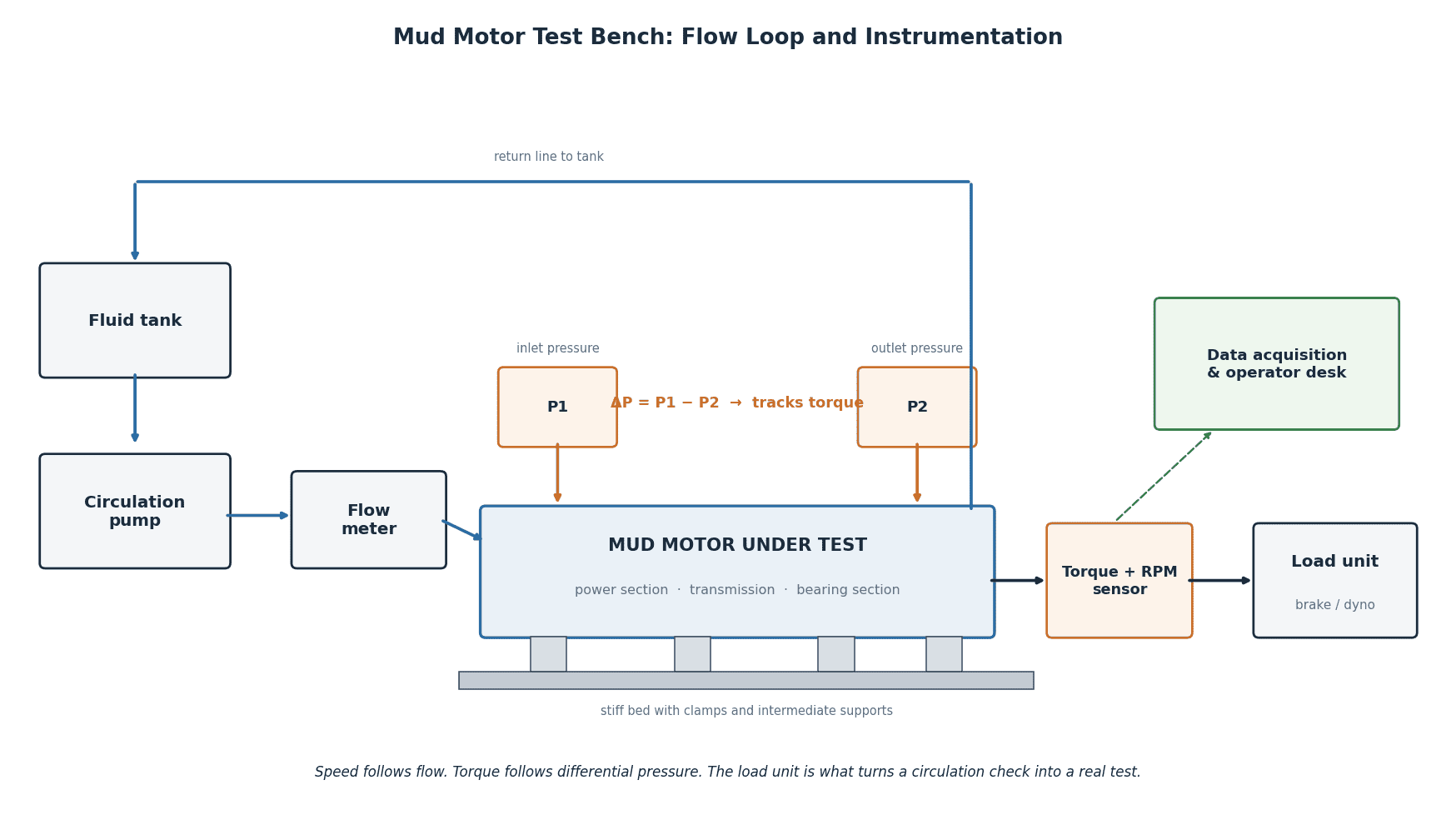
What a bench test can and cannot tell you
| Check | What to confirm | Action when it does not match |
|---|---|---|
| Does it turn freely and seal | No binding, no obvious bypass at low flow | Binding at ambient means excess interference; do not run it hot |
| Torque against differential pressure | The curve shape, compared to the maker’s curve for your fluid and temperature | Compare like with like before condemning the section |
| Repeatability across runs | Same motor, same conditions, similar curve | Drift within a session usually means heat, not a bad build |
| Bearing and driveshaft behaviour | Vibration, end play, temperature rise at the bearing pack | A bench is genuinely good at this; treat it as the primary finding |
| Leaks and seal integrity | Static and running, at pressure | Fix before any performance conclusion is drawn |
| Absolute downhole horsepower | You cannot confirm this on an ambient bench | Use the bench for pass/fail and trend, not for certifying downhole output |
None of that removes the need to know the rotor stator fit the section was built to. A bench is a comparison instrument. It answers “is this motor behaving like it did last time, and like others of its type” far better than it answers “exactly how much torque will this make at 3,000 metres”. Used that way it is one of the most useful pieces of equipment a service centre owns. For how a bench is built and run, see the mud motor test bench guide.
How fit gets specified
Fit is normally expressed as an interference dimension, and it is calculated rather than guessed. The inputs are the expected bottom-hole circulating temperature, the drilling fluid, the differential pressure the motor is expected to work at, and the elastomer compound in the stator. Manufacturers publish fit programmes for their own power sections, and the correct figure comes from the maker of that section.
There is no honest universal number here. A fit that is right for a 60 °C hole with water-based mud is wrong for a 150 °C hole with oil-based mud, using the same hardware. Anyone quoting a single interference figure for all conditions is quoting the wrong thing. Published guidance such as the Tartan drilling motor handbook sets out the general relationships; the specific number stays with the power section supplier.
When fit is the right thing to investigate
- A rebuilt motor stalls below spec on the bench but the build was to procedure
- Stators are chunking or failing early on one particular well or field
- The same motor gives different results between two service centres
- Performance dropped after a change of mud system
- A motor performed well shallow and failed in a hotter section
When another option may be better
Fit gets blamed for a lot of things that are not fit. Before redesigning around it, rule these out.
| Situation | Why fit may not be the cause | What to look at instead |
|---|---|---|
| Vibration and short bearing life | Fit affects sealing, not bearing loading | Bearing pack, driveshaft, run history |
| Motor stalls only at high flow | Points to hydraulics rather than interference | Flow rate against the motor’s rated range, nozzle sizing |
| Sudden failure after a solids event | Abrasion damages the rotor surface directly | Rotor coating condition, solids control |
| Every motor from one shop underperforms | More likely assembly method or measurement | Build procedure, gauge calibration, bench baseline |
| Torque never reaches spec, cold or hot | Could be a lobe or stage-count mismatch, not fit | Confirm the configuration against the data sheet |
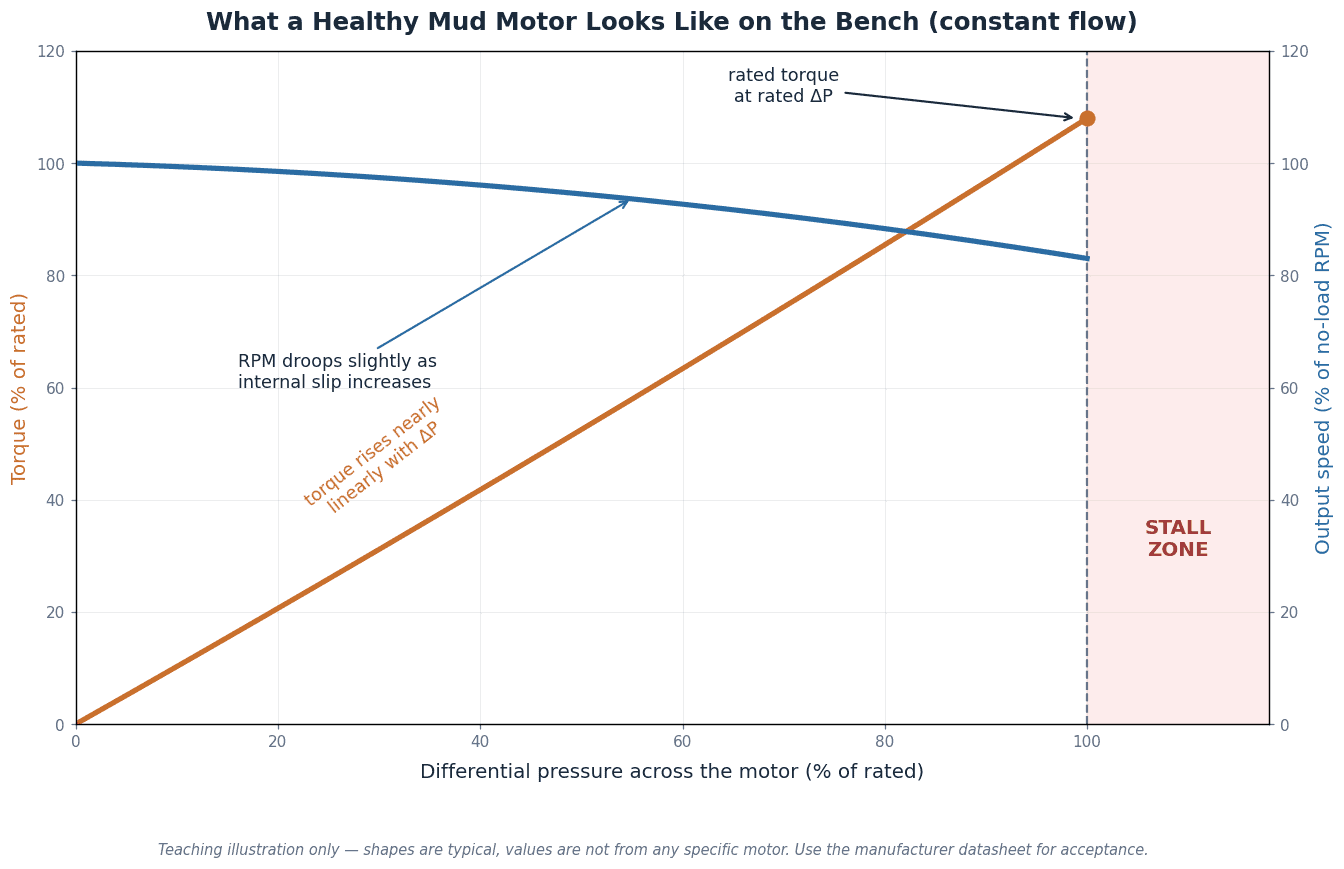
Reading a bench result properly
| Observation | Possible contributing factors | What to verify first |
|---|---|---|
| Lower torque than the data sheet, ambient bench | Expected if the section is fitted for a hot well | The fit specification and the target BHCT |
| Torque falls as the run continues | Elastomer heating and expanding during the test | Fluid temperature rise across the test |
| Binding or high starting torque when cold | Excess interference for these conditions | Do not proceed to a hot run until resolved |
| Good torque, poor RPM | Slip past the seal, or flow below the motor’s range | Flow rate before condemning the stator |
| Two identical motors, different curves | Different fit specifications for different wells | Build records for both before assuming a fault |
| Result improves after the section sits overnight | Elastomer recovering from compression set | Standardise soak and rest time in the procedure |
Proof and documentation
The useful record is not a single pass mark. It is the same motor measured the same way over successive services, on a bench whose conditions are written down: fluid, temperature, flow rate and differential pressure. Without those four values recorded, a torque figure cannot be compared to anything, including itself.
Galip builds the test equipment this work depends on rather than supplying the power sections themselves, which means the honest position is that fit specifications come from your section manufacturer while the measurement discipline comes from the bench. For dynamometer-based measurement see drilling motor dynamometer testing, and for the components involved, the rotor and stator explained and mud motor components.
Motors reach the bench after teardown, and the machine that separated the connections has its own sizing question worth understanding: why break-out force runs higher than make-up torque. The same logic applies here, in that the number on the data sheet is not the number the job demands.
Frequently asked questions about rotor stator fit
Does the stator have more lobes than the rotor?
Yes. The stator always has exactly one more lobe than the rotor. A 5:6 configuration means a five-lobe rotor inside a six-lobe stator. That extra lobe is what creates the progressive cavities the fluid pushes against.
Why does my motor test lower than the data sheet?
Most often because the bench is at ambient temperature and the fit was sized for downhole heat. The elastomer has not expanded, so the seal is looser and slip is higher. Compare against the maker’s curve for your actual test fluid and temperature before concluding anything.
What causes a stator to chunk?
Usually excess interference generating heat in the elastomer, often because the fit was chosen for cooler conditions than the motor met, or because the mud swelled the compound further than expected. The rubber degrades where it is compressed hardest and pieces break away.
Can I measure fit directly?
Rotor and stator dimensions can be gauged, and specialist equipment exists for stator profile measurement. But the number that matters is the interference under running conditions, which is inferred from those dimensions plus the temperature and fluid the motor will see.
Does mud type really change fit?
Yes, for some elastomer compounds. Oil-based and certain synthetic systems can swell the rubber beyond thermal expansion alone. The compound must be rated for the fluid, and a fluid change is a legitimate reason to revisit the fit specification.
Should a service centre keep fit records?
Yes. Recording the fit specification alongside each bench result is what makes results comparable between services and between shops. Without it, every test is a one-off number with nothing to measure against.
Can a bench certify downhole performance?
No. An ambient bench cannot reproduce downhole temperature, pressure and fluid together. It is excellent for pass or fail, for trending a motor across services, and for finding leaks and bearing problems. Treat it as a comparison instrument.
How rotor stator fit changes over a stator’s life
Fit is not a fixed property of a power section. It is set at assembly, and from that point it moves. Elastomer takes a compression set: after enough hours under load the rubber does not fully return to its original dimension when the motor is stripped. Effective interference falls, and with it the seal.
This is why a motor that performed well for three runs can start slipping on the fourth with no visible damage anywhere. Nothing failed. The rotor stator fit simply drifted below what the differential pressure needs, and the first symptom is lost RPM rather than a bang.
Heat accelerates it. A section run repeatedly near its temperature limit loses interference faster than the same section run cool, which is one reason field-by-field records are more useful than a fleet-wide service interval. Two identical motors on different wells will not age at the same rate.
| Observation across services | Possible contributing factors | What to verify first |
|---|---|---|
| Torque falling gradually, run after run | Normal compression set in the elastomer | Whether the decline is linear or accelerating |
| Sharp drop after one particular well | Temperature or fluid exposure beyond the compound’s rating | That well’s BHCT and mud system |
| Fit measures fine, torque still low | Rotor wear rather than stator condition | Rotor coating and dimensions |
| New section underperforms an old one | Different fit specification, not a defect | Build records for both sections |
The practical takeaway is that a single measurement of rotor stator fit tells you less than three measurements over a year. Shops that log the fit specification, the bench conditions and the result together end up able to predict a replacement rather than react to a failure, and that is a scheduling advantage as much as a technical one.
Is rotor stator fit the same as clearance?
They are two ends of the same measurement. Positive fit means interference, where the rotor compresses the elastomer. Negative fit means clearance, where a gap exists. Most drilling applications run positive interference so the cavities seal against differential pressure.
Can I use the same fit for water-based and oil-based mud?
Not safely, unless the elastomer is rated for both and the supplier confirms it. Oil-based systems can swell some compounds beyond thermal expansion, so a fit that suits water-based mud may become excessive. Treat a fluid change as a reason to revisit the specification.
Who sets the rotor stator fit, the motor supplier or the service centre?
The power section manufacturer sets it, because the figure depends on their elastomer compound and geometry. The service centre’s job is to build to that specification, record it, and measure against it consistently. Choosing a fit independently of the section maker is how avoidable stator failures happen.
Specifying a test bench or dynamometer
If the conclusion is that your measurement is the weak link rather than the motors, send the following and the engineering team will return a configuration matched to the motors you actually handle:
- Motor OD range and lobe configurations serviced
- Maximum stage count and overall motor length
- Target flow rate range and available pump capacity
- Differential pressure range you need to reach
- Test fluid, and whether heated fluid is required
- Torque and RPM measurement range, and required accuracy
- Reporting format for QA retention
- Workshop length, lifting capacity and power supply
Related equipment: drilling motors, breakout units for motor teardown, and the downhole tool service centre guide.
Before you condemn a power section: a short checklist
- Do you know the fit specification this section was built to, and the temperature it assumes?
- Was the bench fluid and temperature recorded alongside the torque figure?
- Are you comparing against the maker’s curve for those conditions, or against a generic data sheet?
- Has the rotor been inspected separately from the stator?
- Is the flow rate inside the motor’s rated range for this test?
- Do you have previous results for this same motor to trend against?
- Has the mud system changed since the last successful run?
If the first two have no answer, that is where to start, because rotor stator fit cannot be judged without them. A torque number without its test conditions cannot be compared to anything, and most fit disputes turn out to be comparison problems rather than build problems.
Expert Consultation
Need more information on optimizing your equipment performance? Our engineering team is available for technical consultations.
Request a Quote
Tell us about your requirements and our engineering team will prepare a detailed proposal with specifications, pricing, and delivery timeline.
