
Downhole Tool Service Center Guide: Controlled Make and Break Workflows
Downhole tool service center guide for workshops handling mud motors, jars, stabilizers, and fishing tools with cleaner make and break control.
By Galip Equipment Editorial Team, reviewed by Jason Wang.
downhole tool service center decisions get easier when the shop treats controlled make and break work as a repeatable process instead of a one-off force problem. Downhole tool service center guide for workshops handling mud motors, jars, stabilizers, and fishing tools with cleaner make and break control. The tool families a service centre meets, and who owns each of them, are set out in downhole tools.
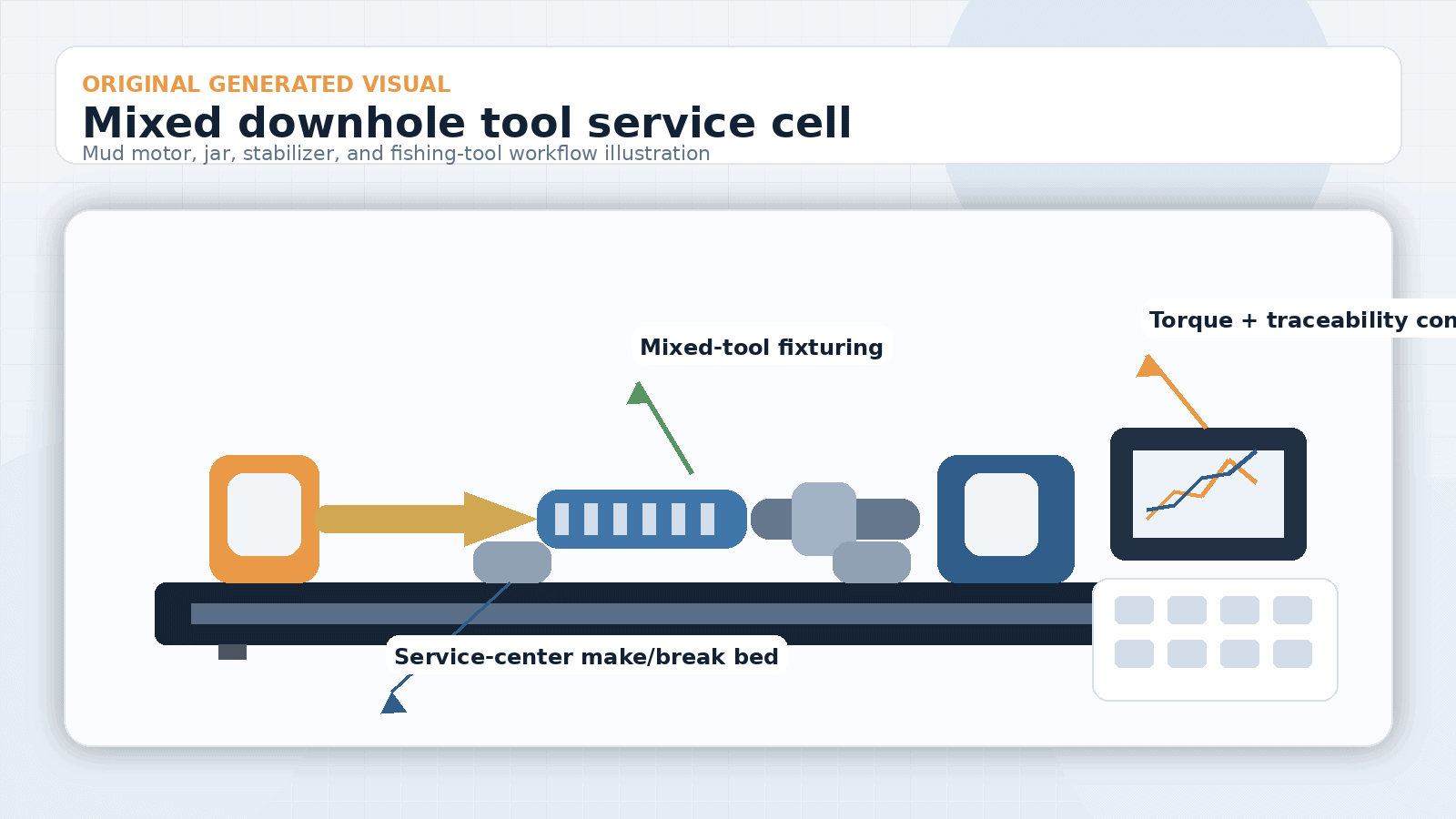
Table of contents
[rank_math_toc]
Downhole tool service torque unit priorities for mixed-tool workshops
- A downhole tool service torque unit helps mixed-tool shops standardize make and break work across mud motors, jars, stabilizers, and fishing tools without treating every assembly like pipe.
- High-mix service bays need repeatable fixture logic, clear reaction control, and one disciplined place where difficult threaded work is supposed to happen.
- The biggest losses usually come from improvised holding, weak exception logging, and rebuild data that never stays connected from intake through release.
- A central make and break cell works best when it supports different tool families with a fixture library instead of promising one clamp solves everything.
- Buyers should compare service-bay workflow, release confidence, and documentation quality before they compare torque numbers on the brochure.
downhole tool service torque unit in practice
downhole tool service torque unit becomes much easier to evaluate when the shop names the real failure points, uses a controlled process, and records what better handling should prevent the next time the job returns.
A lot of service centers say they “do downhole tools,” but that phrase hides a messy reality. One day the shop is rebuilding a mud motor. The next day it is opening a jar, breaking out a fishing tool connection, checking a stabilizer, or dealing with a tool string that does not fit neatly into one product family.
The work is high-value, high-mix, and full of parts that look rugged from the outside but punish casual handling once they are on the bench. Tools coming back from a fishing and recovery job route through exactly this teardown. The lifting gear that moves those parts deserves the same rigour — sling proof load testing belongs in the same workshop programme.
That is exactly why this topic matters for Galip. The company already has strong BU, breakout, and jar-tester coverage around tubulars, premium connections, and oilfield make/break quality.
What is missing is the service-center story for mixed tools — the buyers who are not only making up pipe, but are also rebuilding, inspecting, and releasing motors, jars, stabilizers, and fishing tools through one workshop.
This audience is valuable because its search behavior starts earlier than the purchase inquiry. These buyers do not always type “bucking unit” first. They search around tool servicing, rebuild workflow, shop efficiency, make/break control, turnaround, and how to stop damaging expensive components during maintenance.
If the article answers those problems clearly, it attracts adjacent traffic without repeating Galip’s current OCTG-heavy cluster.
The real opportunity is to describe the shop the way the shop actually works. Mixed-tool service is not a theory. It is a constant series of handoffs, fixture changes, questionable parts, traceability decisions, and release pressure. A useful article should speak that language.
Why mixed-tool service is harder than a pipe-only mindset
Pipe work can be difficult, but it is at least familiar in its geometry. Mixed downhole tools are different. They vary in OD, length, shoulder design, sealing logic, balance, gripping surfaces, and how much damage the component will tolerate before it becomes a rejection or a customer argument.
A mud motor is not just a threaded assembly. It is a product with internals, elastomer-related considerations, alignment concerns, and downstream performance implications. A drilling jar has trigger behavior and acceptance logic that go beyond whether the threads came apart.
A shop taking in motors from several suppliers needs one shared reference on which motor internals wear first and why before the first connection is opened.
Stabilizers, subs, and fishing tools can look robust enough for rough handling until a marred surface, damaged shoulder, or poor reassembly decision puts the tool into questionable service condition.
Non-magnetic collars carry the same risk quietly, because cold work and yard repair can raise permeability with nothing to see on the surface, which is how a non-mag collar stops being magnetically clean.
The result is a shop where every job seems familiar until it suddenly is not.
The other challenge is that mixed-tool shops often inherit habits from whichever product category dominates their history. A shop born from pipe service may use pipe logic on short, heavy tools.
A shop born from tool repair may underinvest in recording and repeatability because the crew trusts its experience. Both habits can work for a while. Neither scales well when customers start asking for cleaner documentation, faster turnaround, and more confidence in what was actually done.
This is also why generic “torque machine” content usually underperforms. Buyers in this segment do not only want to know that the machine can apply force. They want to know whether one workshop can standardize many different jobs without slowing itself down or damaging the very tools it is supposed to restore.
Where service centers actually lose time and money
The most expensive losses in mixed-tool service are rarely dramatic failures. They are usually repetitive small losses that the shop stops noticing.
One common loss is fixture uncertainty. If the crew has to improvise the holding method every time a tool family changes, the work becomes slower, less repeatable, and more dependent on the mood and experience of whoever is on shift.
Another loss is poor reaction control. When a short, heavy assembly breaks loose abruptly, the damage may not show up immediately, but the wear on shoulders, gripping surfaces, or related parts keeps accumulating.
A third loss is data fragmentation. Many service centers have some records, some operator notes, some test sheets, and maybe a few photos, but not one clean trail from intake to release.
That becomes painful when a customer questions a rebuild, when a tool comes back early, or when the shop tries to compare performance across repeated service cycles.
There is also the simple cost of rework. If a motor section has to be reopened because a connection was mishandled, or if a jar moves to test only to reveal that the preceding make/break sequence was not clean enough, the shop loses more than labor.
It loses schedule confidence. Once enough jobs are waiting, every preventable remake poisons the rest of the queue.
These are exactly the kinds of problems that a strong content piece should name directly. Readers do not need another generic lecture about efficiency. They need to see their own service bay on the page.
What a central make/break cell changes
A central make/break cell is useful because it gives a mixed-tool shop one disciplined place where difficult threaded work is supposed to happen. That sounds obvious, but many service centers still operate with scattered habits.
One job gets opened on one bench, another is handled on a floor stand, a third is moved to a different corner because someone thinks that fixture will be “good enough.” The result is not flexibility.
It is inconsistency.
A proper cell creates a repeatable home for the highest-risk part of the job. It concentrates clamp logic, support logic, tooling, operator position, reaction control, and data capture in one environment.
That improves safety, but it also improves judgment. When the crew works through a standard cell, the abnormal jobs become easier to spot because there is a real normal state to compare them with.
The best service cells do not pretend one fixture solves everything. They rely on a fixture library and a clear process for choosing the right support arrangement by tool family. Mud motors need a different handling mindset than jars.
Fishing tools may need different holding surfaces or orientation logic. Stabilizers and short heavy tools can change how balance and support should be managed. The cell should make these differences easier to handle, not harder.
Non-mag collars in austenitic stainless are another case worth naming, since the material is capped near 22 HRC and takes jaw marks that a steel collar body would not show.
This is where Galip has a real content advantage. The site already has a product portfolio that naturally supports the conversation: Bucking Unit for controlled make-up and break-out, Breakout Unit for high-force disassembly and workshop make/break tasks, Drilling Jar Tester for verification, and drilling-related equipment that makes the service context believable.
The article can connect those pieces without turning into a product catalog.
The control points that matter in a high-mix tool shop
Mixed-tool service needs a few control points more than it needs buzzwords.
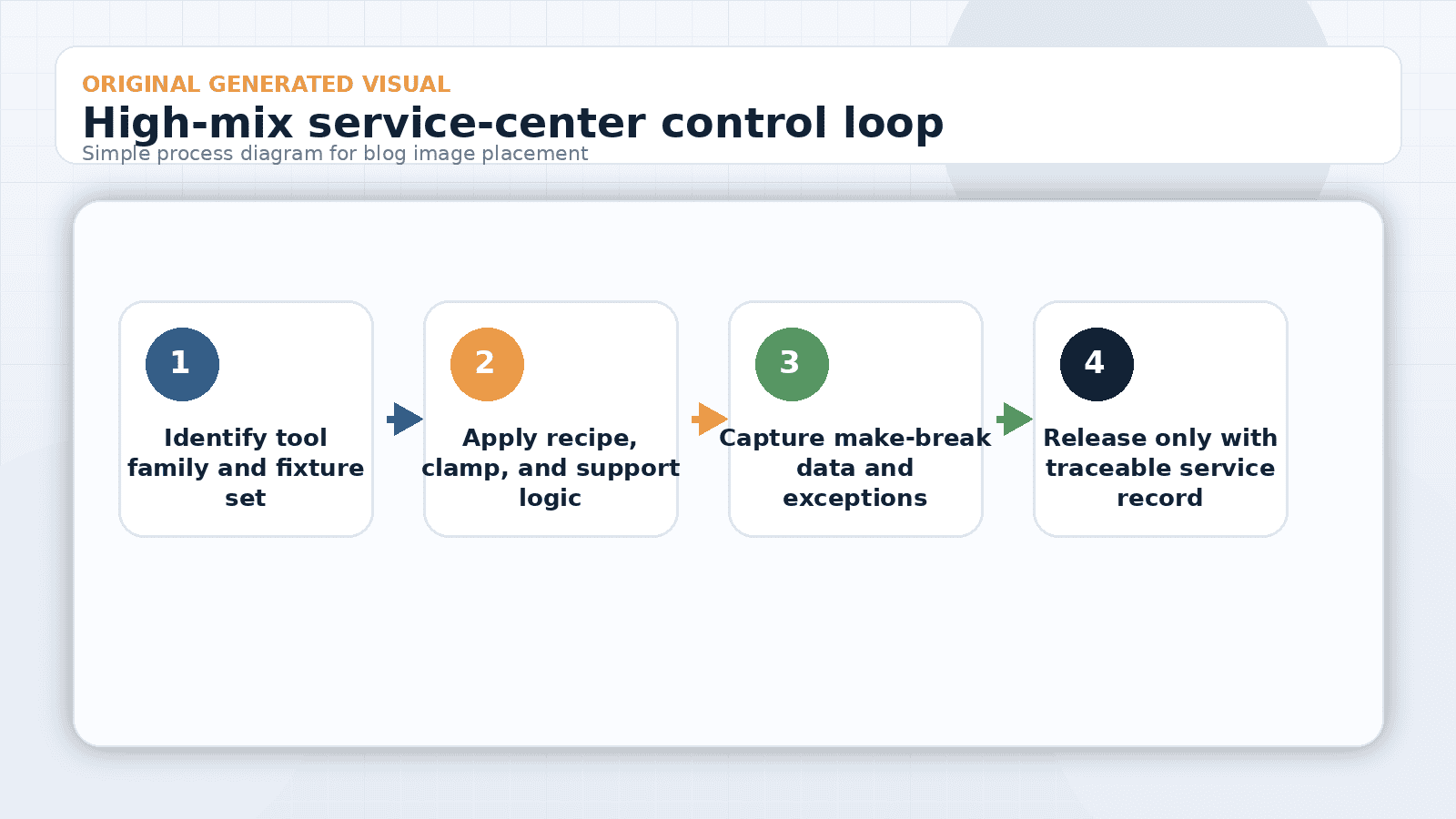
The first is identification. The shop should know exactly what tool family is on the bed, what connection or assembly logic applies, and what acceptance standard will matter later. That sounds basic, but uncertainty at the start is one of the most expensive problems in rebuild work.
The second is fixture selection. The crew should not be inventing the holding method from memory every time. A good service center documents what support package belongs to which tool family and what exceptions require engineering review.
The third is make/break recipe logic. Even if every tool does not require full torque-turn acceptance, the shop still benefits from standardized parameters, sequence control, and operator prompts. That is what keeps process drift from becoming normal.
The fourth is exception logging. Most shops can document the easy jobs. The valuable discipline is recording what happened when a tool behaved unusually, when a connection needed extra attention, when a part was held, or when the unit was re-entered into the workstream after inspection.
Those are the moments that later determine whether the shop looks in control or merely busy.
The fifth is release confidence, which naturally connects to the Drilling Jar Tester and related verification steps.
A service center that handles jars, motors, and tool strings does not win by taking things apart efficiently. It wins by releasing them with confidence and evidence.
Where the Bucking Unit fits in a mixed-tool service model
This is the part many buyers need explained plainly. In a mixed-tool shop, the premium-connection bucking unit is not just a “pipe machine.” It is the controlled make/break platform for jobs where repeatability, clamp stability, and data capture matter enough to justify a higher-control solution.
That does not mean every tool should go to the BU. Some jobs belong on a Breakout Unit because the priority is disassembly force and workflow speed.
Some jobs belong on dedicated test equipment. Some jobs may still be simple enough for lighter handling. But once the service center wants one serious platform for higher-value threaded assemblies, the torque-controlled bucking unit becomes commercially relevant again.
The key is to present it honestly. Readers will trust the article more if it says what the BU is best at: controlled make-up and break-out, repeatable handling, and stronger process discipline.
They will trust it even more if it admits that mixed-tool service often needs more than one machine category around the bay. That is how helpful content earns purchase intent instead of pushing it away.
A practical workflow for service-center managers
If you are managing a mixed-tool shop, the simplest improvement is to map the work by stages instead of by product names.
Intake should identify the tool family, service history, visible condition, and whether the job is routine or exception-based. Make/break should happen in the right controlled cell with a defined support arrangement.
Inspection should document what was found before parts are cleaned into anonymity. Reassembly should follow the same discipline as disassembly, not a looser one. Verification should be tied to the actual tool type, whether that means jar testing, dimensional checks, pressure checks, or other release criteria.
Then the final record should tie the whole sequence together.
This may sound procedural, but it is actually pro-profit. Shops that run mixed work well usually have less drama, not more. Their technicians spend less energy arguing about how to hold parts and more energy diagnosing the parts themselves.
Their supervisors spend less time reconstructing what happened and more time planning the next batch. Their customers feel the difference because the communication gets clearer.
Where that batch work is large and repetitive, our guide to high-volume make-up in a shale completion workshop shows how hold points and record naming stop one setup error repeating across the whole run.
When readers finish this section, they should feel that the article respects the complexity of their work without making it mysterious. That balance matters. The goal is not to sound academic. The goal is to sound like someone who has watched real service work unfold and knows where the money leaks out.
What buyers should compare before expanding a service bay
Buyers looking at equipment for mixed-tool service should compare the service model first and the machine brochure second.
Ask what mix of tools really comes through the shop. How much of it is motors, jars, stabilizers, subs, or fishing tools? How often do those categories overlap in the same week? How many jobs need documentation robust enough to support customer review later?
Then compare the cell design. Can the equipment support high-mix fixture changes without becoming awkward? Can operators work safely around short heavy tools? Is the reaction path clear? Does the shop gain a cleaner process, or just a bigger source of force?
Finally, compare the information output. Does the system make it easier to release tools with confidence? Does it connect smoothly to testing and inspection? Can the shop build a more consistent service record over time?
Those are better buying questions than “What is the max torque?” because they connect the machine to the actual shop model. In mixed-tool service, poor fit is expensive even when the machine itself is impressive.
Conclusion
The mixed-tool service center is one of the best adjacent content opportunities around the bucking-unit topic because it reaches real buyers before they arrive with a narrow product keyword. These readers are already living with the same problem Galip’s core products solve: expensive threaded work being handled with too much variability and not enough control.
By focusing on mud motors, jars, stabilizers, and fishing tools, the article expands beyond pipe without drifting away from Galip’s real commercial universe. It stays practical, it keeps one small but natural GALIP's hydraulic bucking unit section, and it gives the reader something more useful than a machine definition.
It gives them a better way to think about their own service bay.
That is the kind of article that can attract traffic, build trust, and send qualified readers toward the BU, Breakout Unit, Jar Tester, or a direct RFQ — without sounding like it was written just to chase a keyword.
Related Galip resources
- hydraulic bucking unit with torque-turn recording
- Breakout Unit
- Drilling Jar Tester
- Drilling Motors
- Contact Us
External references
- NOV 8026 TorqueMaster machine
- NOV drilling and fishing jar tester
- NOV downhole capabilities brochure
Frequently asked questions about downhole tool service torque unit workflows
What kind of shop benefits most from a downhole tool service torque unit?
The strongest fit is a workshop that services several downhole tool families and wants one cleaner make and break environment for difficult threaded work, repeatable setups, and better release records.
Why is mixed-tool service harder than pipe-only service?
Mixed tools change geometry, support points, acceptance logic, and handling risk from one job to the next, so improvised methods create more inconsistency and more hidden damage.
How does a downhole tool service torque unit connect to jar testing and release quality?
It supports the controlled make and break part of the workflow so testing, inspection, and final release happen on top of a cleaner and more traceable service record.
If your workshop is trying to standardize service work around jar testing, controlled breakout, and higher-value rebuilds, you can share your tool mix with Galip and discuss the right bay layout.
Keyword recap: downhole tool service torque unit
downhole tool service torque unit is ultimately a shop-control question: how the assembly is identified, supported, opened, inspected, and returned to service without creating extra damage on the way.
downhole tool service torque unit checklist
- Keep downhole tool service torque unit tied to the actual failure pattern the shop is trying to stop.
- Document the support method, breakout method, and inspection findings in the same workflow.
- Use internal references and external standards so buyers can compare process control instead of guessing.
- Make the release decision defensible to operators, supervisors, and customer reviewers.
Why downhole tool service torque unit matters for buyers
Buyers searching downhole tool service torque unit are usually trying to stop recurring loss, not just compare a machine specification. That is why process control, equipment fit, documentation, and operator safety all need to appear in the same article.
When downhole tool service torque unit stays connected to the exact parts, fixtures, and release decisions on the floor, the content becomes more useful for ranking and more believable for a technical reader.
downhole tool service torque unit FAQ recap
A strong downhole tool service torque unit workflow is the one technicians can repeat safely, supervisors can audit, and customers can understand after the job is already complete.
Expert Consultation
Need more information on optimizing your equipment performance? Our engineering team is available for technical consultations.
Request a Quote
Tell us about your requirements and our engineering team will prepare a detailed proposal with specifications, pricing, and delivery timeline.
