
Midstream Oil and Gas: Where Line Pipe Is Welded, and Where It Is Still Threaded
Gathering systems, trunk pipelines, storage and gas plants, read through the pipe they are built from: where the joints are welded, where they are still threaded, and why the coupling on a threaded gathering line was made up in an upstream workshop.
Midstream oil and gas is the sector between the well and the refinery: gathering systems, trunk pipelines, pump and compressor stations, storage and gas processing. Its pipe is line pipe made to API 5L, and almost all of it is joined by welding. Threads survive only on small-diameter gathering lines, where the coupling is made up by a threader, on a bucking unit, before the pipe reaches the field.
At a glance
| What midstream does | Collects production from wellheads, moves it by pipeline, ship, rail or truck, stores it, and processes gas into pipeline-quality gas and natural gas liquids |
| The pipe | Line pipe to API 5L: seamless or welded, product specification levels PSL 1 and PSL 2, grades from B through the X-grades. A different product from OCTG under a different specification |
| The joint | Girth welds on trunk lines, flowlines and plant piping. Threaded-and-coupled joints on small-diameter gathering lines, with the threads governed by API 5B alongside casing and tubing threads |
| Where the bucking unit sits | Not in the pipeline company. In the threading shop or pipe distributor that supplies threaded line pipe, bucking the coupling on before shipment and recording the make-up |
| Decision this page supports | Reading a midstream enquiry correctly: whether the work is welded pipe, in which case there is nothing to buck, or threaded gathering line, in which case the customer is really a threader |
What midstream is
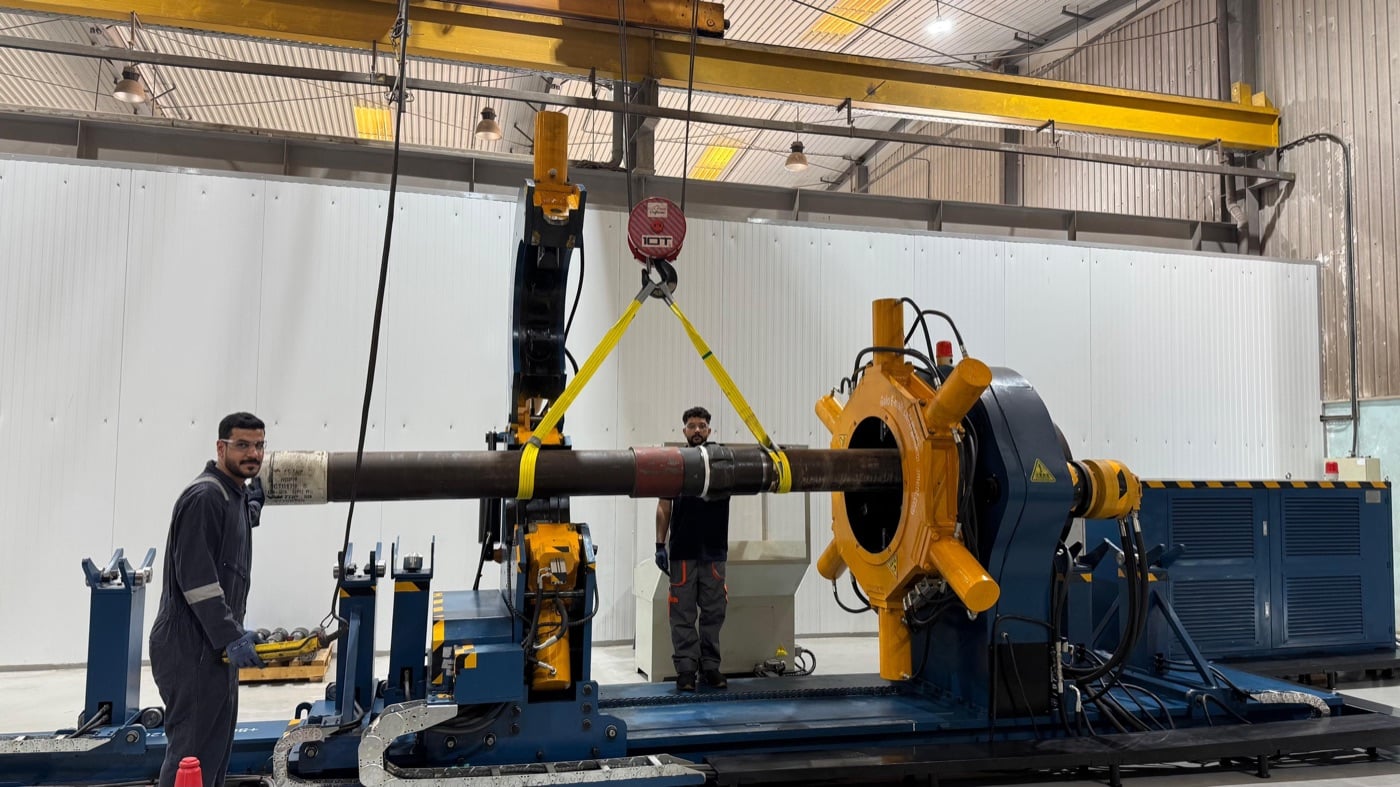
A well produces a mixture at a wellhead in a field. A refinery wants a steady stream of stabilised crude at a fence line hundreds or thousands of kilometres away, and a gas customer wants dry, sweet gas at a set pressure. Everything that closes that gap is midstream. Flowlines take each well to a gathering system; the gathering system takes the field to a processing plant or a central facility; separators, dehydrators and sweetening units make the gas fit for a pipeline; fractionation splits out the natural gas liquids; trunk pipelines, with pump or compressor stations along them, move the product across country; tank farms and caverns store it; terminals load it to ship or rail. A supplier’s own survey of the sector lists pipelines, pumping and compressor stations, storage, gas processing, fractionation, LNG plants and marine loading among its equipment, with API 5L pipe named for the pipelines (Projectmaterials, Oil and Gas Equipment by Sector).
Midstream companies are a distinct population. Pipeline operators, gas processors, storage and terminal owners, some of them arms of integrated operators, many of them independents whose whole business is moving somebody else’s molecules for a fee. They buy pipe by the kilometre, valves by the hundred and compressors by the megawatt. What they do not buy, as a rule, is equipment for making up threaded tubular connections, because with one exception their joints are welded. The rest of this page is about the exception and why it matters to a workshop.
Line pipe: what API 5L covers
API 5L is the specification for steel line pipe for pipeline transportation systems in the petroleum and natural gas industries. It covers seamless and welded pipe, in two product specification levels, PSL 1 and PSL 2, with PSL 2 adding tighter chemistry, mandatory toughness testing and stricter non-destructive examination. Grades run from Grade B upward through the X-grades, where the number after the X is the minimum yield strength in thousands of pounds per square inch, so X52 and X65 are stronger steels than Grade B. Manufacturing routes include seamless, electric resistance welded and submerged arc welded, longitudinal or spiral (American Piping Products, API 5L Pipe Specifications).
Two points in the scope matter for this page. The first is that plain-end line pipe under API 5L is intended for field assembly by circumferential welding; the specification says so, and disclaims responsibility for the field weld. The second is that the specification also covers threaded-end and bell-end pipe, which means a threaded gathering line is still API 5L pipe, with a thread on it. The line pipe thread itself, its form, taper, gauging and inspection, is not in API 5L at all; it lives in API 5B, the same document that governs round-thread casing and tubing threads (API Spec 5B). The reason line pipe is not OCTG, even though it comes from the same mills, is set out in the OCTG explainer: different service, different specification, different inspection regime.
Welded pipe: the joint that never comes apart
A trunk pipeline is built as a single welded object. Joints of pipe are strung along the right of way, bevelled, lined up on an internal clamp, welded around the circumference, inspected, coated at the joint and lowered into the trench. The girth weld is designed to be as strong as the pipe and to stay there for the life of the line; nobody plans to unscrew a section of a gas transmission line. The same is true of flowlines to a central facility above a certain size, plant piping inside a gas plant, and station piping around pumps and compressors, all of it welded and, where it has to be opened, flanged.
For a make-up equipment supplier this is a sector to understand and then leave alone. A pipeline contractor’s enquiry is about welding systems, line-up clamps, bending machines, coating and inspection. A bucking unit has no place on a right of way, and a supplier who tries to sell one there has misread the sector. The value chain overview on this site, upstream, midstream and downstream oil and gas, makes the same point from the other direction: the joint decides the equipment, and a welded joint decides against a threading machine.
Threaded gathering lines: the exception that keeps a thread in midstream
At the well end of the gathering system the pipe gets small and the economics change. A flowline that takes one or two wells to a header might be a few kilometres of small-diameter pipe, laid by a small crew, moved when the wells are re-worked and sometimes recovered when they are abandoned. Welding that pipe means a welder, a procedure, inspection and a permanent joint. Threading it means tongs, thread compound and a joint that can be taken apart. So threaded-and-coupled line pipe persists in that niche: new API 5L pipe with line-pipe threads and a coupling, and in some fields used tubing pressed into flowline service. The thread standard is the same API 5B whose gauging practice is covered in API 5B thread gauging and standoff.
The niche should be sized as what it is. It is small-diameter, low-pressure, onshore work, more common in mature fields with many small wells than in new developments, and it shrinks every time a field moves to larger welded gathering lines. It is real work, and it keeps a thread in the sector, but a shop should not build a business case on it alone.
| Midstream pipe | How it is joined | What that means for make-up equipment |
|---|---|---|
| Trunk pipeline, transmission line | Girth welded on the right of way, flanged at stations and valve sites | None. Welding, bending, coating and inspection equipment only |
| Larger flowlines and plant piping | Welded in the shop or field, flanged where it must open | None on the pipe; bolt torque control on the flanges |
| Small-diameter gathering line, threaded and coupled | Coupling made up at the threading shop; field joint made up with tongs on the lease | A bucking unit at the threader, the same bench used for tubing, with a torque record per coupling if the buyer asks for one |
| Used tubing reused as flowline | Inspected, re-threaded or re-coupled in a pipe yard, then made up with tongs | Break-out of the old coupling and make-up of the new one in the yard; the yard is upstream by trade even though the pipe is going to midstream service |
Who makes up the coupling on threaded line pipe
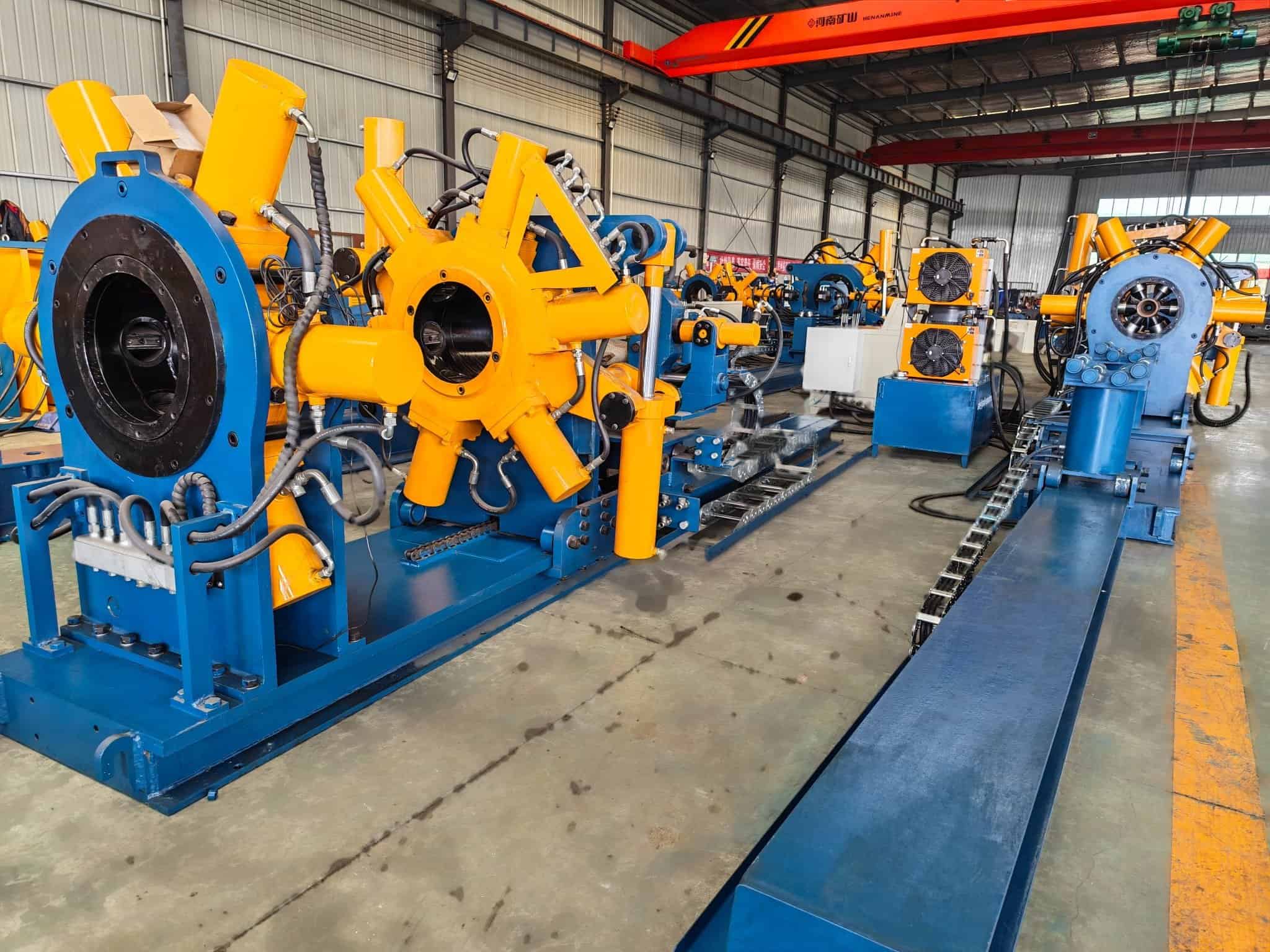
The pipeline operator does not. Threaded line pipe arrives with one end already carrying a coupling, made up at the mill or, more often, at an independent threading shop or distributor’s threading line. That shop threads casing and tubing on the same lathes and bucks couplings onto all of it on the same machine: a horizontal hydraulic bucking unit that clamps the pipe, spins the coupling on and stops at the torque the shop’s procedure calls for. The controls that a threading shop applies to that operation on casing, thread compound, position, torque, the trace, are set out in casing coupling make-up for OCTG threading shops, and a shop running threaded line pipe applies a lighter version of the same discipline.
That has a practical consequence for the specification. A threader serving both OCTG and threaded line pipe customers does not buy a line pipe machine and an OCTG machine. It buys one bench whose clamp range covers the smallest threaded line pipe it sells and the largest casing it threads, and whose torque range covers both the light make-up of a line-pipe coupling and the heavy make-up of a large buttress or premium coupling. The small end of that range is the one that gets forgotten in an enquiry and the one that a poorly chosen jaw set fails on first.
The same logic applies to the pipe yard that reconditions used tubing for flowline service. It breaks out old couplings, often corroded, inspects and drifts the pipe, re-threads or re-cuts, and makes up a new coupling. That yard lives on break-out as much as make-up, and a breakout unit beside the make-up machine earns its space if the volume of used pipe justifies it. Whether the reconditioned pipe is destined for a well or a gathering line changes nothing on the bench.
Gas plants, stations and storage: torque without threads
Inside a gas processing plant, a compressor station or a tank farm the picture is the same as in a refinery. Piping is welded into spools, bolted together at flanges, and opened at those flanges for maintenance. Torque control there is bolt torque: lubricated studs, a cross-pattern sequence, staged passes to a target, calibrated tools, a record per joint. It is a serious discipline with its own guidelines, and it has nothing to do with threaded tubulars. A midstream maintenance department asking about torque tools is asking about bolting equipment, and the right answer from a bucking unit supplier is a referral.
What does travel between the sectors is the habit of traceability. A gas plant that records every flange it closes would recognise a threading shop’s torque-turn archive as the same idea applied to a different joint. The way a workshop keeps that archive honest, with calibrated sensors and certificates that can be traced, is described in torque and load calibration, and it is as relevant to a threader supplying gathering line as to one supplying casing.
When another page is the better start
A reader whose pipe is welded has finished with this site by now; the equipment they need is in a different catalogue. A threading shop that supplies threaded line pipe alongside OCTG should move to the bucking unit product page and its acceptance checklist, and specify by the full range rather than the line-pipe end of it. A buyer trying to choose between API 5L and API 5CT pipe for a job is in the wrong place too: that decision belongs with the pipeline or well designer, and this site does not publish design guidance for it.
There is also a limit to how far the sector labels reach. A pipe yard reconditioning tubing for flowline service is doing upstream work for a midstream customer. An integrated operator’s field workshop may service both. Specify by the joint on the bench, threaded or welded, and by the pipe range, and the labels take care of themselves.
Frequently asked questions
What is midstream oil and gas?
Midstream is the sector between production and refining: gathering systems that collect from wellheads, gas processing plants, trunk pipelines with their pump and compressor stations, storage tanks and caverns, and terminals that load ships and rail. Its business is moving and storing hydrocarbons, usually for a fee, rather than producing or refining them.
What is line pipe?
Steel pipe made to API 5L for transporting oil, gas and water in pipeline systems. It is supplied seamless or welded, in product specification levels PSL 1 and PSL 2, in grades from Grade B through the X-grades. Most of it is plain-ended for field welding; the specification also covers threaded-end pipe used on small gathering lines.
Is line pipe the same as casing or tubing?
No. Casing, tubing and drill pipe are oil country tubular goods under API 5CT and related specifications, designed for the loads inside a well. Line pipe under API 5L is designed for surface transport. They come from similar mills and share a thread specification, API 5B, but the products, grades, inspection and connections are different.
Are pipelines threaded or welded?
Trunk pipelines, transmission lines and larger flowlines are welded joint by joint on the right of way and flanged only where they must open. Threaded-and-coupled joints survive on small-diameter gathering lines and flowlines, where a joint that can be taken apart and a crew without welders make threads the practical choice.
Who makes up the coupling on threaded line pipe?
The threading shop or distributor that supplies the pipe, on a horizontal bucking unit, before shipment; the field crew makes up the other end with tongs. Pipeline operators rarely own make-up machines. A pipe yard reconditioning used tubing for flowline service does the same work, breaking out the old coupling and bucking on a new one.
Does a midstream company need a bucking unit?
Almost never. Its pipe is welded and its plants are flanged. The bucking unit that serves midstream sits in an upstream business, a threader or a pipe yard, that supplies threaded gathering line. A midstream maintenance department asking about torque control is usually asking about flange bolting, which is a different tool and a different guideline.
Send the pipe range, not the sector
A threaded line pipe enquiry is answered from the same list as any threading enquiry: the outside diameter range from the smallest threaded line pipe to the largest casing the shop handles, the thread types and connection families run, the highest make-up and break-out torque expected across that range, whether a torque record per coupling must be produced for a customer, the site power supply, and a sketch of the bay. Stating that the shop also supplies gathering line is useful context; it does not change the machine, only the small end of its range.
The midstream checklist
- Establish whether the pipe in question is line pipe under API 5L or OCTG under API 5CT; the specification decides the inspection regime and the connection.
- Establish the joint: welded, flanged or threaded and coupled. Only the last is make-up equipment work.
- If the joint is welded, redirect the enquiry to welding, bending, coating and inspection suppliers.
- If the joint is flanged, the torque question is bolt torque under the plant’s bolting programme.
- If the pipe is threaded and coupled, identify who bucks the coupling on: the threader or the pipe yard, not the pipeline operator.
- Size the threader’s bench from the smallest threaded line pipe to the largest casing it handles, and check the jaw set at the small end.
- Where used tubing is reconditioned for flowline service, count the break-out volume and decide whether a breakout unit is justified.
- Ask which customer will audit the coupling record, and match the record the machine produces to that customer’s expectation.
Expert Consultation
Need more information on optimizing your equipment performance? Our engineering team is available for technical consultations.
Request a Quote
Tell us about your requirements and our engineering team will prepare a detailed proposal with specifications, pricing, and delivery timeline.
