
Power Tong Guide: How It Works, Torque and Buying Limits
A power tong makes up and breaks out casing, tubing and drill pipe. Learn how torque is calculated, how backups work and when a bench machine fits better.
A power tong is a hydraulic wrench that grips and turns a tubular connection. It makes up or breaks out casing, tubing and drill pipe without hand tools. On the rig floor it works alongside equipment such as backups, spinning wrenches and casing-running tools.
Problems start when the same tong is expected to handle short tools or controlled horizontal workshop work.
Article contents
Power tong at a glance
| Question | Short answer |
|---|---|
| What does it do? | Grips and rotates a tubular to make up or break out a connection |
| Where does it work? | At the well, on pipe hanging vertically in the string |
| Main types | Open-head and closed-head, sized by pipe range and torque |
| What is the backup for? | Holding the lower joint still, so torque goes into the connection |
| How is torque set? | Hydraulic pressure, read through a load cell in the snub line |
| Where does it stop? | Horizontal bench work, short tools, and serial-number traceability |
How the rotating head and backup work
Hydraulic fluid drives a motor and gear train. The gear train turns a ring fitted with cam-actuated jaws. As the ring rotates, the cams force the jaws inward, so the grip rises with the applied torque. The rotating head therefore does not need a separate clamping cylinder.
The elevators or slips carry the pipe weight. The tong only grips and turns the connection.
Underneath sits the backup, which clamps the joint below the connection and holds it stationary. Without it the reaction has to go somewhere else: down the string into the joints below, and into the slips or spider. The connection you meant to tighten ends up with whatever torque the string happened to resist, and a lower connection can be over-torqued or backed off in the process.
Types, pipe range and torque rating
| Type | Character | Typical use |
|---|---|---|
| Open-head | The head opens so the tong can be rigged onto pipe already hanging in the hole | Casing and tubing running |
| Closed-head | A continuous ring, stiffer and generally higher torque | Drill pipe and heavier connections |
| Single, with separate backup | Two units rigged together | Flexible, more to rig up and align |
| Integrated tong and backup | One frame carrying both | Faster, and fixed in its size range |
Two numbers size the machine: the pipe outside diameter range it will accept, and the torque it will deliver.
Torque ratings are usually stated in low gear, the slow high-torque gear, at the tong’s maximum rated hydraulic pressure. Ask what pressure and which gear the rating assumes, and what flow the power unit has to supply to hold it. A tong quoted on a figure your hydraulic unit cannot feed will make that torque briefly and then sit there while the pressure recovers.
How the torque reading is calculated
A power tong does not measure torque directly. It measures tension in a load cell fitted in the tong’s snub line and multiplies by the tong’s arm length, or it infers torque from hydraulic pressure. Either way the reading is a calculation, and the assumptions inside it are worth knowing.
- The load cell has to be the one the gauge was calibrated with.
- The snub line has to sit perpendicular to the tong arm, because the effective lever arm shortens as the angle departs from square.
- The gauge, the cell and the tong are a matched set. Swapping one and keeping the certificates for the others is a common and invisible error.
- Calibration carries a date, and rig floors are hard on instruments.
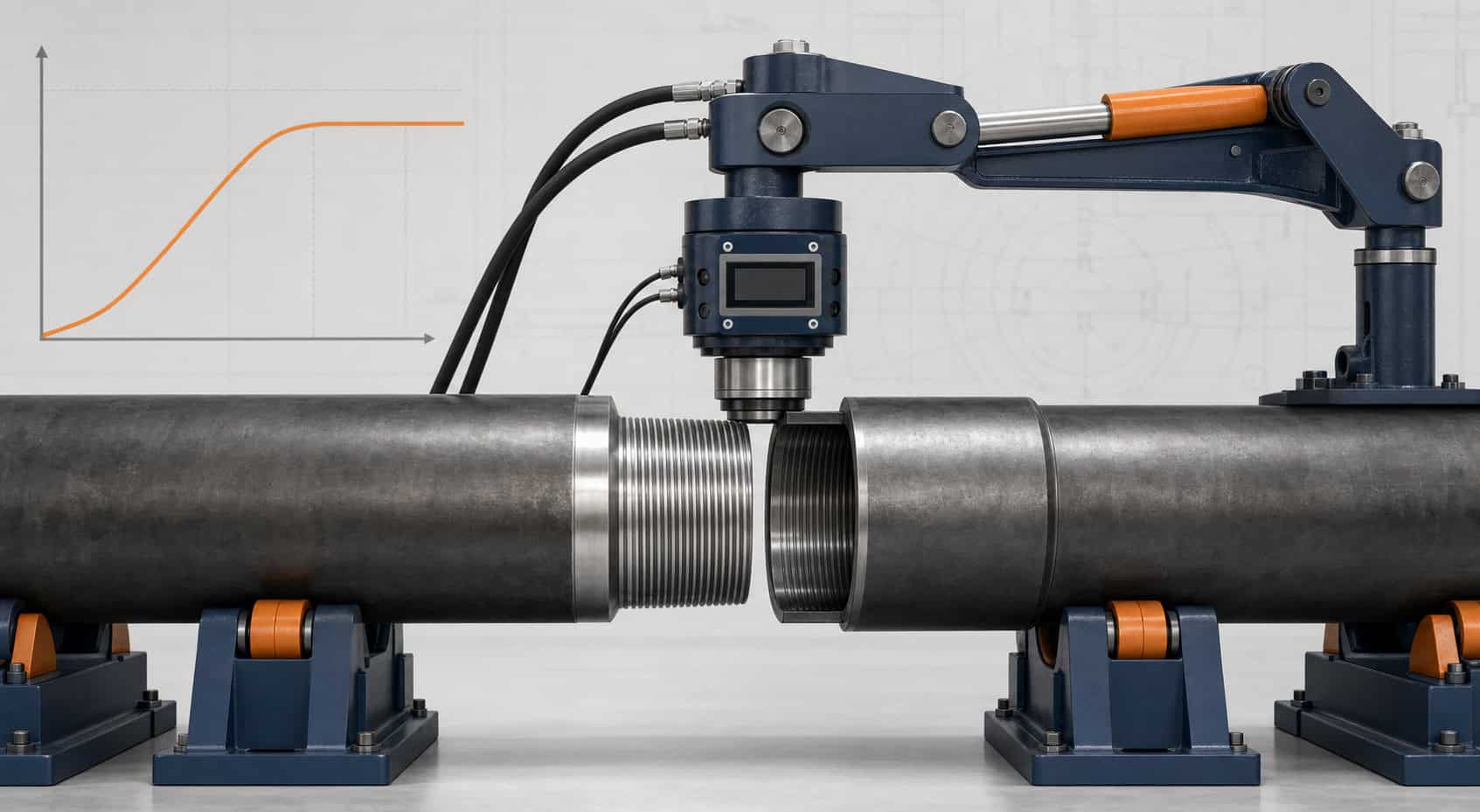
The reading is a property of the whole rigged system rather than of the tong alone. That matters when someone asks you to prove what torque a specific connection received.
What the hydraulic power unit must supply
The tong is a consumer of hydraulic power, and it only produces its rated figures if something upstream supplies them. Pressure sets the torque available. Flow sets how fast the head turns at that torque.
Undersize the unit and the symptoms look like a tong problem rather than a supply problem: spin-up is slow, the tong stalls short of the target and recovers when you back off, and torque readings drift between joints because the pressure at the tong is not the pressure at the gauge on the unit. Before condemning a tong, check what the power unit actually delivers at the tong’s inlet, under load, with the hoses that are on it.
Dies, grip and acceptable pipe marking
Gripping is done by hardened dies with a tooth pattern that bites into the pipe. Marking is how the tong holds on.
| Consideration | Why it matters |
|---|---|
| Tooth pattern and sharpness | Worn dies slip, and slipping does more damage than gripping |
| Die curvature vs pipe OD | The wrong radius concentrates load on the edges of the die |
| Pipe grade and coating | Higher grades and coated pipe tolerate less tooth penetration |
| Acceptance limits | Rental and premium pipe carry written limits on permitted marking |
On pipe going into a hole this is an accepted cost. On pipe that has to be inspected, certified and handed back to an owner, the acceptable mark depth is written into a contract. It is the same argument that governs tool joint OD and bevel diameter, where surface condition decides whether the joint still has a class.
Where a power tong works best
On a rig floor, a tong is hard to beat for running a long string quickly.
- Pipe hanging vertically in the rotary, where gravity holds alignment for you.
- High joint counts at speed, which is exactly what running casing demands.
- Coming to the pipe rather than the pipe coming to it.
- Working in the open, in weather, on a floor that moves.
Those advantages depend on the pipe hanging vertically in a supported string.
When the work needs a bench machine
A tong is designed around a long vertical tubular. The rig carries the weight, and the backup holds the joint below. Short tools and horizontal work remove those supports.
| Situation | What goes wrong |
|---|---|
| Short downhole tools | There is no long joint below to grip as a backup, and nothing holding the tool in line |
| Horizontal bench work | Alignment is no longer free. The tong was never asked to solve it |
| Per-joint traceability | Torque-turn units on running tongs do record joint by joint against a tally number. Tying that record to a tool serial number, in a repeatable setup, is a different job |
| Repeat make and break | Cycling a connection under controlled conditions, several times, is bench work by nature |
| Marking-sensitive pipe | Dies grip by biting, and the limit is written into someone’s contract |
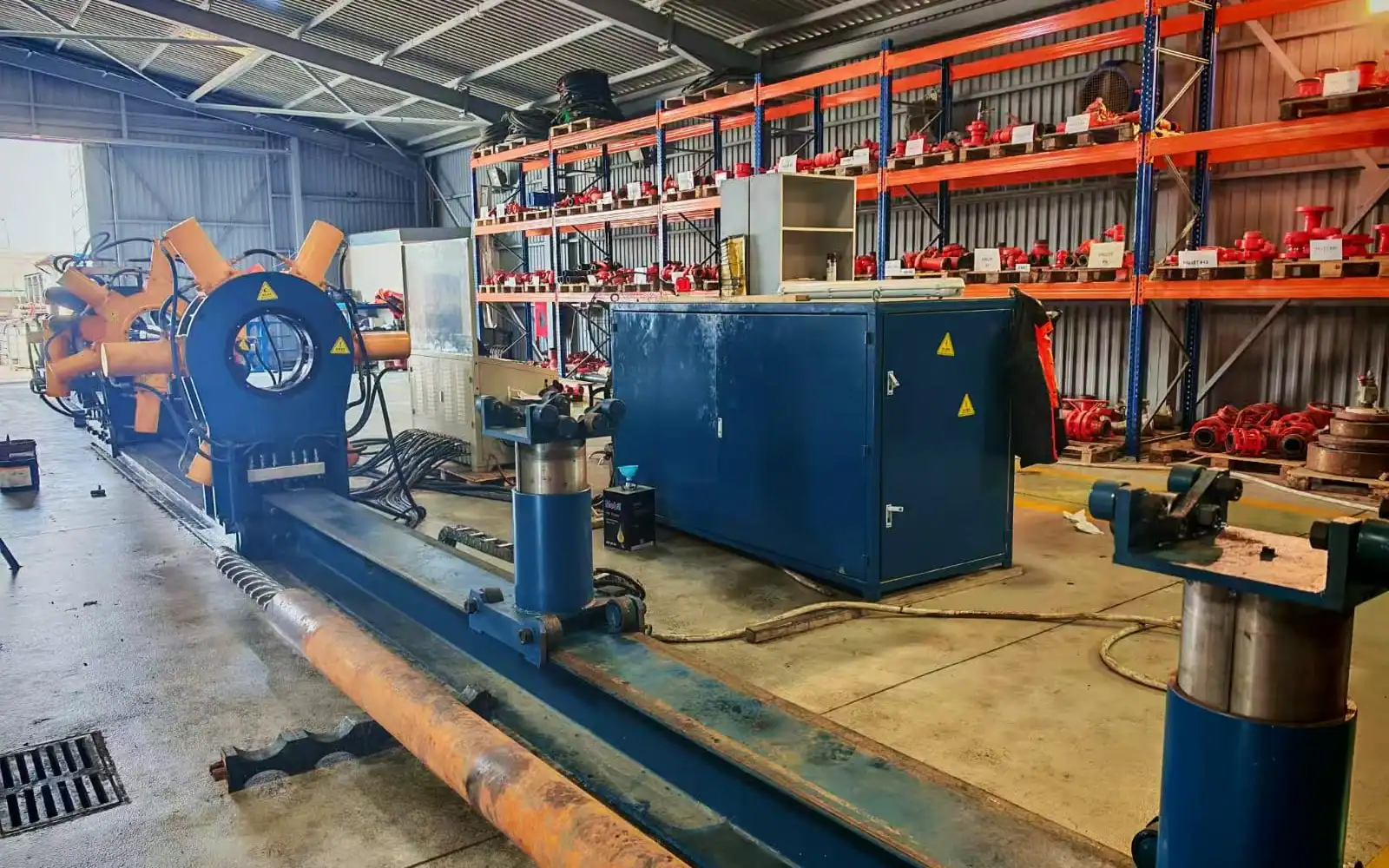
A running tong completes each connection once as part of a trip. A workshop may need to cycle the same connection several times and return a record tied to a serial number. Rig-floor torque-turn systems can record each joint well. The difference is the setup and the job, not whether the tong has electronics.
Why peak torque does not tell the whole story
A peak torque figure says the connection reached a value. It does not say how it got there. Two connections can both stop at the same final torque, one having risen smoothly to a clean shoulder and the other having climbed early because the threads were galling, and only the second one is going to fail. The information that separates them lives in the shape of torque plotted against turns.
That is why premium connection procedures specify a shoulder point and a delta turn window rather than a single target figure, and why the underlying values come from a make-up torque specification rather than shop habit. If a customer asks for the graph, more torque capacity does not answer the request.
Wellsite running and workshop make-up are different jobs
| Comparison | At the well | In the workshop |
|---|---|---|
| Pipe orientation | Vertical, weight carried by the rig | Horizontal, supported by the machine |
| What is optimised | Joints per hour | Repeatability and evidence |
| Alignment | Free, from gravity | Has to be engineered |
| Typical workpiece | Long casing, tubing, drill pipe | Short tools, subs, assemblies |
| Record | Against the tally, during the trip | Against a serial number, repeatable later |
| Acceptable marking | Operational reality | Contractual limit |
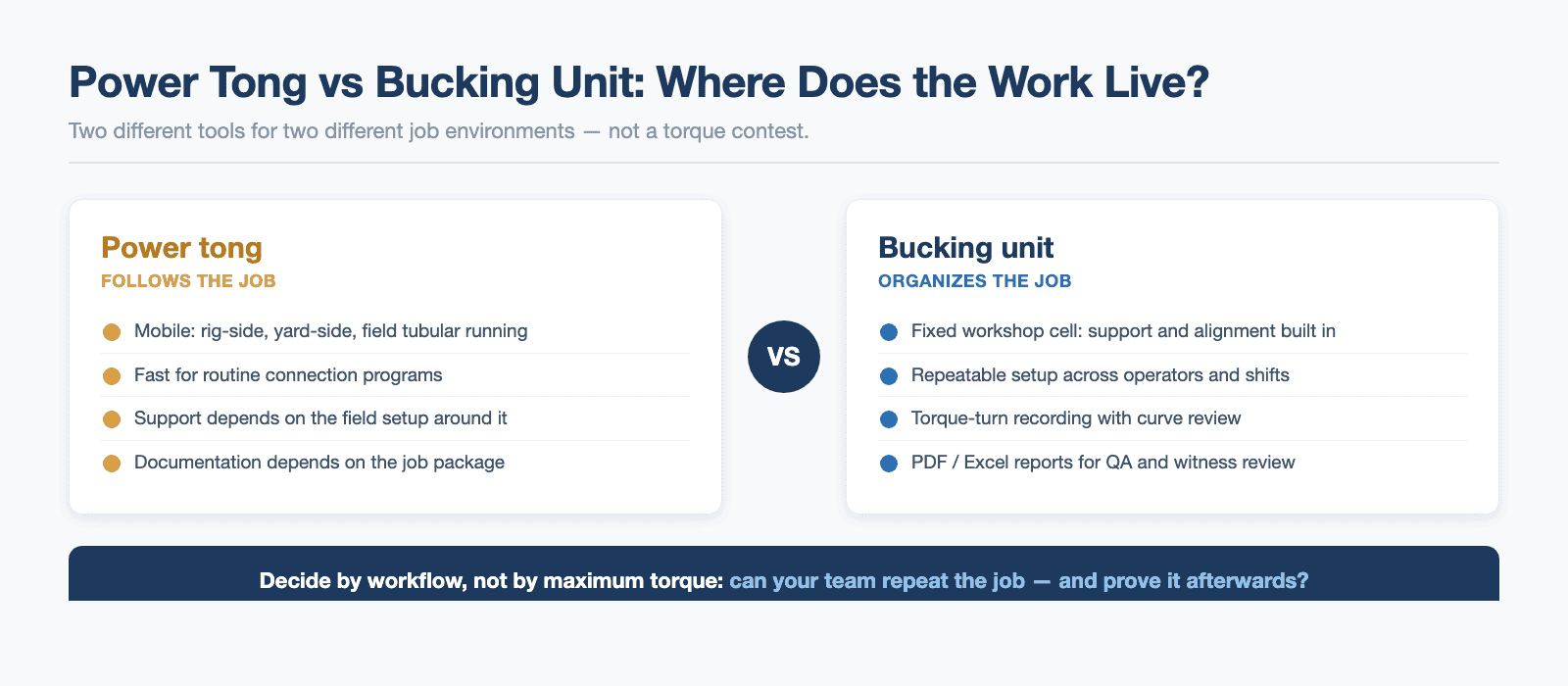
A shop that services downhole tools, rebuilds assemblies or returns certified pipe to an owner is working in the right-hand column. More tong capacity does not solve the missing support, alignment and serial-number record. Those requirements point to a bench machine built for horizontal, recorded make-up.
Questions to answer before choosing a machine
- What is the largest connection you handle, and what is its recommended make-up torque?
- What break-out torque have you actually seen on that connection after a run, not in the catalogue?
- Does anyone ask you for a torque-turn graph per item, and will they start?
- What is the shortest item you have to make up, and is there anything below it to grip?
- What marking limit do your customers accept in writing?
- Is the work vertical at a well, or horizontal on a bench?
- Who calibrates the torque measurement, against what, and how often?
Connection size and break-out torque set the required capacity. Workpiece length, orientation, marking limits and record format determine whether the machine should be a tong or a bench unit. Calibration determines whether the final record can be trusted.
Power tong questions
What is a power tong used for?
Making up and breaking out threaded connections on tubulars at the well, mainly while running casing and tubing or tripping drill pipe. It grips the joint and rotates it while a backup holds the joint below stationary.
What is the difference between a power tong and a backup tong?
The power tong turns the upper joint. The backup clamps the lower joint and stops it turning, so the torque goes into the connection rather than into rotating the whole string. They are a pair, not alternatives.
What is the difference between open-head and closed-head?
An open head lets you rig onto a string already hanging in the hole, which is what casing and tubing running needs. A closed head has to be threaded on from the end of the pipe, so it is used where you can do that, and the continuous ring buys stiffness and torque.
How accurate is power tong torque?
Accurate enough for running pipe, provided the load cell, gauge and tong are the calibrated set and the snub line sits square to the arm. Torque is calculated from a measured tension and a lever arm, so accuracy belongs to the whole rigged system.
How is a power tong sized?
Check the outside diameter range and the torque against the same connection, not the largest of each taken separately. A tong that covers your biggest pipe and, elsewhere in its range, your biggest torque may do neither at the same time.
Can a power tong be used in a workshop?
For long tubulars handled vertically, yes. It becomes awkward for short downhole tools, where there is no joint below to act as a backup and nothing holding the item in alignment, and for work that has to be repeated under controlled conditions against a serial number.
Do power tongs damage pipe?
They mark it, because the dies grip by biting into the surface. Whether that counts as damage depends on the pipe: routine on casing going downhole, and a contractual limit on rental or premium pipe that has to be certified and returned.
Do power tongs record torque per joint?
Many do. Computerised torque-turn units are standard on premium casing running and store or print a chart per joint against the tally number. What they are not built for is reproducing that make-up later, in a controlled setup, against a tool serial number.
For workshop work, start with the largest connection, the shortest workpiece and the record format the customer requires. Those details are enough to check whether a bench machine fits the job and what capacity it needs.
Expert Consultation
Need more information on optimizing your equipment performance? Our engineering team is available for technical consultations.
Request a Quote
Tell us about your requirements and our engineering team will prepare a detailed proposal with specifications, pricing, and delivery timeline.
