
Cylinder Honing and Deep-Hole Boring: How Repair Shops Save a Bore
Honing finishes, boring corrects, and the repair oversize is an engineering limit. The cross-hatch, the repair ladder, and when deep-hole capacity belongs in-house.
Cylinder honing restores the bore that seals a hydraulic cylinder: rotating abrasive stones, stroked along the bore, remove scoring and leave the cross-hatched finish seals need to seat and live. Boring corrects geometry and removes serious damage first; honing finishes. Which bore is repairable, and to what oversize, is an engineering limit — not a judgement call at the machine.
At a glance
| What honing does | Finishes and lightly sizes a bore: removes shallow scoring, restores roundness within its small stock allowance, and leaves the controlled cross-hatch surface that hydraulic seals require |
| What boring does | Single-point cutting that corrects geometry and removes real damage — the roughing partner honing then finishes. Long components need dedicated deep-hole machines |
| Who needs it in-house | Repair shops and service bases that live on cylinder turnaround: hydraulic cylinders, jar seal bores, motor bearing housings, long tool bodies |
| The governing rule | Maximum repair oversize is set by wall thickness, pressure rating and seal availability — approved by engineering, never improvised at the stones |
| Decision this page supports | Judging which bores to repair versus replace, and whether honing and deep-hole capacity belongs in your shop or at a subcontractor |
Why bores fail, and why the surface matters as much as the size
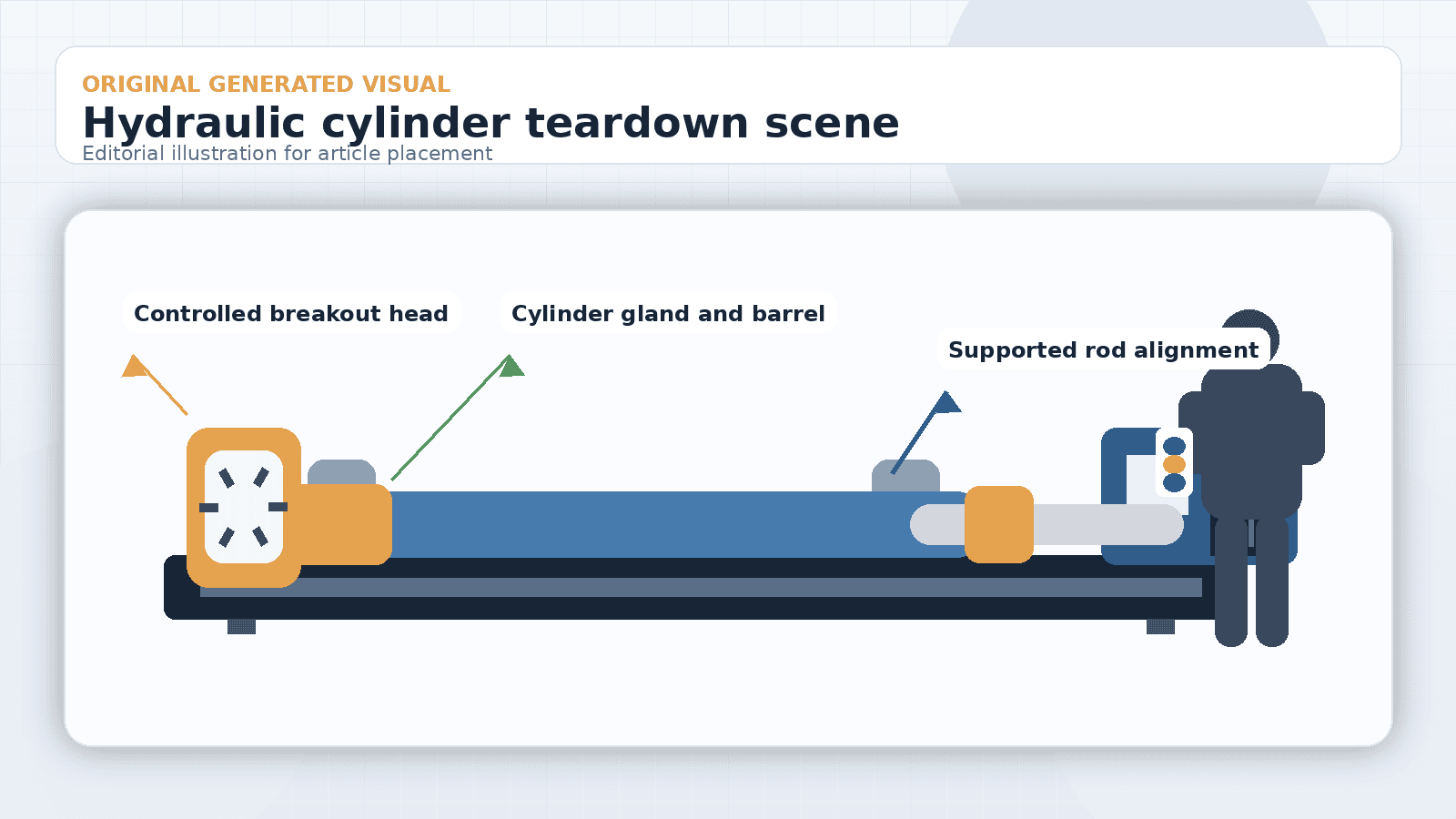
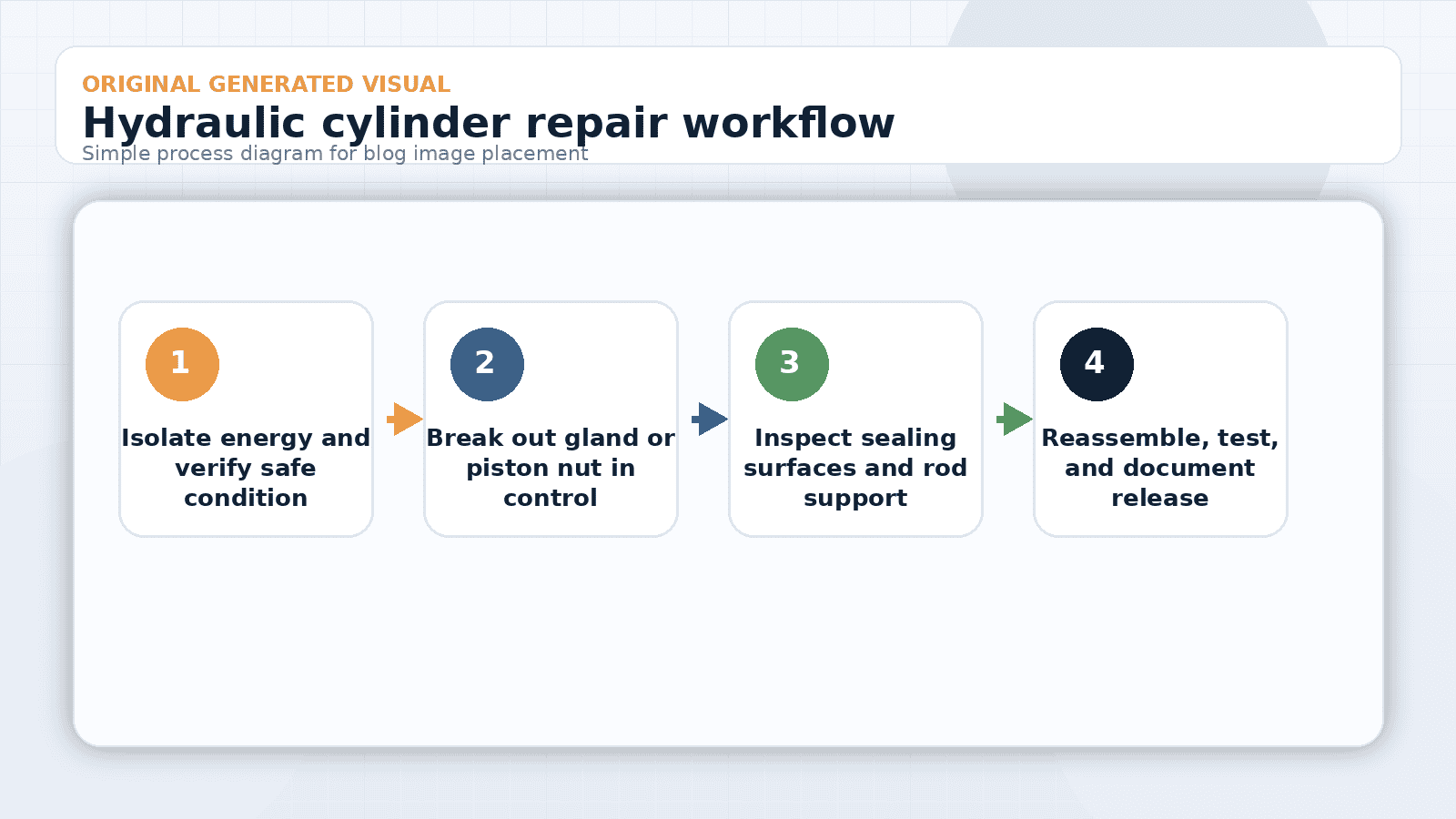
A hydraulic cylinder seals between a moving seal and a machined bore, and the bore is the half nobody sees. Contaminated oil scores it. A failed rod bearing lets the piston ride metal on metal. Water pits it. A cylinder that drifts under load or weeps past the piston usually has a bore problem, and the repair decision starts with reading that bore honestly — which is why a disciplined cylinder teardown comes first, before anyone talks about machining.
Size is only half the specification. A bore can measure perfectly and still eat seals, because seal life depends on surface texture: too rough and the seal abrades; polished smooth and the seal runs dry, overheats and hardens. Honing exists to produce the in-between surface — a controlled cross-hatch, commonly ground at around 30 to 45 degrees, whose valleys hold an oil film while the plateaus carry the seal. The seal manufacturer publishes the finish window for each seal family; the shop’s job is to hit it and prove it, not to guess what looks right under the lamp.
Honing and boring do different jobs — use them in order
| Operation | What it corrects | What it cannot do |
|---|---|---|
| Honing | Surface finish, shallow scoring, small roundness and straightness errors, final size within a light stock allowance | Remove deep damage or correct a bore that was machined off-axis — stones follow the existing hole |
| Boring | Geometry: location, straightness, taper, and bulk stock removal to a repair oversize | Produce a seal-ready surface — a bored bore still needs honing to finish |
| Deep-hole boring | The same, on long length-to-diameter bores where an ordinary machine’s tooling deflects and chips will not clear | Substitute for good measurement: long bores hide taper and drift that only proper gauging reveals |
The sequence matters because honing follows the hole it is given. Stones cutting on a spring-loaded head enlarge and refine the existing bore; they do not decide where it goes. A scored bore inside the repair allowance goes straight to the hone. Damage deeper than the allowance means boring to the next approved oversize, then honing to finish. Damage beyond the last approved oversize means a new tube, and the honest shops say so early — the most expensive bore repair is the one that should have been a replacement two operations ago.
Length changes the machinery, not the logic. A metre-class cylinder hones on a standard machine; long tool bodies, deep housings and slender tubes push into deep-hole territory, where tool support, chip evacuation and coolant delivery become the engineering problem and dedicated deep-hole drilling and boring machines earn their floor space. A shop quoting long-bore repair without that capacity is quoting a subcontract with its own margin on top.
At the machine: what good honing practice looks like
The machine does the stroking; the craft is in the choices around it. Stones are graded like any abrasive — coarser grits to cut scoring out, finer grits to bring the surface into the seal window — and a bore is usually finished in stages rather than asked of one stone. Plateau finishing adds a final light pass that knocks the peaks off the fresh cross-hatch, so the seal beds on carried plateaus from its first stroke instead of wearing the peaks away itself during a noisy run-in.
Three habits separate a bore that lasts from a bore that measures well on day one. The stroke runs the full length, past the ends of seal travel, because a hone that dwells or turns around inside the working length leaves a step or a belled zone exactly where the seal will find it. Coolant flow is generous and filtered, because honing swarf recirculated across the stones scratches the finish it just produced. And the reversal points are set so the cross-hatch stays symmetrical — the angle comes from the ratio of rotation to stroke speed, and it is set deliberately, not inherited from wherever the levers happened to be on the last job.
Then the step everyone underrates: cleaning. A honed bore is full of embedded grit and swarf that a wipe with a rag does not remove, and grit left behind laps the new seals from the moment the cylinder strokes. The bore is washed out properly — brushed with solvent or hot detergent until a clean white cloth comes out clean — before assembly begins. More rebuilt cylinders are killed by their own honing debris than by the scoring that brought them in.
The same station serves more than cylinders in a downhole shop. Jar bodies carry seal bores that are dressed on the identical logic during service, motor bearing housings and accessory subs come through with bores to clean up, and the measurement bench that accepts them is common to all of it. That shared workload is usually what turns the machine from an occasional convenience into a working station.
The repair ladder, and who approves each rung
| Bore condition | Repair route | Who signs it off |
|---|---|---|
| Light scoring, size within limit | Hone to clean up, verify finish and geometry, fit standard seals from in-date stock | The shop, against the OEM’s published bore limit |
| Damage beyond hone-out, wall allows | Bore to an approved oversize, hone to finish, fit matching oversize piston and seals | Engineering: oversize limits come from wall thickness and pressure rating, and the seal maker must actually stock the size |
| Pitting or damage past the last oversize | Replace the tube; recover rod, gland and end fittings as inspection allows | Engineering, with the customer told plainly why |
| Plated or coated bore surfaces | A plating route, not a honing route — cutting through a coating is not a repair | The coating applicator’s process, on engineering instruction |
The thread running through that table is the same rule that governs specifications everywhere in this trade: a capability limit is changed by engineering sign-off, not by inference at the machine. Honing another half millimetre because the stones are already in the bore is how a cylinder gets a bore its wall was never rated to carry. When the limit is not documented, the answer is to get it documented — not to improvise.
Proving the repair: measure, then test
A honed bore is finished when the numbers say so: diameter at several stations along the stroke, roundness and taper within the drawing, and surface finish measured against the seal maker’s window rather than judged by eye. The record of those measurements travels with the job.
Then the assembled component proves itself the same way any serviced tool does — on a bench, before dispatch. A rebuilt cylinder holds test pressure without drift or weep; a jar whose seal bores were dressed goes back to the bench test that verifies its firing values before it returns to the string. Machining without the closing test is half a repair, and the test without a calibrated bench is half a test — the same logic that runs through every certificate a tool service centre issues.
In-house honing or subcontract: the arithmetic
| Factor | Effect to consider | What the team should use for a decision |
|---|---|---|
| Cylinder and bore volume through the shop | Subcontracted machining adds freight both ways and someone else’s queue to every repair | Twelve months of subcontract invoices and the turnaround days lost, against a machine sized for the real bore range |
| Bore length and diameter spread | One vertical hone covers a lot of cylinder work; long slender bores need deep-hole capacity that costs more and runs less often | The actual bore list — diameters, lengths, quantities — before any machine is specified |
| What else the capacity serves | Jar seal bores, motor bearing housings and accessory bores keep a hone busy between cylinder jobs | The full range of bores the service side touches in a year, from the jar service bench to the cylinder bay |
| Skill and measurement | The machine is the visible cost; bore gauges, finish measurement and a trained operator are the real capability | Whether the shop will invest in gauging and training, or the machine will stand as furniture |
Galip supplies workshop machinery in this family — vertical honing machines and deep-hole drilling and boring machines have been quoted alongside our test benches for exactly these repair shops — and the specification always starts from the bore list, not the catalogue. Where volume is small and bores are ordinary, a good machining subcontractor remains the right answer, and the honest quotation says that too.
Frequently asked questions
What is cylinder honing?
A finishing operation in which rotating abrasive stones are stroked along a bore, removing light damage and producing the cross-hatched surface hydraulic seals need. It corrects size, roundness and straightness within a small allowance, and it is the final machining step before a sealing bore is measured and assembled.
What is the cross-hatch pattern for?
The intersecting scratch pattern — commonly ground at around 30 to 45 degrees — holds an oil film in its valleys while its plateaus carry the seal. Too rough a surface abrades seals; a polished bore runs dry and overheats them. The seal manufacturer’s published finish window is the target, not appearance.
When is boring needed instead of honing?
When damage runs deeper than the honing allowance, or the bore’s geometry — straightness, taper, position — is wrong. Boring cuts the bore to an approved oversize and corrects geometry; honing then finishes the surface. Stones follow the hole they are given, so honing alone cannot fix a crooked bore.
How much can a cylinder bore be honed oversize?
Only to the limit engineering approves, set by wall thickness, pressure rating and the availability of matching oversize pistons and seals. There is no universal figure, and honing past the documented limit trades a leak for a wall the cylinder was never rated on. Undocumented limits get documented, not guessed.
Can a plated or coated bore be honed?
Not as a repair. Cutting through a plating or coating exposes the base material and ends the surface’s protection; the repair route for coated bores runs through the coating process itself. Honing belongs to plain machined bores and to final finishing after an approved re-coating.
What is deep-hole boring and when does a shop need it?
Boring long, slender bores where ordinary tooling deflects and chips cannot clear — long cylinder tubes, tool bodies and deep housings. Dedicated machines support the tool and deliver coolant through it. A shop repairing long-bore components without that capacity is subcontracting it, with the margin and delay that implies.
How is a honed bore accepted?
By measurement, then by test: diameter at stations along the bore, roundness and taper against the drawing, surface finish against the seal maker’s window — recorded — and then a pressure or function test of the assembled component on a calibrated bench before dispatch. Looking right under the lamp is not acceptance.
Send the bore list, not the machine model
Honing and deep-hole capacity is specified by the bores it must serve: diameter range and lengths · the components behind them — cylinders, jar bodies, housings · annual volumes · the finish windows your seal families require · measurement equipment already in the shop · whether test benches share the bay. Write to the contact page or sales@galipequipment.com with that list and the reply will be a machine specification against it, with approved figures stated rather than assumed.
Honing is the middle of a repair, not the start of one. The cylinder has to come apart first, and gland nuts and end caps seized by years of service are where shops lose threads and knuckles — which is why service bases pair the honing bay with a hydraulic breakout unit that breaks those connections under controlled torque instead of heat and cheater bars.
Before the stones touch the bore: the checklist
- Teardown and inspection complete, with the bore’s damage mapped and measured — not summarised as “scored”.
- OEM bore limit and approved oversize steps on paper before any metal is removed.
- Hone-or-bore decision made from measured depth of damage against the honing allowance.
- Oversize route confirmed against seal and piston availability before machining, not after.
- Plated bores routed to the coating process, never honed through.
- Finish window taken from the seal manufacturer’s data for the seals actually being fitted.
- Bore measured at stations along the stroke — diameter, roundness, taper — and recorded with the job.
- Cross-hatch verified against the window, not judged by eye.
- Assembled component pressure- or function-tested on a calibrated bench before dispatch.
- The whole file — measurements, limits, sign-offs, test — kept under the component’s serial number.
Expert Consultation
Need more information on optimizing your equipment performance? Our engineering team is available for technical consultations.
Request a Quote
Tell us about your requirements and our engineering team will prepare a detailed proposal with specifications, pricing, and delivery timeline.
