
Hydraulic Cylinder Teardown Guide: Safer Break-Out and Repair Checks
Hydraulic cylinder teardown guide for repair shops covering controlled breakout, gland removal, rod support, and safer disassembly.
By Galip Equipment Editorial Team, reviewed by Jason Wang.
Hydraulic cylinder teardown goes better when the bench is treated as a controlled process, not a strength contest. Before a gland, nut, or threaded end cap is forced loose, the repair team should think through clamping, thread condition, tool support, and the way torque will be applied.
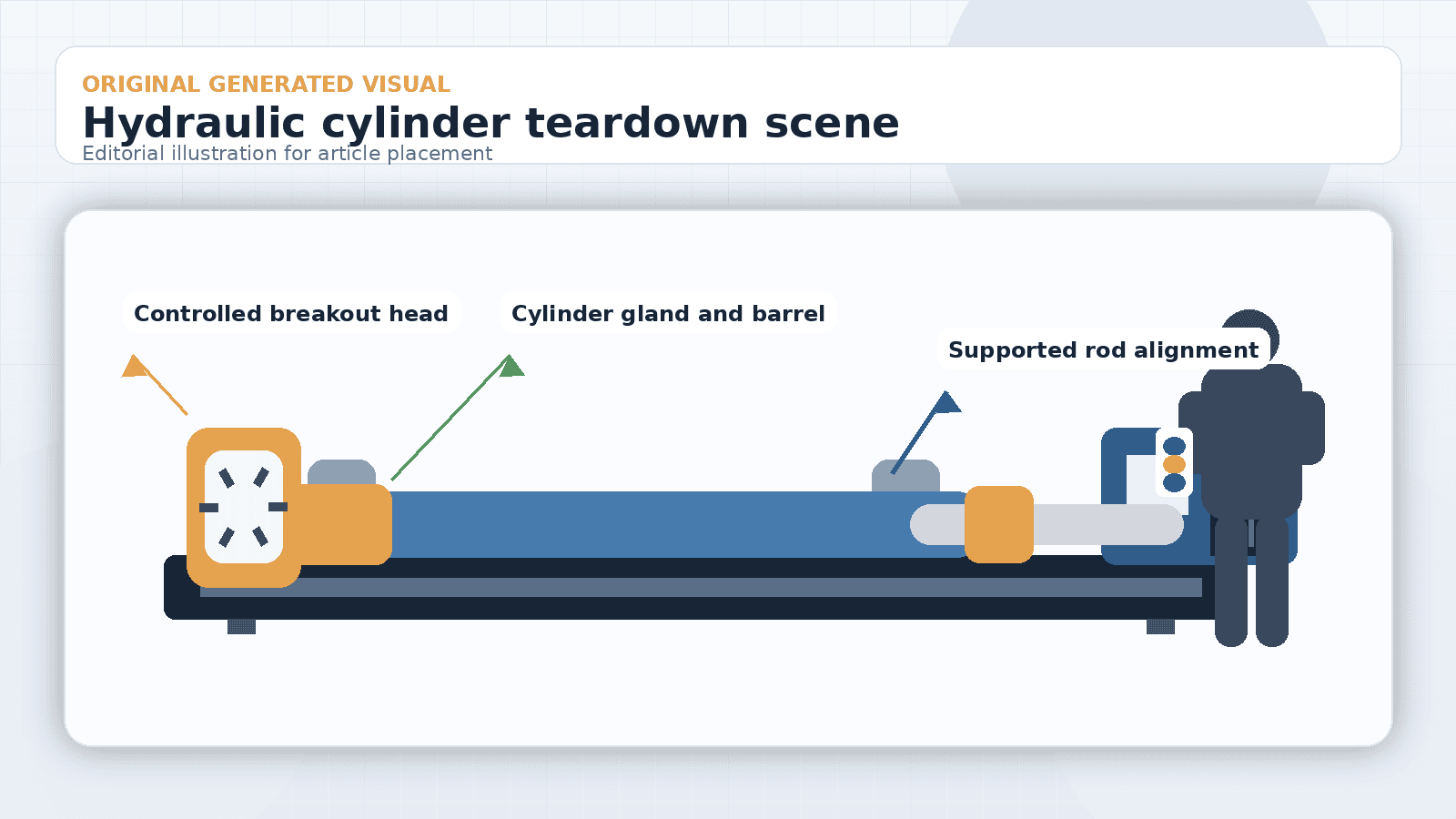
Table of contents
[rank_math_toc]
Hydraulic cylinder repair bench priorities that reduce teardown damage
- Use a hydraulic cylinder repair bench to control the reaction path before seized glands, piston nuts, or rod assemblies become a damage-control job.
- Support the rod and gripping points so chrome, seal surfaces, and barrel geometry stay protected throughout breakout and reassembly.
- Treat energy isolation, cleaning, and design identification as part of the repair method, not as paperwork before the real work starts.
- Standardize fixturing across common cylinder families so technicians stop reinventing the holding method from memory on every odd job.
- Compare equipment by the specific teardown failures you want to stop: gland damage, rod scoring, operator risk, or recurring delays on stubborn cylinders.
hydraulic cylinder repair bench in practice
hydraulic cylinder repair bench becomes much easier to evaluate when the shop names the real failure points, uses a controlled process, and records what better handling should prevent the next time the job returns.
Hydraulic cylinders are funny pieces of equipment. On paper, they look simple: a tube, a rod, a piston, a gland, seals, and a couple of threaded components that come apart and go back together. In the shop, they can turn into one of the most frustrating repair jobs on the floor.
Anyone who has spent time around heavy cylinders knows the pattern. The unit comes in leaking, slow, scored, or bypassing internally. The outside is dirty, maybe painted over three times, and the end cap has not moved since the last overhaul years ago.
Somebody says, “We’ll just crack it loose.” Then the real job begins. A pipe wrench slips. A chain bites into the OD. The rod is not supported well enough. The gland finally moves, but not cleanly.
What should have been a repair job quietly becomes a damage-control job.
That is why this topic deserves its own article. Hydraulic cylinder work is adjacent to bucking-unit logic even though it is not the same market language. The shared issue is not “pipe.” The shared issue is controlled make-up and controlled breakout of expensive threaded assemblies.
When the part value is high, the sealing surfaces matter, and the cost of a mistake follows the part back into service, rough methods stop being acceptable.
This article is written for repair-shop owners, service managers, maintenance supervisors, and buyers who are asking a practical question: when does hydraulic cylinder teardown need more than a vise, a wrench, and shop muscle? The short answer is when the cost of secondary damage, safety risk, and lost turnaround time becomes bigger than the cost of proper control.
Why cylinder teardown goes wrong more often than shops admit
Cylinder work fools people because the assembly looks familiar. Many technicians have broken out threaded parts their whole careers. That experience is valuable, but it can also create false confidence.
A hydraulic cylinder is not just a stubborn threaded component. It is a threaded component wrapped around sealing surfaces, chrome-finished rod surfaces, bearing interfaces, and parts that often need to be reused.
That changes the standard.
The most common shop mistake is to treat breakout force as the only problem. In reality, breakout force is only one part of the job. The real problem is how that force is introduced.
If reaction control is sloppy, the gland can distort. If the rod is unsupported, the chrome can be marked or bent under side load. If the part is braced with improvised fixtures, the cylinder tube can be scarred or ovalized.
If the tool bites into the wrong location, the cosmetic damage may look minor but the customer notices it immediately when the rebuilt cylinder comes back looking worse than it arrived.
There is also a big difference between a shop that does occasional cylinder work and a shop that lives on it. In low-volume environments, rough methods can survive longer than they should because the damage seems isolated.
In higher-volume repair shops, the same habits show up as recurring delays, extra polishing, unnecessary part replacement, seal rework, and callbacks that eat margin. The work feels normal because everyone is busy.
The cost hides in labor drift and reputation.
Another issue is variety. Not all cylinders come apart the same way. Some use threaded glands with spanner holes. Some have large locknuts. Some are peened, pinned, or contaminated with corrosion, paint, hardened residue, or old threadlocker. What that oil is carrying is its own subject — hydraulic oil cleanliness decides how soon the next teardown comes.
Some are thin-walled enough that careless holding methods create their own problem. A system that works on one cylinder family can be completely wrong on another. That is why the best teardown shops think in terms of process control and fixturing, not just force.
What safe breakout really starts with
Before anyone touches a wrench, the safe part of the job has to be real, not ceremonial. Residual hydraulic energy must be isolated. Accumulators, trapped pressure, mechanical load, and gravity have to be considered.
On heavy mobile-equipment cylinders, that is not a box-checking exercise; it is the difference between a planned repair and a bad incident.
Good shops also inspect before they force anything. They confirm the cylinder design, look for lock screws, staking, pinning, paint bridges, deformation, and evidence of previous damage.
They identify where gripping is acceptable and where it is not. They think about rod support before breakout, not after the rod starts moving. They decide whether the first job is truly “opening the cylinder” or whether the first job is cleaning, unstaking, warming, and exposing the connection properly.
That step is often where experienced shops separate themselves from impatient ones. The impatient shop says, “Let’s see if it moves.” The experienced shop says, “What is keeping it from moving, and what will we damage if we force the wrong interface?” That second question saves money.
Even when the cylinder is safe to work on, a poor reaction path can still make the job unsafe for the operator. High breakout torque and awkward body position are a bad combination.
Manual cheater bars, chain arrangements, and improvised leverage are exactly the kind of method that feels normal right up until it slips. Once a shop reaches a certain cylinder size, frequency, or stubbornness level, safety and quality stop being separate conversations.
They become the same conversation.
What a controlled breakout bench changes in real life
A proper repair bench or controlled breakout station changes the work in a way that is easy to describe and hard to overstate: it turns a wrestling match into a process.
First, it gives the shop a stable way to hold the cylinder without treating the barrel like scrap. That matters because the holding method is often the hidden source of secondary damage. And once the barrel is open, the bore’s future is decided by machining, not by hope — honing and deep-hole boring pick the repair up from there.
Chain vises, shaped holders, fixture sets, reaction arms, and purpose-built clamping systems all serve the same goal: let the connection move without letting the whole assembly twist wherever it wants.
Second, it gives the job a predictable reaction path. That phrase sounds technical, but the floor-level meaning is simple. The force goes where you expect it to go. The operator does not have to “absorb” the torque with body weight or improvisation.
The rod does not become the unintended lever arm. The gland is not shocked loose in a way that leaves everyone hoping the threads survived.
Third, it supports alignment. In cylinder work, alignment is not glamorous, but it is expensive when neglected. A supported rod is easier to inspect, easier to withdraw cleanly, and easier to reinstall without nicking the seals or scraping the ID.
If a shop routinely works on long or heavy rod assemblies, support is not a convenience feature. It is part of the quality system.
Fourth, it improves repeatability. This is the piece buyers often underestimate. A repair bench is not just for the hardest jobs. Its value compounds when the shop handles similar work week after week.
The same bench, same fixture family, same breakout logic, same reassembly workflow, and same testing handoff make the entire operation more predictable. That shows up in labor planning, technician confidence, and customer trust.
Finally, a controlled station makes it easier to document what happened. In a shop that wants to move upscale, this is where the commercial case gets stronger. When a technician can record the condition found, the method used, the parts changed, the test result, and any exception during teardown or assembly, the shop starts acting less like a general repair bay and more like a reliable service provider.
The parts of the job that deserve support, not heroics
There are a few places in hydraulic cylinder teardown where support equipment earns its keep immediately.
The first is gland breakout on large cylinders that have not been serviced in years. This is where manual methods become least honest. A shop can occasionally get the cap loose by force, but that is not the same thing as having a sound method. Seized glands reward control, not bravado.
The second is piston-nut work. Large piston nuts can require substantial torque, and the cost of slipping on the part can be ugly. Once the job involves repeat service on heavy cylinders, the right fixturing and reaction setup usually pay for themselves faster than shops expect.
The third is rod extraction and reassembly. Anyone who has watched a heavy rod transition from “almost supported” to “why did we let it do that?” knows this stage deserves more planning. Good benches keep the rod and barrel in a relationship that stays manageable as the assembly moves.
The fourth is mixed work. Many repair shops do not only rebuild one cylinder family. They handle mobile-equipment cylinders, hydraulic presses, industrial actuators, marine cylinders, and custom assemblies.
The more variation a shop sees, the more important it becomes to build a disciplined fixture and support system rather than relying on the memory of whichever technician handled the last unusual job.
This is one reason adjacent traffic content can work well for Galip. The same buyer who searches for a bucking unit is often also thinking about other controlled make/break problems in the shop.
Cylinder service is one of those problems. It lives right next to the BU conversation even if the search terms look different.
Where a bucking-style unit fits — and where it does not
Here is the honest version, because this is where a lot of marketing content gets slippery: not every hydraulic cylinder repair job needs a bucking unit.
If the shop mainly handles smaller cylinders, low volume, and standard service work, a dedicated cylinder repair bench or purpose-built breakout arrangement is usually the better fit. It is more direct, more economical, and more tuned to the way cylinders are actually handled.
But the underlying logic of a bucking unit absolutely matters here. A bucking-style system becomes relevant when the shop is dealing with larger threaded assemblies, wants better torque control during reassembly, needs more stable reaction control, or wants a more formal make/break process around expensive components.
That is especially true in repair environments that also touch downhole tools, drill motors, jars, or other heavy threaded equipment. In those shops, the question is not “cylinder bench or bucking unit forever?” The question is which controlled system should sit at the center of the service workflow.
This is why a small section about the Bucking Unit belongs in an article like this. The bucking unit is not the keyword target, and it should not be forced into the opening paragraphs.
But it is a natural next-step link for buyers who are outgrowing manual teardown habits and are beginning to think in terms of control, traceability, and repeatable workshop output rather than isolated repair tricks.
A smarter workflow for hydraulic repair shops
The best cylinder shops usually follow a repair rhythm that looks boring on the surface and profitable underneath.
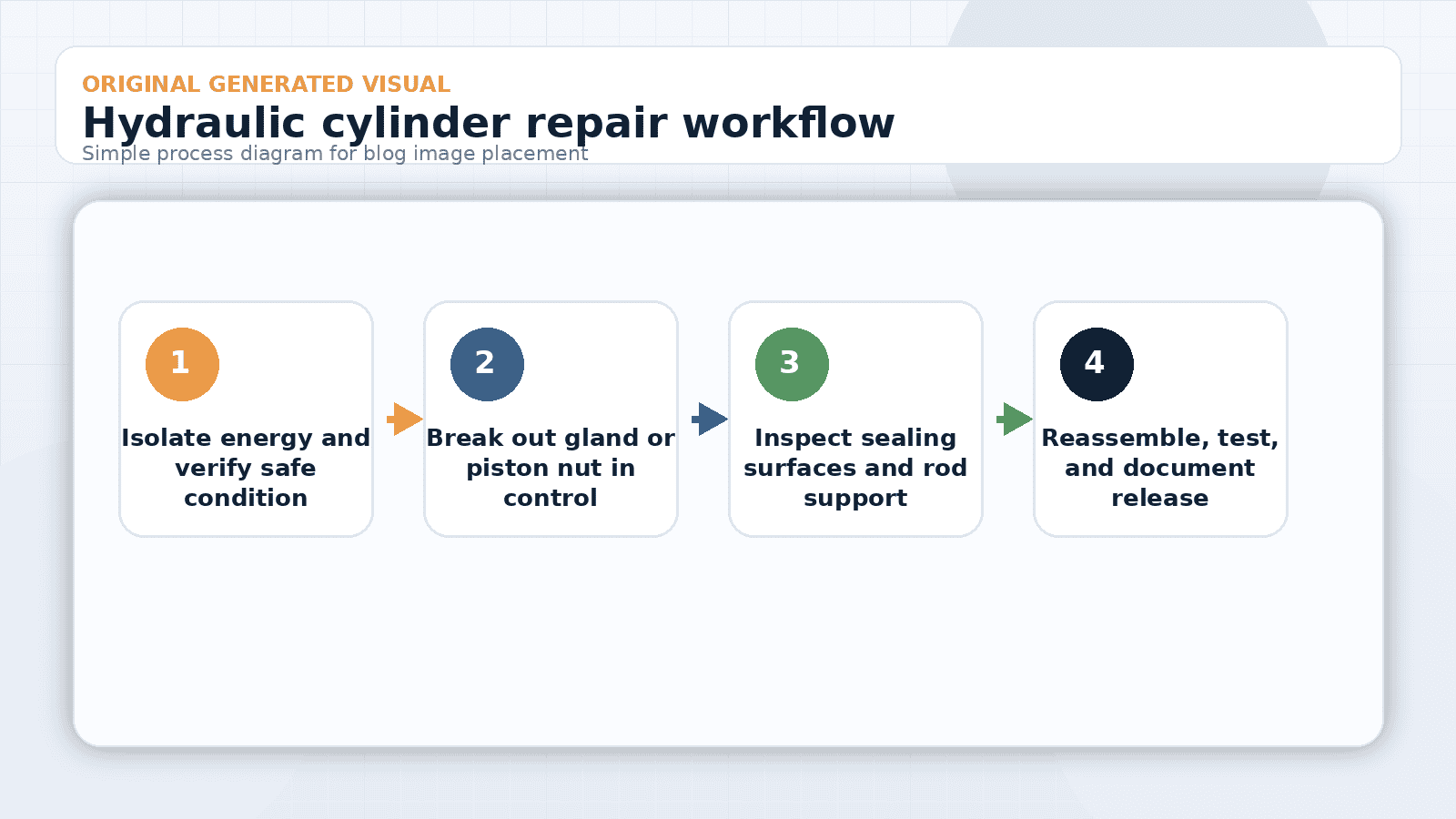
They receive the cylinder and identify the design before teardown. They isolate energy and verify safe condition. They clean and expose the threaded interfaces. They select the right holding method and support points.
They break out the assembly in control rather than by shock. They inspect the rod, barrel, threads, wear points, and sealing areas before ordering parts blindly. They reassemble with the same level of discipline, not with less.
Then they test and document before release.
None of that is exotic. The value comes from doing it the same way on purpose.
This is also where turnaround time improves. People sometimes assume more control means slower work. Usually the opposite is true once the shop gets organized. Manual improvisation can be fast on the easiest 10 percent of jobs.
On the other 90 percent, it wastes time through repositioning, slip events, secondary cleanup, part chasing, and technician fatigue. Controlled workflow feels slower only if you are comparing it to the memory of one lucky teardown, not to the average of a month’s real jobs.
If you want the article to convert well, this section is where readers should start imagining their own shop. They should see the bench they already have, the damaged glands they keep fighting, the rod handling they know is not ideal, and the hours lost every time a “simple” cylinder becomes a stubborn one.
That is how the article earns traffic and commercial relevance at the same time.
What buyers should compare before they buy
Buyers evaluating equipment for this kind of work should ask better questions than “How much torque does it make?”
Start with the cylinder range you actually see. What barrel diameters, rod weights, gland styles, and piston-nut sizes are common in your shop? How often do you deal with seized or corroded assemblies? What percentage of your work is repeatable versus one-off?
Then ask about control and support. How is the cylinder held? How is the rod supported? How easy is it to adapt the setup across different designs? How much of the operator’s success still depends on personal technique rather than machine logic?
After that, ask about workflow. Does the equipment support both disassembly and reassembly? Can it integrate with your test routine? Can technicians use it consistently across shifts? If the shop wants to grow into more documented, higher-value service work, can the process evolve without rebuilding the whole bay?
Finally, ask the most practical question of all: what damage or delay are we trying to stop? Buyers often waste time shopping by machine category instead of by pain point. If your pain point is rod scoring, say that.
If it is ugly gland damage, say that. If it is technician safety, say that. If it is long turnaround on seized cylinders, say that. Once the real problem is named, the right equipment discussion gets easier.
Conclusion
Hydraulic cylinder teardown should not be treated like a strength contest that the shop occasionally wins. It should be treated like controlled service work on expensive components that need to leave the shop in better shape than they arrived.
That is the reason this topic can attract the right traffic for Galip. It reaches people who may not start with the phrase “bucking unit” but who are already living with the same operational problem: valuable threaded assemblies being handled too casually.
The article solves a real reader problem first, then lets the GALIP hydraulic bucking unit and Breakout Unit enter naturally as the next conversation for shops that want more control.
In other words, the article is useful even if the reader never buys. That is exactly why it has a chance to rank, build trust, and bring in the kind of inquiry that is worth answering.
Related Galip resources
External references
- OSHA lockout/tagout guidance for hydraulic systems
- Parker hydraulic cylinder service and maintenance manuals
Frequently asked questions about hydraulic cylinder repair bench workflows
When does a hydraulic cylinder repair bench become worth the investment?
It usually makes sense once large or stubborn cylinders are creating enough secondary damage, rework, or operator risk that manual breakout methods are no longer predictable.
What does a controlled hydraulic cylinder repair bench improve first?
The first gains usually show up in safer breakout, cleaner gripping, better rod support, and fewer avoidable marks on glands, rods, and barrel surfaces.
Is a bucking unit the same thing as a hydraulic cylinder repair bench?
No. A dedicated cylinder repair bench is usually the better fit for routine cylinder teardown, while a bucking-style platform becomes relevant when a shop needs higher-control make and break handling across broader heavy threaded work.
If your team is comparing a controlled breakout workflow against rough manual teardown, you can send Galip your cylinder range and service pain points for a more practical equipment discussion.
Keyword recap: hydraulic cylinder repair bench
hydraulic cylinder repair bench is ultimately a shop-control question: how the assembly is identified, supported, opened, inspected, and returned to service without creating extra damage on the way.
hydraulic cylinder repair bench checklist
- Keep hydraulic cylinder repair bench tied to the actual failure pattern the shop is trying to stop.
- Document the support method, breakout method, and inspection findings in the same workflow.
- Use internal references and external standards so buyers can compare process control instead of guessing.
- Make the release decision defensible to operators, supervisors, and customer reviewers.
Why hydraulic cylinder repair bench matters for buyers
Buyers searching hydraulic cylinder repair bench are usually trying to stop recurring loss, not just compare a machine specification. That is why process control, equipment fit, documentation, and operator safety all need to appear in the same article.
When hydraulic cylinder repair bench stays connected to the exact parts, fixtures, and release decisions on the floor, the content becomes more useful for ranking and more believable for a technical reader.
hydraulic cylinder repair bench FAQ recap
A strong hydraulic cylinder repair bench workflow is the one technicians can repeat safely, supervisors can audit, and customers can understand after the job is already complete.
Expert Consultation
Need more information on optimizing your equipment performance? Our engineering team is available for technical consultations.
Request a Quote
Tell us about your requirements and our engineering team will prepare a detailed proposal with specifications, pricing, and delivery timeline.
