
Tricone Bit Types: What the IADC Code Tells You Before You Order
Read any tricone bit’s IADC code in four parts, match it to the interval, and use the dull grade so the next order corrects the last. Full code tables included.
A tricone bit’s IADC code has four parts. The first digit gives the cutting structure and the rock it is built for: 1 to 3 are milled tooth, 4 to 8 are tungsten carbide insert. The second narrows the formation within that series. The third sets the bearing and gauge protection. The fourth, a letter, marks optional features.
At a glance
| What the code is | The IADC roller cone classification: three digits and an optional letter, stamped or quoted against every tricone bit, that let you compare one manufacturer’s bit with another’s |
| What it encodes | Cutter type and formation hardness (digit 1), formation subdivision (digit 2), bearing and gauge protection (digit 3), optional features (letter) |
| What it does not encode | Hydraulics, nozzle sizing, steel and carbide grades, seal design, or run life. Two bits sharing a code are comparable, not equivalent |
| The expensive digit | The third. Bearing choice governs how long the bit stays in the hole, and an open-bearing bit in a deep sealed-bearing application is the most costly ordering mistake in this category |
| Decision this page supports | Reading a quoted code before you order, and reading the dull grade after you pull so the next order is better than the last |
Why the code exists at all
Every bit manufacturer names its own products, and no two naming systems agree. One supplier’s premium hard-formation insert bit is another’s mid-range. The International Association of Drilling Contractors classification exists to cut across that: it describes what the bit is in terms every drilling contractor can check, independent of the brochure on top of it.
The code is a comparison tool and nothing more. It will tell you that two bits are built for similar rock with similar bearings. It will not tell you which one lasts longer, because that comes down to metallurgy, seal design and manufacturing consistency that no three-digit code captures. Treat it as the first filter, not the decision.
The four parts, in order
| Position | What it encodes | Range |
|---|---|---|
| First digit | Cutting structure type and the broad formation class it is designed for | 1–3 milled tooth, 4–8 tungsten carbide insert |
| Second digit | Formation hardness subdivision inside that series, softest to hardest | 1–4 |
| Third digit | Bearing type and whether the gauge row carries extra protection | 1–9 |
| Fourth character | Optional feature designation, added only where a feature applies | A single letter, or nothing |
A bit quoted as 517 is a series 5 cutting structure, type 1 within that series, on a sealed friction bearing with gauge protection. A bit quoted as 136 is a milled tooth built for hard abrasive rock on a sealed friction bearing. Once the pattern is familiar, a price list stops being a list of names and becomes a list of specifications.
First digit: what the cutters are made of, and what they are for
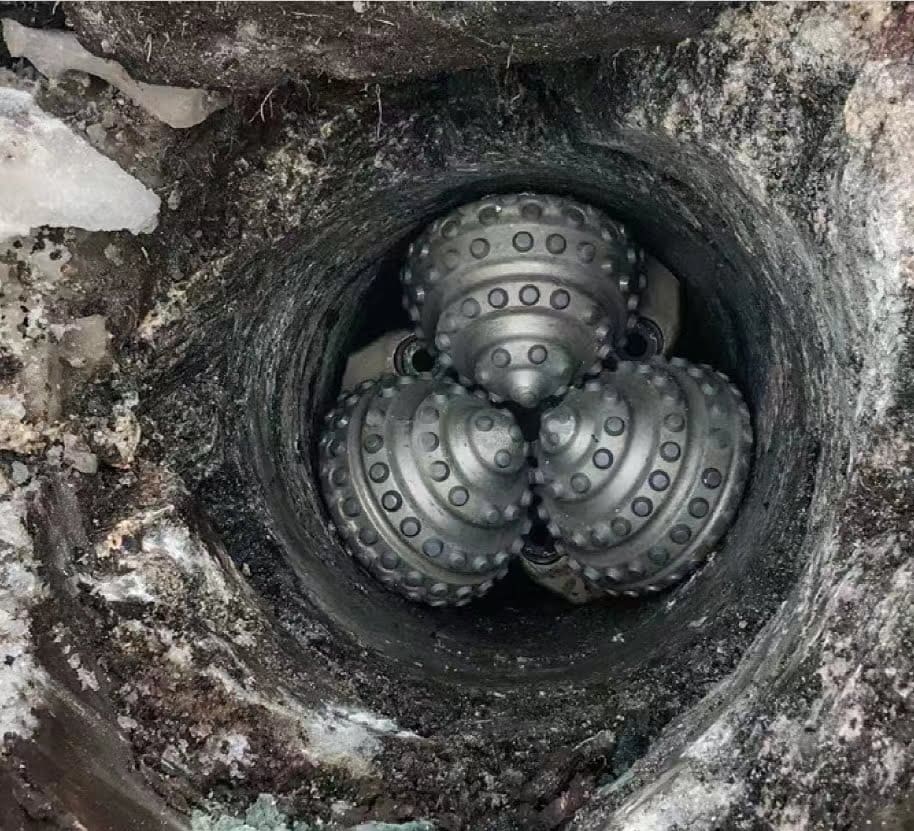
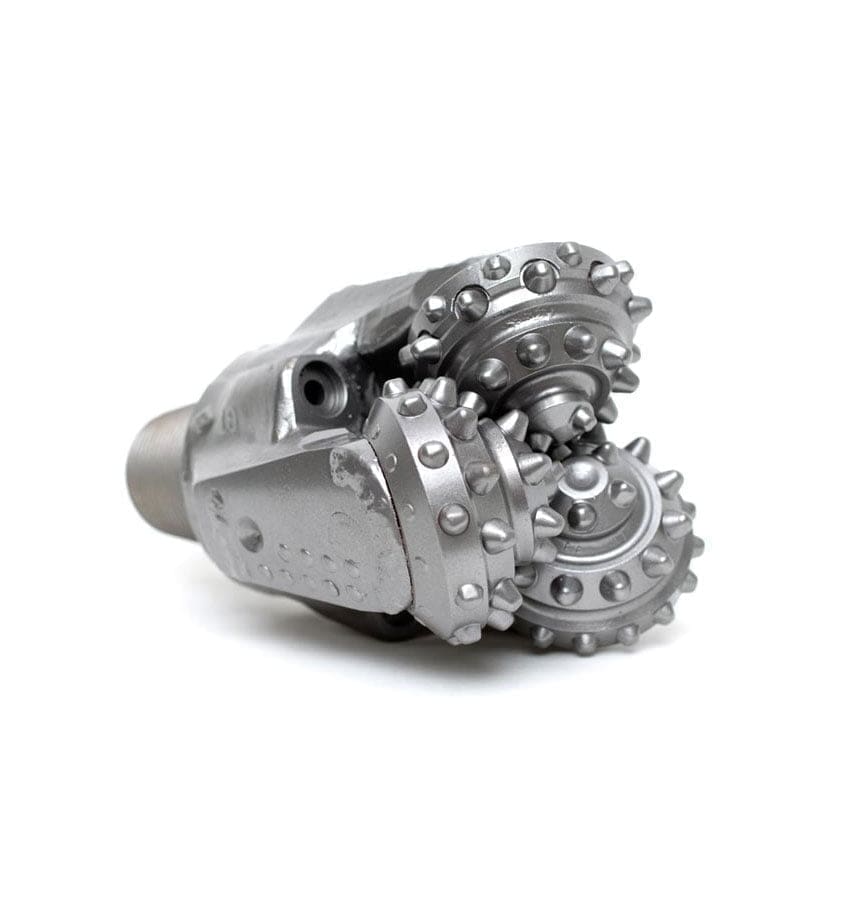
This is the digit that does the most work, because it settles two things at once. Below 4, the bit has steel teeth milled into the cone. From 4 up, it carries tungsten carbide inserts pressed into the cone body. That is a manufacturing difference with real consequences: milled teeth are cheaper and cut aggressively in soft rock, inserts survive abrasion that would round steel teeth off in hours.
| Series | Cutting structure | Formation it is built for |
|---|---|---|
| 1 | Milled tooth | Soft formations, low compressive strength, high drillability |
| 2 | Milled tooth | Medium to medium-hard formations with high compressive strength |
| 3 | Milled tooth | Hard, semi-abrasive and abrasive formations |
| 4 | Tungsten carbide insert | Soft formations, low compressive strength, high drillability |
| 5 | Tungsten carbide insert | Soft to medium formations with low compressive strength |
| 6 | Tungsten carbide insert | Medium-hard formations with high compressive strength |
| 7 | Tungsten carbide insert | Hard, semi-abrasive and abrasive formations |
| 8 | Tungsten carbide insert | Extremely hard and abrasive formations |
Note that the two families overlap in the middle. A series 3 milled tooth and a series 6 insert bit are both offered for hard rock, and both will drill it. The insert bit will normally stay sharper for longer and cost more up front. Which one wins depends on how much of your cost sits in trips rather than in bits, and that is a rig-day arithmetic question rather than a bit question.
Second digit: where inside the series the bit sits
The second digit runs 1 to 4 and subdivides each series from softest to hardest. It is relative, not absolute. A 4-1 is the softest bit in the soft insert series; a 4-4 is the hardest bit in that same soft series, and it is still softer in intent than a 6-1.
Buyers get caught here more often than anywhere else in the code. Reading the second digit as an absolute hardness scale produces the wrong order roughly half the time, because a 3-4 and a 7-1 are not neighbours despite the digits looking close. Read the series first, always, and the type second.
Third digit: the bearing, and the money
Bearing choice decides how long the bit can stay on bottom, which decides how many trips the interval costs. It is also where the price steps are largest. There are three families inside the nine values: open roller bearings that let drilling fluid through, sealed roller bearings, and sealed friction or journal bearings. Gauge protection is layered on top of each.
| Digit | Bearing and gauge design | Where it belongs |
|---|---|---|
| 1 | Non-sealed roller bearing | Shallow, short runs, or where bit cost dominates and trips are cheap |
| 2 | Roller bearing, air cooled | Air, mist and foam drilling |
| 3 | Roller bearing, gauge protected | Abrasive intervals where hole size matters more than bearing life |
| 4 | Sealed roller bearing | General oilfield work where the bit must survive a full interval |
| 5 | Sealed roller bearing, gauge protected | The same, in abrasive rock |
| 6 | Sealed friction (journal) bearing | Long runs, higher loads, deeper holes |
| 7 | Sealed friction bearing, gauge protected | Long runs in abrasive rock. The most common premium specification |
| 8 | Directional | Directional applications |
| 9 | Other or special application | Anything the manufacturer classes outside the list above |
Two practical readings follow. Any value of 4 or above is sealed, so a quotation offering a 1, 2 or 3 for a deep hole deserves a direct question about expected bearing hours. And the odd numbers from 3 upward carry gauge protection, which is what keeps the hole to size in abrasive rock. Losing gauge is not a bit problem that stays a bit problem: the next bit has to ream before it can drill, and that time comes out of the same rig day.
The fourth character: features, not marketing
The letter is optional and is only added where a feature genuinely applies. It is the part of the code most often dropped from a quotation, which is a shame, because two of the letters change how the bit should be run.
| Letter | Feature | Letter | Feature |
|---|---|---|---|
| A | Air application | L | Lug pads |
| B | Special bearing seal | M | Motor application |
| C | Center jet | S | Standard steel tooth model |
| D | Deviation control | T | Two-cone bit |
| E | Extended nozzle | W | Enhanced cutting structure |
| G | Additional gauge or body protection | X | Chisel tooth insert |
| H | Horizontal or steering application | Y | Conical tooth insert |
| J | Jet deflection | Z | Other insert shape |
M is the one worth checking on every order that involves a downhole motor. A bit built for motor application is designed around the speed and loading a drilling motor imposes, which is a different duty cycle from rotary drilling. H matters for the same reason in steering work. The rest are useful description; those two are specification.
Reading three codes side by side
| Code | What it says | What to check before ordering it |
|---|---|---|
| 117 | Milled tooth, softest type, sealed friction bearing with gauge protection | A soft-formation cutting structure on a premium bearing. Sensible for a long soft interval; wasteful if the interval is short |
| 537 | Insert bit for soft to medium rock, hardest type in that series, sealed friction bearing with gauge protection | The workhorse specification. Confirm the insert shape letter if steering or motor work is planned |
| 731 | Insert bit for hard abrasive rock, softest type in that series, roller bearing with gauge protection but no seal | The mismatch to question. Hard abrasive rock usually means a long run, and an unsealed bearing is at odds with that |
The third row is the pattern to watch for in real quotations. The cutting structure and the bearing should be telling the same story about how long the bit is expected to stay on bottom. When they disagree, something has been substituted, and it is usually the bearing.
What the code does not tell you
The classification stops well short of a specification, and the gaps are not small.
| Not in the code | Why it matters | What to ask for instead |
|---|---|---|
| Hydraulics and nozzle sizing | A correctly classified bit with the wrong nozzles will not clean the hole, and cuttings that are not evacuated get re-drilled | Nozzle sizes offered, total flow area, and the flow rate the bit is designed around. The same logic covers nozzle sizing on a mud motor |
| Steel, carbide and seal grades | This is most of the difference in run life between two bits carrying the same code | Insert grade designation, seal type, and whether the bearing is pressure compensated |
| Recommended operating window | Weight on bit and rotary speed limits are set by the manufacturer, not by the code | The published WOB and RPM range for the specific bit, in writing |
| Connection and gauge dimensions | Pin size and bit diameter have to match the string and the hole programme | API connection, bit diameter, and gauge tolerance as supplied |
| Actual run history | The code describes design intent, not field results | Offset run data for a comparable interval, if the supplier has it |
Weight on bit deserves particular attention, because the drill string has to be able to deliver it without putting the wrong components in compression. That is a drill collar sizing question and it is settled at bottom hole assembly design stage, not when the bit arrives.
When a tricone is the wrong bit
There is no honest universal answer to roller cone against fixed cutter, and anyone offering one is selling something. The comparison turns on the rock, the footage and what happens when a bit fails.
A fixed cutter bit has no bearings and no moving parts, so nothing can be left in the hole when it wears out. In long homogeneous intervals that a PDC can shear cleanly, it will normally out-drill a tricone by a wide margin. That is why so much soft and medium-soft footage moved away from roller cones.
The tricone keeps its place where that argument breaks down. Interbedded formations with hard stringers, chert, conglomerate and rubble punish fixed cutters. Air and hammer applications, water well and mining work, and holes where the cost of a lost cutter is tolerable but the cost of a stuck PDC is not, all still favour a roller cone. So does budget: for a short interval, a milled tooth bit on an open bearing is a fraction of the price of anything with a polycrystalline face. State the interval honestly and the choice usually makes itself.
After the run: what the dull bit is telling you
The IADC dull grading system is the other half of this, and it is the half most buyers never use. It records the condition of a pulled bit in eight positions, and it exists so that the next order is an informed one rather than a repeat.
| Position | What it records | Scale |
|---|---|---|
| 1. Inner cutting structure | Wear on the inner two thirds of the bit face | 0 (no wear) to 8 (no usable cutting structure left) |
| 2. Outer cutting structure | Wear on the outer third, including the gauge row | 0 to 8, same scale |
| 3. Dull characteristic | The main thing that went wrong, as a two-letter code | BT broken teeth, WT worn teeth, LT lost teeth, CT chipped teeth, LC lost cone, RG rounded gauge, ER erosion, HC heat checking, BU balled up, PN plugged nozzle, and others |
| 4. Location | Where on the bit that characteristic appears | N nose, M middle, G gauge, A all rows, with the cone number where relevant |
| 5. Bearings and seals | Bearing condition | E seals effective or F seals failed on a sealed bearing; a 0 to 8 scale of bearing life used on a non-sealed bearing |
| 6. Gauge | Whether the bit came out to size | I for in gauge, otherwise the amount undergauge in sixteenths of an inch |
| 7. Other dull characteristic | The second most significant condition | Same two-letter codes as position 3 |
| 8. Reason pulled | Why the run ended | TD total depth, PR penetration rate, HR hours on bit, TQ torque, FM formation change, DMF downhole motor failure, and others |
The value is in the pattern, not the individual grade. A bit that consistently comes back with a rounded gauge in the same interval is asking for gauge protection, which means moving to an odd third digit. Broken and chipped teeth in a soft-formation bit usually means the cutting structure is too soft for what is actually down there, and the first digit needs to move up. Failed seals well before the expected hours point at the bearing specification or at the operating parameters, and those are two different conversations with two different people.
| Dull observation | Possible contributing factors | What to verify first |
|---|---|---|
| Rounded gauge, repeatedly, same interval | Abrasive section; no gauge protection specified; bit run too long | Whether the third digit carries gauge protection, and the hours the bit was run against the recommended limit |
| Broken or chipped teeth early in the run | Cutting structure too soft for the rock; hard stringers; excessive weight on bit | Formation log against the series ordered, and the WOB actually applied against the published range |
| Seals failed well short of expected hours | Bearing class below the application; temperature; solids in the mud | Third digit against hole depth and expected hours; mud solids control during the run |
| Balled up, low penetration rate | Hydraulics inadequate for the formation; nozzle sizing; flow rate | Total flow area and flow rate at the bit, before changing the bit type |
| Erosion of the bit body or nozzle | Flow rate above design; abrasive solids; nozzle loss during the run | Whether a nozzle was lost, and the flow rate against what the bit was specified for |
Note the shape of that table. Two of the five most common dull conditions are not bit-selection problems at all; they are hydraulics and operating-parameter problems. Ordering a different bit will not fix either, and it is an expensive way to find that out.
Frequently asked questions
What does the IADC code on a tricone bit mean?
It classifies the bit in four parts. The first digit gives cutter type and formation class, 1 to 3 for milled tooth and 4 to 8 for tungsten carbide insert. The second subdivides hardness within that series. The third sets bearing and gauge design. An optional letter marks features such as motor application.
What is the difference between a milled tooth and an insert tricone bit?
Milled tooth bits have steel teeth cut into the cone and fall in IADC series 1 to 3. Insert bits carry pressed tungsten carbide buttons and fall in series 4 to 8. Milled tooth costs less and cuts aggressively in soft rock; inserts resist abrasion and hold their cutting structure far longer.
Which IADC third digit should I order?
Any value of 4 or above is a sealed bearing, and odd values from 3 upward add gauge protection. Short shallow runs can justify 1 to 3. Deep holes and long intervals usually point to 6 or 7. If a quotation pairs a hard-formation cutting structure with an unsealed bearing, ask why.
Do all manufacturers use the same IADC numbers?
They classify to the same system, so codes are comparable across suppliers. They are not equivalent. Steel and carbide grades, seal design and manufacturing consistency all sit outside the code and account for most of the run-life difference between two bits sharing the same three digits.
When should I use a tricone bit instead of a PDC?
Where the rock is interbedded or contains hard stringers, chert or conglomerate, where the application is air or hammer drilling, and where a short interval does not justify fixed-cutter pricing. In long homogeneous soft to medium sections a PDC will usually drill more footage per bit.
What is IADC dull grading used for?
It records a pulled bit’s condition in eight positions so the next order can be corrected rather than repeated. Read across several runs rather than one: a repeated rounded gauge argues for gauge protection, repeated broken teeth argue for a harder cutting structure, early seal failure argues about bearing class or parameters.
What information does a bit supplier need to quote properly?
Hole size, a formation summary for the interval, the drilling method including whether a downhole motor is used, circulation details and flow rate, and any known concern about wear, penetration rate or bit life. Without the interval, any quotation is a placeholder built on a guess.
Send the interval, not just the size
A bit size on its own cannot be quoted usefully. Send these and you will get a specification rather than a placeholder: hole size · formation summary for the interval · drilling method, including whether a downhole motor is in the string · circulation details and flow rate at the bit · expected footage and hours · any known concern about wear, penetration rate or bit life · dull grades from previous runs in the same interval if you have them. Galip sources tricone bits against the real interval rather than a catalogue family. Write to the contact page or sales@galipequipment.com.
Before you sign the order: the checklist
- Full IADC code quoted, including the feature letter, not just a manufacturer’s product name.
- First digit checked against the formation log for the interval, not against the interval above it.
- Second digit read as a position inside its series, never as an absolute hardness scale.
- Third digit checked for sealed bearing where the run is long or deep, and for gauge protection where the rock is abrasive.
- Feature letter M confirmed if the bit runs on a downhole motor, H if the section is steered.
- Cutting structure and bearing telling the same story about expected run length.
- Nozzle sizes, total flow area and design flow rate stated, since none of it is in the code.
- Published weight on bit and rotary speed range obtained in writing.
- API connection, bit diameter and gauge tolerance confirmed against the string and hole programme.
- Bottom hole assembly able to deliver the weight the bit needs without putting the wrong components in compression.
- Dull grades from previous runs in the same interval reviewed before repeating an order.
- Offset run data requested where the supplier has it for a comparable interval.
Expert Consultation
Need more information on optimizing your equipment performance? Our engineering team is available for technical consultations.
Request a Quote
Tell us about your requirements and our engineering team will prepare a detailed proposal with specifications, pricing, and delivery timeline.
