
Wire Rope Sling Load Testing: The 3 Tests Buyers Confuse
Proof test, breaking test and inspection answer different questions. What each proves, what ASME B30.9 requires, and how to read a sling certificate like an auditor.
Wire rope sling load testing covers three different things buyers routinely confuse: a proof test, which pulls one sling to a defined multiple of its rated capacity and certifies it; a breaking-force test, which destroys a sample to establish what the design can hold; and periodic inspection, which no test replaces. A certificate is only as good as the bench and the records behind it.
At a glance
| What the work covers | Verifying lifting slings before first use and after repair, on a calibrated horizontal pull-test bench, with a certificate per sling serial number |
| Who needs it | Rigging shops, sling fabricators, oilfield service bases and any workshop whose customers demand documented proof loads rather than a supplier’s word |
| Governing documents | ASME B30.9 in North America, EN 13414 for wire rope slings in Europe, plus the sling maker’s own data. The standard in force decides the test multiple, not habit |
| What a proof test is not | A substitute for inspection. A sling can pass a pull today and be condemned tomorrow by broken wires the test did not create and cannot find |
| Decision this page supports | Reading a test certificate critically, and specifying a test bench or a test service that will survive an auditor |
Three tests, three different questions
The lifting trade uses one word for three procedures that answer different questions. Order one when you mean another and you either destroy good slings or certify bad ones.
| Test | The question it answers | What happens to the sling |
|---|---|---|
| Proof load test | Does this individual sling hold a defined load above its rating without damage or permanent deformation? | Survives. The load is held, released, and the sling is examined and returned to service with a certificate |
| Breaking-force test | What does this design actually break at, and does the margin over the rated capacity meet the design factor? | Destroyed. Run on samples, never on slings that will lift anything again |
| Periodic inspection | Has service damaged this sling since the last look — broken wires, crushing, corrosion, heat, damaged fittings? | Untouched. Visual and dimensional, against the removal criteria of the governing standard |
The relationship between the first two is the design factor. A wire rope sling’s rated capacity is set far below its breaking force — ASME B30.9 works to a design factor of five for wire rope slings — and the proof load sits in between: high enough to expose a bad splice or a cracked fitting, low enough to leave the sling unharmed. That is why a proof test at roughly twice the vertical rated capacity tells you something useful, while “we tested it to breaking” on a sling offered for service tells you the vendor does not understand the trade.
When a proof test is actually required
Not every sling needs one. Under ASME B30.9 a proof test before first use is mandatory for slings with welded end attachments and for metal mesh slings; for ordinary mechanically spliced wire rope slings it is optional unless the purchaser specifies it. European practice under EN 13414 differs in detail. Three rules keep a buyer out of trouble.
First, the standard named on the certificate governs, so decide which standard you are buying to before the order, and write it down. Second, the exact proof load multiple comes from that standard and the sling’s construction — commonly around twice the vertical rated capacity for a single-leg wire rope sling, but the document decides, not the round number. Third, a repair is a new beginning: a sling that has been repaired is proof tested again before it lifts, whatever its history.
There is also a case for testing where no standard demands it: critical lifts, a new supplier, gear bound for a remote site. Each is buying certainty cheaply. The discipline is the same one that applies to downhole tools — equipment whose failure is expensive gets verified on a bench first, which is exactly why a drilling jar’s trip load is proved before the jar is run.
What happens on the bench
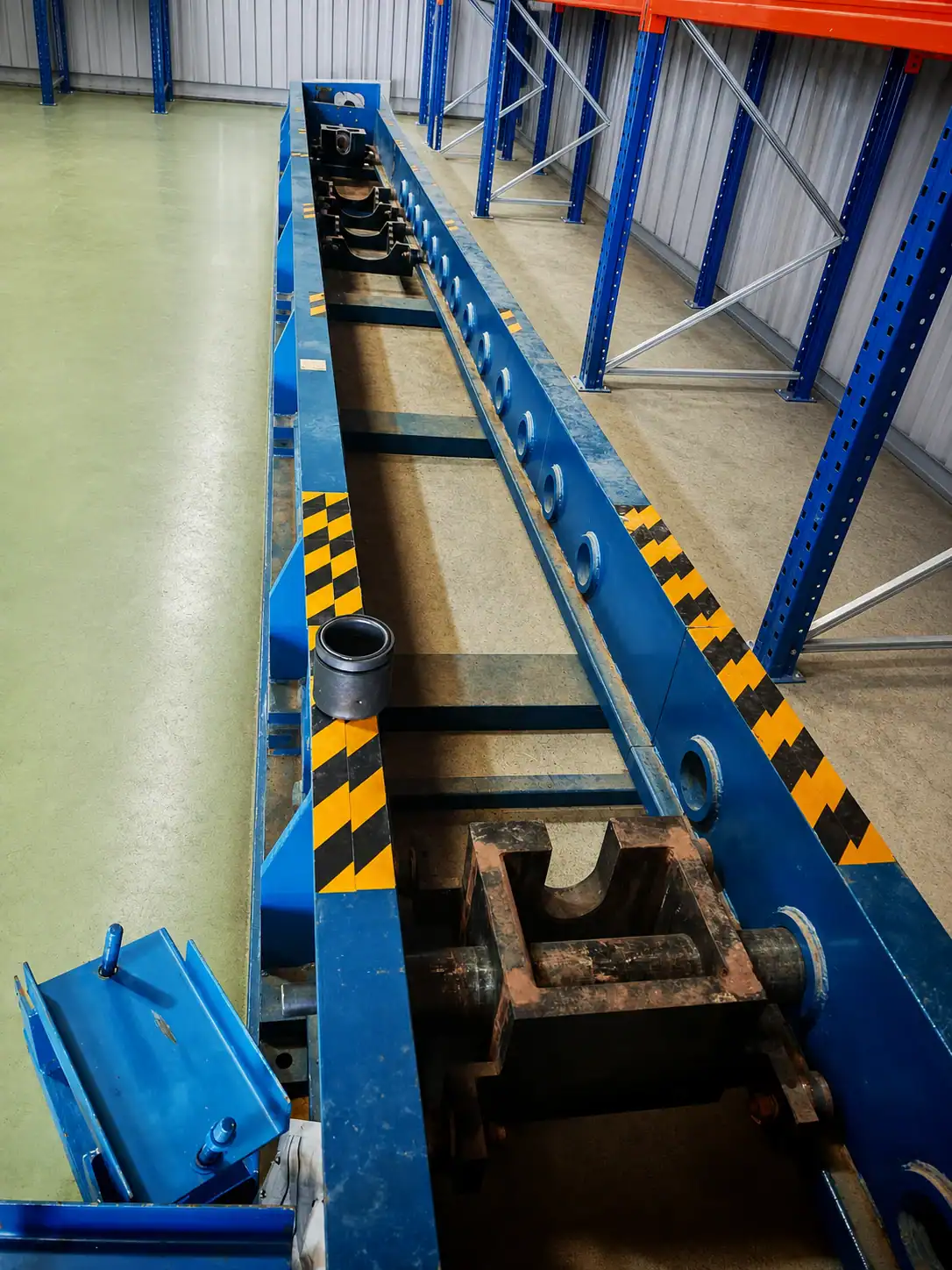
A sling test bench is a horizontal pull frame: fixed anchorage at one end, hydraulic cylinder at the other, a calibrated load cell in the line of pull, and enough stroke to take the sling from slack to full test load with its fittings seated as in service. The load is applied smoothly, held for the required dwell, then released.
What separates a real test from a ritual is what gets recorded. A gauge needle touching a number proves little; a logged force-versus-time trace proves the load was reached, held, and that nothing let go on the way up — the same argument as logged curves on a drilling jar test bench, and the file is what your customer’s auditor reads two years later. After the pull, the test is finished only when the sling has been examined.
Galip builds this class of equipment: the combined benches we have supplied test drilling jars and wire rope slings on the same calibrated frame — one cylinder, one load cell, two kinds of certificate — a sensible arrangement for a service base that maintains downhole tools and lifting gear in one workshop.
What a proof test cannot do
The honest limit first: a proof test is a snapshot of one day. It does not predict fatigue or internal corrosion, and passing says nothing about how the sling will be stored, dragged or shock-loaded next month. A shop that proof tests but skips inspection has the paperwork of a safety programme without the substance.
Condition judgement belongs to inspection, and the removal criteria are specific. Under ASME B30.9 a wire rope sling comes out of service for: ten randomly distributed broken wires in one rope lay, or five in one strand in one lay; severe corrosion; kinking, crushing or bird-caging; heat damage; cracked, deformed or worn end attachments; a missing or illegible tag. None of those need a bench to find — they need a trained eye and the discipline to condemn a sling that cost money.
Reading a test certificate like an auditor
| Field on the certificate | Why it is there | Reject the certificate when |
|---|---|---|
| Sling identification and serial | Ties the paper to one physical sling, not a batch of lookalikes | The number is absent, or does not match the tag on the sling in your hand |
| Standard and proof load applied | Shows which rulebook set the multiple, and what force was actually reached | A load is quoted with no standard, or the multiple does not follow from the sling’s rating |
| Hold time | A load touched for an instant is not a load held | No dwell is stated anywhere |
| Test equipment identity and calibration reference | A pull measured by an uncalibrated cell is a number, not a measurement | No bench identity, or a calibration date that had expired on the day of the test |
| Post-test examination result | The pull can open a flaw; the examination confirms nothing did | The certificate records a pull but no inspection after it |
| Date, place, tester | Accountability — someone signed this | Any of the three is missing |
A shop that issues certificates lives by the calibration chain behind them. The load cell’s own traceable certificate is the root of every sling certificate the bench produces — the same logic that governs any performance test stand customers rely on. Ask a test house for its calibration certificate before accepting its first sling certificate.
Bench or test service: the buying decision
| Factor | Effect to consider | What the team should use for a decision |
|---|---|---|
| Volume of slings and tools tested per month | Sending gear out costs freight and days each cycle; a bench costs once and then costs calibration | Twelve months of test-house invoices and turnaround delays, set against a bench sized for the largest sling and tool in the fleet |
| What else the frame can test | A pull frame that only ever tests slings idles between campaigns; a combined jar-and-sling bench works most weeks in an oilfield base | The full list of pull-tested equipment in the operation — slings, jars, shackles-in-assembly, custom lifting frames — before specifying stroke, capacity and fixtures |
| Certificate format your customers demand | An auditor who cannot read the record treats it as absent; retyping results into reports invites errors | Whether the bench logs the force-time curve and produces the certificate itself, or leaves the paperwork to whoever is on shift |
| Who stands behind the calibration | The bench is only as credible as its load-cell calibration and the ease of renewing it locally | Calibration interval, who can perform it in your country, and what the bench does to flag an expired calibration |
Where the volume is genuinely small, a good test house is the right answer and a bench is a vanity purchase. The frames that pay for themselves belong to workshops already running a tool service operation, where the bench joins a workflow rather than standing alone.
Frequently asked questions
What is a proof load test on a wire rope sling?
A nondestructive pull of one specific sling to a load above its rated capacity, defined by the governing standard, held, released and followed by examination. Passing certifies that sling’s splices, fittings and construction at that load, and the certificate ties the result to the sling’s serial number.
How much load is applied in a sling proof test?
The governing standard and the sling’s construction set the multiple. For a single-leg wire rope sling it is commonly around twice the vertical rated capacity, but the figure on the certificate must follow from the named standard, not from a round-number habit. Multi-leg and fitted slings follow their own rules.
Does a proof test replace sling inspection?
No. A proof test is a snapshot of one day and cannot predict fatigue, corrosion or abuse that comes later. Slings still need inspection before use and documented periodic inspection against the removal criteria of the governing standard — broken wire counts, distortion, heat damage, fitting condition and tag legibility.
When must a wire rope sling be proof tested?
Under ASME B30.9, before first use when the sling’s end attachments are welded, and after any repair. For ordinary mechanically spliced slings it is optional unless the purchaser specifies it. Many buyers specify it anyway for critical lifts, new suppliers, or gear headed to remote sites where failure is unmanageable.
What removes a wire rope sling from service?
Under ASME B30.9: ten randomly distributed broken wires in one rope lay or five in one strand in one lay, severe corrosion, kinking, crushing or bird-caging, heat damage, cracked or deformed end attachments, and a missing or illegible identification tag. Any one condition condemns the sling regardless of test history.
What should a sling test certificate contain?
The sling’s serial number, the standard tested to, the proof load applied and the hold time, the identity and calibration reference of the test equipment, the post-test examination result, and the date, place and tester. A certificate missing the calibration reference is a number without a measurement behind it.
Can one bench test both drilling jars and wire rope slings?
Yes. Both are horizontal pull tests through a calibrated load cell, differing in fixtures, stroke and the record produced. A combined bench suits oilfield service bases that maintain downhole tools and lifting gear in one workshop, keeping a single calibration chain and one report format for both.
Specify the bench against the real fleet
A test bench is sized by what it will actually pull, so send the fleet, not a guess: largest and smallest slings to be tested and their rated capacities · the standard your certificates must cite · whether drilling jars or other tools share the bench · required stroke for the longest assembly · certificate and curve format your customers demand · the calibration regime available in your country. Write to the contact page or sales@galipequipment.com and the reply will be a specification against that list, with the approved figures stated rather than assumed.
Before you trust a sling certificate: the checklist
- The governing standard chosen and named before the order — ASME B30.9, EN 13414, or the customer’s own specification.
- Proof load multiple taken from that standard for that sling construction, not from habit.
- Welded-fitting slings and repaired slings proof tested before use, without exception.
- Certificate carries serial, standard, load, hold time, equipment identity, calibration reference, post-test examination, date and signature.
- The bench’s load-cell calibration certificate current on the test date, and traceable.
- Force-time curve logged and archived with the certificate, not just a peak number.
- Post-test visual examination recorded — a pull without a look afterwards is half a test.
- Inspection programme running alongside testing, against the standard’s removal criteria.
- Broken-wire counts, distortion, heat and fitting condition checked by someone trained to condemn.
- Test-house route costed against an owned bench using twelve real months of volume, freight and delay.
Expert Consultation
Need more information on optimizing your equipment performance? Our engineering team is available for technical consultations.
Request a Quote
Tell us about your requirements and our engineering team will prepare a detailed proposal with specifications, pricing, and delivery timeline.
