Premium Connection Make-Up: Torque-Turn Machine Capabilities to Verify Before You Buy
Premium connection make-up is judged by far more than a single torque number. When workshops compare a make-up torque machine, the conversation too often stops at maximum torque — but the real question is what the machine can actually do: how it makes up premium connections, what records it leaves behind, how it handles damage-sensitive…
Premium connection make-up is judged by far more than a single torque number. When workshops compare a make-up torque machine, the conversation too often stops at maximum torque — but the real question is what the machine can actually do: how it makes up premium connections, what records it leaves behind, how it handles damage-sensitive pipe, and how well it can be matched to your workshop. This guide walks through the five capability areas that matter most for a torque-turn make-up machine, what proof to look for in each, and the caveats an honest supplier will tell you.
At Galip, a bucking unit is never quoted from torque capacity alone. Each configuration is reviewed around the buyer’s OD range, torque range, connection family, report format, daily output target, floor space, power supply, and accessories. Below is how those capabilities break down — and how to verify them.
1. Premium connection make-up
Premium connections cannot be judged by final torque alone. The make-up needs controlled rotation, stable clamping, and a torque-turn record that proves the shoulder was reached correctly. A capable bucking unit is built around that whole process, not just the peak number at the end.
What to look for:
- 360-degree continuous rotation, so make-up runs without re-clamping and the torque-turn curve stays smooth
- Torque-turn recording with automatic shoulder-point detection
- Per-joint PDF and Excel report export for QA and witness review
- Jaws and parameters configured around the specific connection family
Caveat: premium connection acceptance should always follow the latest connection-owner procedure, customer specification, and approved workshop QA requirements. No machine replaces the licensor’s spec. In short, a Galip hydraulic bucking unit can be configured for premium connection make-up workflows that require torque-turn monitoring and traceable report output. For the deeper engineering view, see the premium connection bucking unit control guide.
2. Torque range and OD coverage
The right machine matches your actual pipe sizes and torque window with margin — not the biggest headline figure. Bucking unit capabilities here come down to frame size and how the torque and OD ranges line up with your product mix.
What to look for:
- Frame sizes to suit your OD range (Galip offers 10″, 15″, 18″, 20″, 22″, and 24″, with custom builds up to 32″)
- Pipe OD from 1-5/8″ and make-up / break-out torque from 500 to 199,000 ft-lb across listed models, with higher-torque packages on request
- Torque range, connection range, jaw configuration, voltage, and control package tailored to the application
Caveat: the correct machine is chosen from normal workload, peak requirement, connection family, safety margin, and future product range — not headline torque alone. A Galip bucking unit can be configured for OCTG, drill pipe, BHA, and heavy-tool workflows that need model-matched OD capacity and controlled torque delivery. The bucking unit specifications guide covers how to compare these fields.
3. Torque-turn records and report traceability
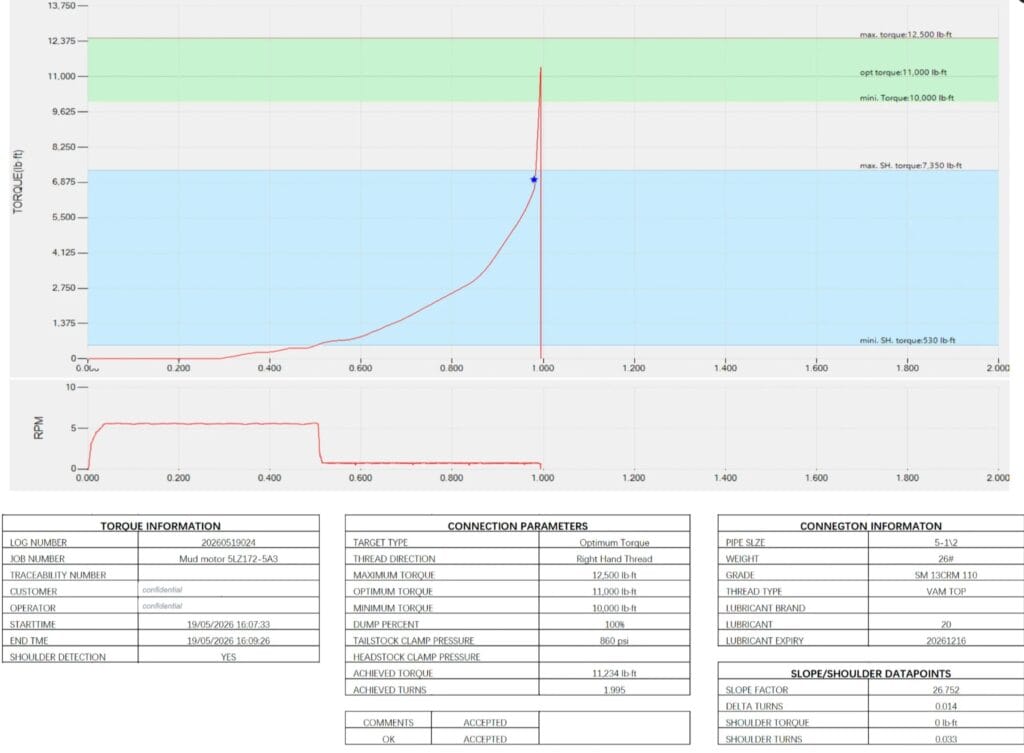
For any workshop that faces QA review, customer witness, or audits, the record is the product. A bucking unit’s reporting capability decides whether good connections can actually be proven weeks later.
What to look for:
- Real-time torque-turn curve on a large touchscreen (Galip uses a 19″ display plus a dedicated 10″ control screen)
- Automatic PDF report generation and Excel export for every joint
- Records covering torque, turn count, curve behavior, operator and job identification, target versus final values, and exception events
Caveat: a good public specification describes what the buyer can review in the report — not confidential internal measurement architecture. A Galip bucking unit can be configured for workshops that need torque-turn records, QA review files, and traceable report output after each make-up job. To interpret those curves, see how to read a torque-turn report.
4. Damage-sensitive pipe: CRA and chrome tubulars
Chrome, CRA, and premium-thread tubulars punish rough handling. The machine can lower the risk, but only when the jaw and clamp system is set up for the material.
What to look for:
- Soft-contact jaws for premium connections, CRA, and chrome tubulars
- Electro-hydraulic proportional valves for precise clamp-pressure control
- Support stands, jaw inserts, and jaw-protection accessories specified per application
Caveat: the machine helps reduce handling and clamping risk, but damage prevention still depends on correct jaws, clamp setup, clean handling, operator discipline, and the approved procedure. A Galip bucking unit can be configured for damage-sensitive CRA or chrome tubular workflows when jaw selection, clamp setup, and handling procedure are matched to the application. See CRA connection handling operator habits.
5. Custom configuration around your workshop
The last capability is the one buyers underweight: fit. A bucking unit should be configured around your actual conditions, not sold as a generic catalog machine.
What a strong proposal is built from:
- Your OD range, torque range, thread family, report format, and daily output target
- Floor space, power supply, lifting method, and accessories
- Voltage and control packages matched to the destination site (380–480V, 50/60Hz)
Caveat: quotation quality improves when you share the real workflow instead of only a headline torque number. A Galip bucking unit can be configured around the buyer’s OD range, torque range, connection family, reporting format, daily output target, workshop space, and power supply. The bucking unit operation procedure includes an RFQ checklist that maps into a configuration review.
How to compare bucking unit capabilities
Put the five areas together and the comparison stops being about one torque figure. Ask instead: can this machine make up my connections correctly, prove it afterward, protect my pipe, and be configured to my workshop? That is the difference between buying a torque source and buying a controlled make-up system.
Talk to Galip About a Configured Bucking Unit
Send your OD range, target torque window, connection family, reporting requirement, daily workload, floor space, and power supply, and Galip can recommend a hydraulic bucking unit with torque-turn recording matched to your real job envelope — manufactured in China and priced for cost-effectiveness against Western-built equivalents.
FAQ
What are the most important bucking unit capabilities to check?
Beyond maximum torque, check premium connection make-up control, torque-turn recording and report export, OD and frame-size coverage, damage-sensitive pipe handling, and how well the machine can be configured to your workshop. Torque capacity alone does not describe whether a machine fits your work.
Can a bucking unit make up premium and OCTG connections?
Yes, when it is configured for controlled rotation, stable clamping, torque-turn monitoring, and traceable reporting. Galip hydraulic bucking units can be configured for premium connection make-up workflows that require torque-turn monitoring and report output; final acceptance still follows the connection owner’s procedure.
What torque and pipe sizes do Galip bucking units cover?
Make-up / break-out torque from 500 up to 199,000 ft-lb, and pipe OD from 1-5/8 inches up to 32 inches, across frame sizes from 10 to 24 inches with custom builds to 32 inches. Higher-torque packages are available on request.
Should I choose a bucking unit by torque rating alone?
No. Torque rating is one input. Select from normal workload, peak requirement, connection family, safety margin, reporting needs, and future product range so the machine fits the whole workflow rather than a single number.
Expert Consultation
Need more information on optimizing your equipment performance? Our engineering team is available for technical consultations.
Request a Quote
Tell us about your requirements and our engineering team will prepare a detailed proposal with specifications, pricing, and delivery timeline.
