
Pre-Shift Operator Checklist: 8 Essential Checks Before the First Joint
A practical pre-shift article covering calibration, support, dies, and first-joint readiness for bucking unit operators.
A practical pre-shift article covering calibration, support, dies, and first-joint readiness for bucking unit operators.
A disciplined pre-shift operator checklist is what separates shops whose first joint goes cleanly from shops that use the first joint to diagnose the machine.
Why the first joint should not diagnose the machine
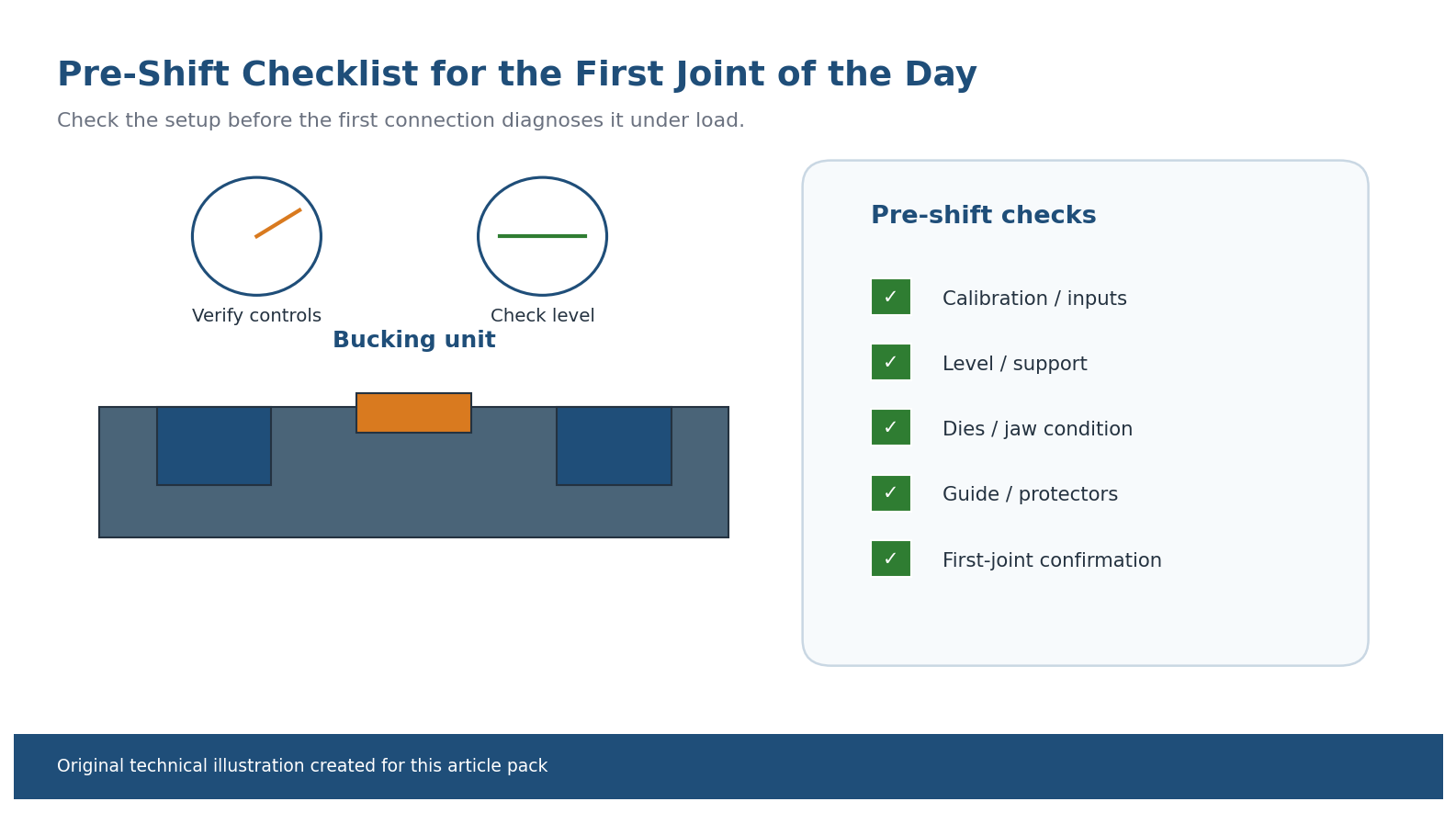
The first joint of the shift tells the truth about the whole day. If the setup is wrong, the first connection will expose it. The trouble is that many workshops still let the first joint function as a test. The machine is powered on, everyone assumes yesterday’s condition is close enough, and the crew discovers the real state of support, grip, inputs, or calibration while the connection is already under load. That is a risky way to start.
Related reading: bucking unit 101 workflow.
Good operators work differently. They do not ask the first joint to reveal whether the setup is acceptable. They check the setup before the first joint is allowed near the machine. This is not bureaucracy. It is a way to protect the shift from avoidable noise. A few deliberate checks at the start of the day usually prevent hours of discussion later about odd torque curves, unstable motion, or unexpected marks.
End users often focus on machine capacity when they compare bucking units, but first-joint readiness is what determines whether that capacity can be used cleanly. The best shops know that a machine is not “ready” because it starts. It is ready because the whole process around it has been verified for the job that is about to run.
Pre-shift operator checklist: start with the measurement chain, not just the display
Pre-shift discipline should begin with the measurement side of the system. Operators should confirm the control package is live, the inputs are correct for the job, and the shop is not relying on stale assumptions about calibration or settings. A confident-looking screen is not the same thing as a trustworthy process. If the wrong recipe, wrong arm value, wrong joint parameters, or wrong sensor assumptions are in the system, the shift can begin with false confidence.
Related reading: how to select a rotational bucking unit.
This does not require a complicated ritual. It requires an honest one. Verify the current setup against the actual job. Confirm that the records and equipment status are current. Make sure the machine will record and respond the way the crew expects. If the workshop uses torque-turn monitoring, this is the time to confirm it is capturing what matters and not simply displaying numbers.
Shops that skip this step often end up overreacting to the first strange curve of the day. The problem then gets blamed on the connection, the operator, or the thread compound when the real issue was a setup assumption that should have been checked before the machine ever turned.
Level, support, and centerline are part of the same check
One of the most common pre-shift mistakes is checking components in isolation. The crew looks at support rollers, or checks the frame, or adjusts the tailstock, but never asks whether the assembly as a whole creates a true working centerline. In practice, level, support, and axis control belong in the same conversation. A machine can be mechanically healthy and still create poor make-up behavior if the workpiece is not honestly supported for the job being run that day.
Related reading: rotational bucking unit setup for high-mix jobs.
This matters even more when the shift includes different lengths, diameters, or stepped assemblies. What worked on yesterday’s short job may not work on a longer or heavier assembly this morning. Support points need to reflect reality, not habit. Operators should ask whether the work will sag, whether a reaction point will shift under load, and whether the connection will still look centered once torque is applied. Those questions are more useful than a quick visual check from one side of the bed.
A clean first joint usually comes from a clean load path. If the support and centerline checks are weak, the machine starts the day by fighting geometry instead of doing precision work.
Do not ignore the small interfaces: dies, jaws, and contact surfaces
Large machines make it easy to forget how much the job depends on small contact points. Yet the dies, jaws, and contact surfaces are where the machine actually touches the work. If those surfaces are dirty, worn, badly chosen for the material, or unevenly loaded, the first joint will show it quickly. Slippage, marking, unstable motion, and odd feel during make-up often begin here.
A useful pre-shift check therefore includes more than a glance at whether the dies are physically installed. Operators should confirm the contact condition suits the day’s material, especially if the shop runs both ordinary and marking-sensitive jobs. They should make sure nothing in the grip area is carrying contamination from the previous shift. They should also confirm the crew has the right accessories and protectors staged nearby, so the job does not drift into improvisation once work starts.
These are easy checks to dismiss because they look small compared with the rest of the machine. In real service work, they are often the difference between a shift that begins smoothly and a shift that starts with the first avoidable defect.
What a strong first-joint routine looks like
The smartest workshops treat the first joint as a confirmation step, not an experiment. The connection chosen for the first run is supported carefully, the operator watches the start closely, and the crew uses that first make-up or breakout to confirm that the prepared setup is behaving as expected. If the movement, grip, or curve feels wrong, the shop corrects the condition before pushing volume through the machine.
Over time, this produces a different kind of culture. Operators become more comfortable stopping early because the expectation is accuracy, not bravado. Supervisors get cleaner information because the first irregularity is investigated when it appears, not after several questionable joints have already gone through. Customers see more consistency because the shop is not treating setup verification as optional.
A good pre-shift checklist does more than avoid mistakes. It makes the whole workshop feel calmer. The first joint goes better. The rest of the shift is easier to trust. And the machine begins to look like what it is supposed to be: a controlled process tool, not a device that figures itself out under load.
Key takeaways
- A machine is not ready because it powers on; it is ready because the whole setup has been verified for the actual job.
- Check controls, settings, and recording logic before trusting the first curve of the day.
- Level, support, and centerline should be verified together, not as unrelated items.
- Dies, jaws, and contact surfaces deserve pre-shift attention because they define how the machine touches the work.
Related Products
- Explore our Bucking Unit and Breakout Unit product pages.
- Read more on bucking unit 101 workflow and how to select a rotational bucking unit.
- Ready to discuss your setup? contact our team.
Frequently asked questions about pre-shift operator checklist
What should a pre-shift operator checklist include?
A pre-shift operator checklist should cover the measurement chain (controls, inputs, calibration), level and support verification for the actual job being run, centerline honesty under load, die and jaw contact condition, protector and compound readiness, and a planned first-joint verification pass.
Why check calibration before the first joint of the shift?
A confident-looking screen is not the same as a trustworthy process. If the wrong recipe, arm value, or sensor assumption is loaded, the shift begins with false confidence — and the first strange curve of the day gets blamed on the connection instead of the setup.
How often should dies and jaws be inspected pre-shift?
Every shift, at minimum, and additionally whenever material class changes (carbon to CRA, for instance). Dies carrying contamination from the prior shift cause slippage, marking, and uneven grip long before anyone suspects the contact surface.
What pre-shift steps prevent unstable first-joint behavior?
Verify that level, support, and centerline agree under the actual load path for today's work. Longer or stepped assemblies sag differently from yesterday's job — support points must reflect reality, not habit.
How long should a proper pre-shift operator checklist take?
Usually ten to twenty minutes, depending on change-over. That small investment prevents hours of discussion later about odd torque curves, unstable motion, or rejected joints — and it lets the first joint confirm the setup rather than diagnose it.
Talk to our team
Invite readers to request a bucking-unit review based on their pipe range, support layout, and torque-turn control needs. For broader context on threaded-connection care, see API standards for oilfield threaded connections. When you are ready to specify or upgrade, review our Bucking Unit options or contact our team.
Expert Consultation
Need more information on optimizing your equipment performance? Our engineering team is available for technical consultations.
Request a Quote
Tell us about your requirements and our engineering team will prepare a detailed proposal with specifications, pricing, and delivery timeline.
