
Large Threaded Assemblies Guide: Controlled Make and Break for Repairs
Large threaded assemblies guide for industrial repair teams handling pump housings, gear couplings, retaining nuts, and controlled make and break work.
By Galip Equipment Editorial Team, reviewed by Jason Wang.
Large threaded assemblies are usually difficult because the part is heavy, the fit is expensive, and one rough make-up can damage a housing, coupling, or retaining nut that is hard to replace. This guide explains when a controlled make-and-break process is worth using, and what repair teams should check before choosing a fixture or torque machine.
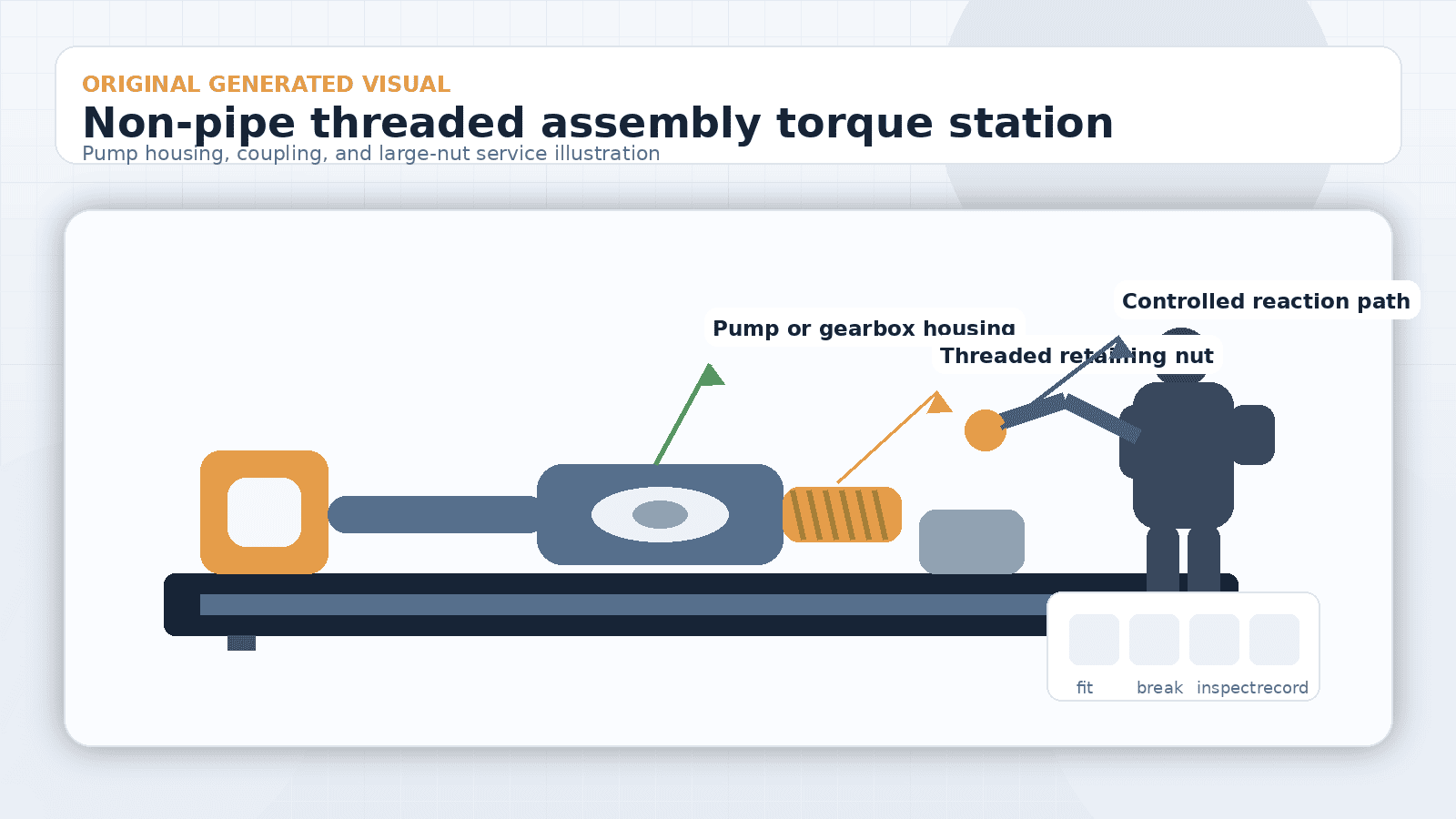
Table of contents
[rank_math_toc]
Industrial make break torque machine questions buyers should settle first
- An industrial make break torque machine becomes relevant when high-value threaded assemblies need more control than bars, chain wrenches, and improvised fixtures can safely provide.
- Value, difficulty, and repeat frequency are the three signals that separate a one-off hard job from a process problem worth solving properly.
- The real comparison is not force versus force. It is controlled reaction, safer operator position, cleaner gripping, and fewer damaged housings or retaining components after the joint finally moves.
- Some jobs still belong to dedicated bolting tools, so good industrial content should explain where a controlled station fits and where it does not.
- Buyers should evaluate geometry, acceptable contact points, reaction path, and future workflow needs before they commit to a machine category.
industrial make break torque machine in practice
industrial make break torque machine becomes much easier to evaluate when the shop names the real failure points, uses a controlled process, and records what better handling should prevent the next time the job returns.
Not every expensive threaded assembly is a piece of pipe.
That sounds obvious, but a surprising amount of content around make/break equipment still acts as if torque control begins and ends with tubular work. In reality, repair shops and industrial maintenance teams fight stubborn threaded assemblies everywhere: pump housings, large retaining nuts, gearbox covers, actuator sleeves, coupling systems, bearing retainers, mechanical subassemblies, and other parts that are too valuable, too awkward, or too sensitive to be handled with casual methods.
This is one of the better traffic opportunities around Galip’s BU and breakout cluster because it expands the conversation without walking away from the real product logic. The shared need is not “pipe.” The shared need is controlled force, stable holding, cleaner reaction paths, and fewer expensive mistakes on high-value threaded components.
It is also a useful topic because it lets Galip sound more like an expert and less like a machine list. The best industrial buyers do not want a supplier that force-fits one machine into every job.
They want a supplier that can say, with credibility, where a bucking-style or breakout-style station fits, where a dedicated bolting tool is better, and where the wrong method creates more damage than value.
That honesty is not a weakness. It is part of what makes the article useful enough to rank and credible enough to convert.
Why manual methods break down on large non-pipe assemblies
Manual methods survive longer than they should because many industrial joints do eventually move. That is the trap. A job can be completed and still be a bad method.
The trouble starts when the assembly is large enough to require serious reaction control but not standardized enough to already have a dedicated process around it. Pump housings are a good example.
A shop may only see a certain housing size occasionally, so the team leans on bars, chain wrenches, improvised fixtures, or the strongest person in the bay. Gear couplings and retaining nuts can create the same problem.
Everyone knows the joint needs force, but few people pause to ask whether the force is being introduced in a way that protects the parts.
That is where secondary damage hides. A slip can mark the component. An off-axis reaction can load the housing the wrong way. A retaining nut may loosen, but the joint surface is scarred or the alignment relationship is disturbed. The job still “gets done,” yet the method is quietly eating reliability.
There is also a human factor that industrial teams know well but rarely name directly: when a job looks awkward, operators compensate with body position. They absorb reaction, lean into bars, and improvise leverage.
That increases injury risk and it also reduces quality. The operator’s body should not be part of the torque path.
Once the joint value rises or the rework cost becomes painful, shops usually realize the real issue was not lack of force. It was lack of control.
The assemblies that usually justify a controlled station
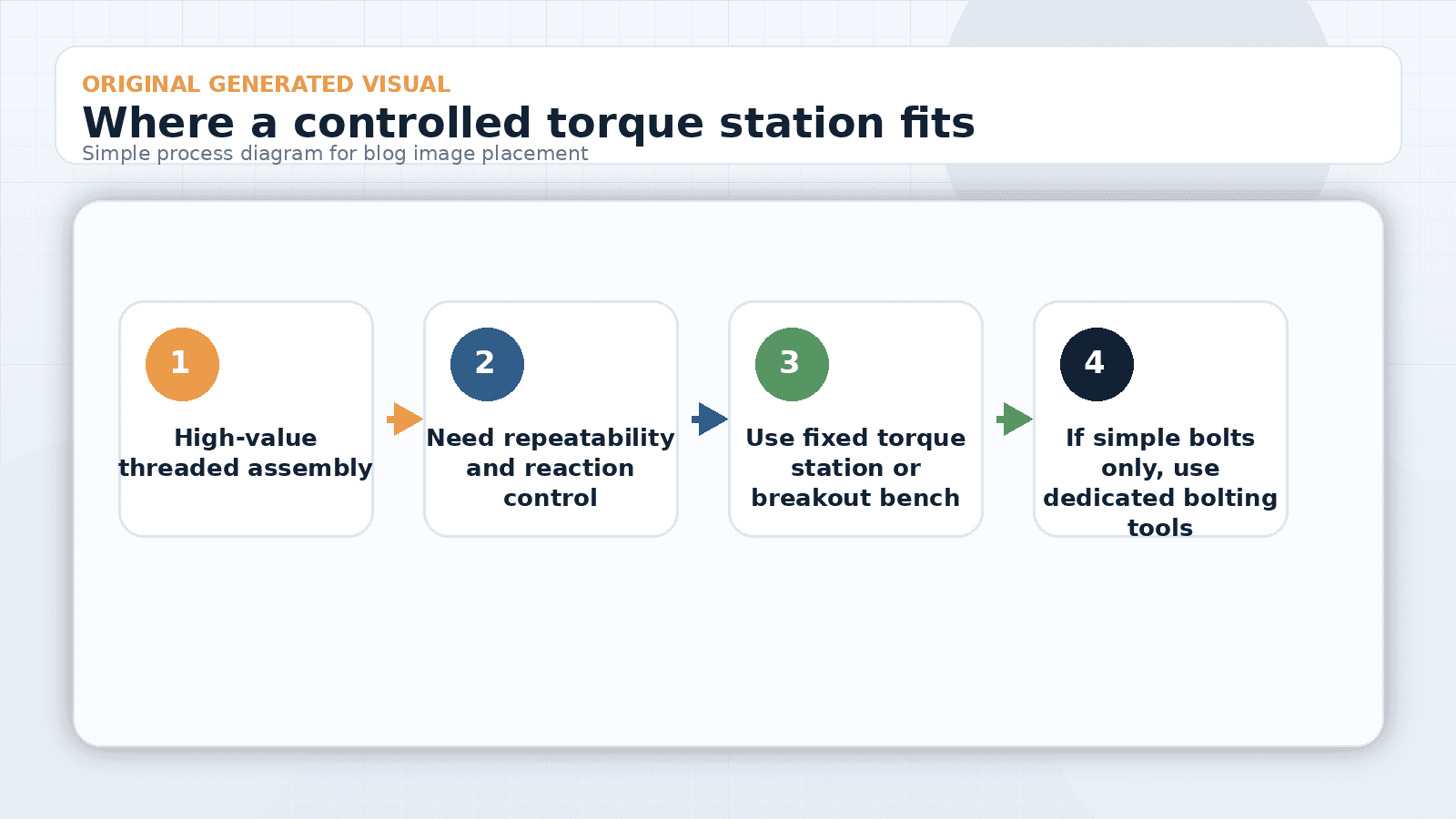
A controlled make/break station becomes relevant when three conditions overlap.
First, the threaded assembly has real value. Replacing or remachining it would hurt. That value can be obvious, as with specialized pump or gearbox components, or less obvious, as with assemblies whose downtime cost is much larger than their part cost.
Second, the joint is difficult enough that reaction control matters. This may come from size, seizure, repeat service cycles, awkward geometry, or the sensitivity of the mating surfaces. A simple wrench solution may still work in theory, but the practical risk is too high.
Third, the shop sees enough similar work that process improvement has somewhere to land. One isolated hard job may justify creative handling. A recurring class of hard jobs usually justifies a better system.
Examples can include pump casings with large threaded retainers, coupling assemblies that need repeat opening and closing in overhaul cycles, threaded sleeves or housings in heavy-equipment repair, actuator assemblies where sealing or bearing surfaces matter, and rebuild environments where different non-pipe threaded parts keep showing up on the same floor.
The most important thing is not the label. It is the combination of value, difficulty, and repeat frequency. That is the combination that should trigger a buyer to stop asking, “Can we get it loose?” and start asking, “What is the right process for this class of work?”
What a controlled torque station changes
A controlled station changes the work by giving the assembly a stable home, a predictable reaction path, and a repeatable way to apply or release torque.
Stability comes first. If the part is not held properly, the rest of the system is compromised. Controlled stations allow the shop to think deliberately about contact points, support, and where gripping is acceptable.
That matters more on non-pipe assemblies than many people assume because the geometry is often less forgiving than a tubular product.
Reaction control comes next. This is where many improvised methods fail. The joint may move, but the system stores and releases energy in ugly ways. A controlled station directs that force through the equipment rather than through the operator’s body or a makeshift brace.
That immediately improves safety and often improves the quality of the outcome.
Repeatability is the third change. If the shop can approach similar jobs with similar logic, it becomes easier to train technicians, compare outcomes, and keep unusual cases from becoming the norm.
This is also where documentation gets easier. A station that supports consistent make/break work creates cleaner records and clearer accountability.
Notice what is missing from this section: hype. A controlled station is not magic. It does not replace engineering judgment, and it does not automatically make every hard job easy. What it does is remove a lot of the chaos that manual methods bring with them.
In industrial repair, that is often the difference between “we can handle this” and “we handle this well.”
Where a Bucking Unit fits outside pipe work
The Bucking Unit belongs in this article for the same reason a good expert belongs in a buying conversation: because sometimes the right answer is more nuanced than a category label.
A bucking unit is not the right solution for every non-pipe threaded assembly. If the job is really a bolted-joint problem, or if the work is best handled with hydraulic torque wrenches, bolt tensioners, or lighter assembly tools, a BU should not be forced into the story. Why refinery and plant flanges are bolting work rather than make-up work is set out in downstream oil and gas.
That would make the article less credible and less helpful.
But when the industrial problem starts to resemble controlled make/break of large, valuable, threaded assemblies — especially those that benefit from stable clamping, reaction control, and repeatable handling — BU logic becomes very relevant. In some shops, the machine that solves an oilfield connection problem also solves a non-pipe maintenance problem because the underlying mechanical challenge is similar.
That is exactly the kind of small BU section that works for SEO and for trust. It does not try to rename every pump housing a pipe job. It simply explains that the same principles of control, support, and repeatability matter outside pipe work too. Readers respect that more than a hard sell.
Where the Breakout Unit may be the better conversation
For many industrial repair teams, the Breakout Unit is actually the more natural bridge product. If the priority is difficult disassembly, high breakout force, and workshop make/break handling rather than full premium-style make-up control, the breakout conversation lands more naturally.
That matters because some readers are not trying to build a formal QA-driven torque program. They are trying to stop losing time and damaging parts during teardown.
Once the shop sees the value of controlled disassembly, the BU can enter later when make-up quality, traceability, or broader service-center standardization becomes important.
This is another reason adjacent-content pieces like this can outperform generic machine explainers. They meet the reader where the pain actually is. Not everyone wakes up wanting a BU.
Many buyers wake up wanting fewer damaged housings, cleaner breakouts, and less improvisation in the bay. Good content connects those dots instead of pretending the reader already has the exact product language.
How to evaluate fit before buying equipment
Buyers considering a controlled station for non-pipe threaded assemblies should begin with the jobs, not the brochure.
What exact assemblies are creating trouble? How often do they return? What part damage or safety issue keeps showing up? What would one avoided rework loop be worth? These questions are more useful than broad statements about industrial maintenance.
After that, look at the geometry. Are the parts cylindrical, flanged, irregular, thin-walled, or heavy in ways that change support needs? What surfaces are safe to grip? What alignment relationships must be protected?
If the equipment supplier cannot have a sensible conversation about these issues, the machine category is probably not the main problem.
Next, review the force path and operator method. Will the operator still be fighting reaction manually, or is the system truly absorbing it? Can the work be done in a cleaner, safer position? Does the station reduce dependence on the one technician who “knows how to make it work”?
Finally, think about the future state of the shop. Are you solving one ugly problem, or are you building a more standardized repair workflow? The answer shapes whether you need a breakout-focused solution, a BU-style higher-control platform, or a completely different bolting approach.
Honest evaluation here prevents expensive category mistakes later.
What makes the content genuinely useful
This kind of article performs best when it does not overclaim. It should say, clearly, that some high-torque industrial joints belong to dedicated bolting tools and some belong to a controlled make/break station.
It should explain the difference in plain language. It should name the warning signs that manual methods are no longer good enough. And it should describe the decision process in a way that helps a maintenance manager think more clearly before making a purchase inquiry.
That is what gives the article E-E-A-T weight even before a real named reviewer is added. Readers can tell when the author is trying to be helpful instead of trying to drag every search into the same product page.
In industrial SEO, that matters. Buyers in this segment are not casual readers. They can smell weak content immediately.
The more human and practical the article feels, the more likely it is to attract the right visitor — the one who does not yet know Galip, but already knows their current method is costing them more than it should.
Conclusion
Large threaded assemblies do not become lower-risk just because they are not pipe. In many shops, they are actually more vulnerable to bad handling because they fall between established process categories. That makes them a smart adjacent topic for Galip.
The article expands the BU and breakout conversation into pump housings, gear couplings, retaining nuts, and other non-pipe assemblies without forcing a false fit. It helps readers think clearly about when controlled make/break logic matters, when the Breakout Unit is the better bridge, and when dedicated bolting tools may still be the right answer.
In other words, it acts like expert content instead of catalog filler. That is exactly the kind of article that can pull in broader industrial traffic while still guiding the right readers toward Galip’s core equipment lines.
Related Galip resources
External references
- Atlas Copco pocket guide to tightening technique
- Atlas Copco high-torque tightening solutions
- Mountz guide to choosing the right power tool for the joint application
Frequently asked questions about industrial make break torque machine selection
What assemblies usually justify an industrial make break torque machine?
Pump housings, gear couplings, retaining nuts, threaded sleeves, and similar overhaul components are strong candidates once their value, difficulty, and repeat frequency make manual methods too risky.
Why do manual methods stay in place so long on non-pipe assemblies?
Because the joint often still moves eventually, which hides the real cost of secondary damage, awkward operator loading, repeat rework, and unreliable handling quality.
When is a breakout-focused solution a better fit than a bucking-style platform?
It is often the better bridge when the priority is controlled disassembly, high breakout force, and cleaner workshop handling rather than premium-style make-up control.
If your maintenance team is comparing a breakout-focused station with a broader bucking-style workflow, you can send Galip the assemblies causing the most pain and narrow the fit discussion quickly.
Keyword recap: industrial make break torque machine
industrial make break torque machine is ultimately a shop-control question: how the assembly is identified, supported, opened, inspected, and returned to service without creating extra damage on the way.
industrial make break torque machine checklist
- Keep industrial make break torque machine tied to the actual failure pattern the shop is trying to stop.
- Document the support method, breakout method, and inspection findings in the same workflow.
- Use internal references and external standards so buyers can compare process control instead of guessing.
- Make the release decision defensible to operators, supervisors, and customer reviewers.
Why industrial make break torque machine matters for buyers
Buyers searching industrial make break torque machine are usually trying to stop recurring loss, not just compare a machine specification. That is why process control, equipment fit, documentation, and operator safety all need to appear in the same article.
When industrial make break torque machine stays connected to the exact parts, fixtures, and release decisions on the floor, the content becomes more useful for ranking and more believable for a technical reader.
industrial make break torque machine FAQ recap
A strong industrial make break torque machine workflow is the one technicians can repeat safely, supervisors can audit, and customers can understand after the job is already complete.
Expert Consultation
Need more information on optimizing your equipment performance? Our engineering team is available for technical consultations.
Request a Quote
Tell us about your requirements and our engineering team will prepare a detailed proposal with specifications, pricing, and delivery timeline.
