
OCTG Quality Assurance: Bucking Unit Records for Mill Audit
Hydraulic bucking unit for OCTG guide covering premium connection make-up, torque-turn monitoring, QA checklists, and reliable field implementation steps.
OCTG quality assurance audits center on demonstrating that every premium connection on a string was made up to spec, and that you have records to prove it. The hydraulic bucking unit’s torque-turn capture is what produces those records.
This guide explains what mill auditors look for and how to structure make-up data for submission. For bucking unit hardware specifications, see the main product page.
Why premium OCTG connections require strict control
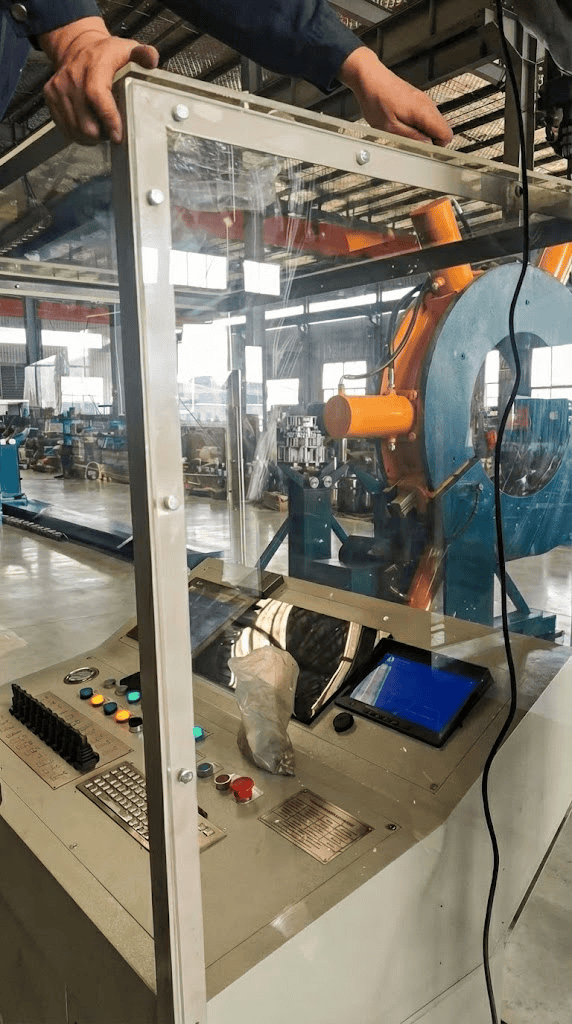
Premium OCTG connections are engineered sealing systems. They include thread geometry, shoulders, and sealing surfaces that react sensitively to alignment, friction, and speed. A connection can reach nominal torque yet still fail quality intent if curve behavior is abnormal. This is why modern QA programs use dual acceptance logic: final torque target plus torque-turn signature behavior.
- Stable axial and radial alignment under load
- Controlled clamp force to prevent slip and OD damage
- Consistent make-up speed at low RPM
- High-quality torque-turn capture and storage
- Clear pass/fail criteria tied to SOP
Hydraulic bucking unit for OCTG: selection checklist
1) Torque range, margin, and control resolution
Build a connection matrix by size and premium type, then map minimum, nominal, and maximum torque demand. Select a system that covers the full envelope with healthy operating margin. In many facilities, daily work performs better when the machine normally runs in a mid-load zone rather than near limits. The objective is stable control behavior and repeatable shoulder approach, not maximum brochure torque.
2) RPM stability under rising load
Premium running procedures in the industry consistently emphasize controlled and relatively low make-up speed. Ask vendors for loaded-speed demonstrations, not no-load spin videos. If speed oscillates while torque rises, connection behavior can become inconsistent and curve interpretation becomes noisy.
3) Clamp system and die management
Clamp architecture must hold securely without crushing or marking OD. Confirm die options by OD range, die replacement cycles, and repeatability after repeated use. For sensitive surfaces or coatings, require documented setup values and maintenance intervals. Clamp inconsistency is one of the most common hidden causes of torque variation between nominally identical joints.
4) Data quality and report export
Treat torque-turn data as quality evidence, not a visual accessory. Require high sampling density, sensor stability, and export formats usable by QA and customer teams. A robust reporting package should include date/time, operator ID, connection ID, setup recipe, final torque, and the full graph.
5) Operator interface and alarms
The HMI should present live torque, turns, trend slope, and alarms in a way operators can act on immediately. Good systems reduce cognitive load and prevent late reactions. Alarm thresholds should map directly to SOP responses so operators know when to stop and inspect instead of “pushing through.”
Standard workflow for premium connection make-up
- Verify connection specification, acceptance criteria, and job traveler.
- Inspect threads, shoulders, and sealing surfaces; reject damaged parts before make-up.
- Clean and dry components; apply approved compound consistently.
- Set alignment, clamp force, speed, and torque recipe according to SOP.
- Run controlled make-up while monitoring torque-turn behavior in real time.
- Confirm final torque and curve signature both satisfy acceptance criteria.
- Export and store the full quality record for traceability and audit readiness.
Failure modes and corrective actions
Thread galling during make-up
Typical causes: contamination, incorrect compound usage, excessive speed, or poor alignment. Corrective actions: tighten pre-job cleaning, enforce compound discipline, reduce speed, and stop immediately at abnormal curve onset.
Inconsistent final torque between similar joints
Typical causes: hydraulic pressure drift, die wear, clamp slip, and setup variation by shift. Corrective actions: routine calibration, hydraulic health checks, die life tracking, and locked connection recipes.
“Pass by torque, fail by graph” cases
Typical causes: unstable shoulder approach or friction irregularity. Corrective actions: enforce dual-criteria acceptance, review graph signatures systematically, and retrain operators on abnormal pattern recognition.
How this page stays unique and SEO-safe
Your site already has multiple bucking-unit articles. This page is intentionally positioned as an OCTG premium implementation and QA guide, not a generic product introduction. That helps prevent keyword cannibalization and aligns with current Google quality direction: intent-match, practical depth, and evidence-backed structure.
- Primary query intent: hydraulic bucking unit for OCTG
- Secondary long-tail terms: premium connection make-up system; torque turn monitoring for OCTG; OCTG connection quality control workflow
- Audience: technical buyers, workshop leads, and QA teams
- Outcome: lower rework, stronger traceability, and better connection reliability
Internal and external references
Internal reference: Torque-Turn Monitoring Systems.
External references: Hunting premium connection running procedure; JFE OCTG Service Handbook.
FAQ
What is the main benefit of a hydraulic bucking unit for OCTG?
Repeatable make-up quality with traceable torque-turn records. In operations, this typically means lower rework, better auditability, and reduced quality disputes.
Is final torque alone enough for acceptance?
No. Final torque is necessary but not sufficient. Use torque plus curve behavior plus procedural compliance for robust quality control.
Can one machine optimally cover every OCTG size?
Usually no. Validate torque envelope, clamp configuration, die sets, and fixture compatibility against your real connection mix.
Conclusion
A hydraulic bucking unit for OCTG should be selected and operated as a quality system, not just a torque machine. If your goal is fewer rejects and stronger premium connection reliability, focus on stable control, clear SOPs, and disciplined torque-turn acceptance.
Hydraulic Bucking Unit for OCTG: commissioning checklist
Before production use, run a commissioning protocol for the hydraulic bucking unit for OCTG. Verify sensor calibration, hydraulic pressure stability, clamp repeatability, RPM control under load, and report export integrity. A controlled commissioning phase prevents quality drift during the first operating weeks and gives management a baseline for later troubleshooting.
- Calibrate torque and turn channels with certified references
- Run three repeatability tests on the same connection type
- Validate alarm limits and operator stop-response timing
- Confirm report export includes all mandatory traceability fields
- Approve SOP version and lock production recipes
Hydraulic bucking unit for OCTG ROI and quality impact
Most teams justify investment through quality and downtime reduction rather than speed alone. In practical deployments, stronger process control reduces rejected connections, decreases rework hours, and shortens dispute cycles because data records are clearer. For procurement, the key is to evaluate total lifecycle value: machine stability, maintainability, operator usability, and reporting quality.
Vendor registration usually runs alongside the technical review, so procurement will also want the manufacturer’s own QHSE records and certificate gallery to close out the supplier assessment.
Need OCTG QA support or hydraulic bucking unit sizing guidance? Contact Galip.
Expert Consultation
Need more information on optimizing your equipment performance? Our engineering team is available for technical consultations.
Request a Quote
Tell us about your requirements and our engineering team will prepare a detailed proposal with specifications, pricing, and delivery timeline.
