
HDD Tooling Service Guide: Make and Break Checks for Trenchless Shops
HDD tooling service guide covering sonde housings, drill-string accessories, reamers, thread protection, and controlled make and break discipline.
By Galip Equipment Editorial Team, reviewed by Jason Wang.
When HDD tooling comes back from the field, the expensive problems are rarely dramatic at first. A scarred shoulder, mixed thread compound, or a housing made up by feel can turn into a failed sonde housing or stuck front-end assembly on the next bore. This guide covers the shop checks Galip recommends before sonde housings, subs, reamers, swivels, and other trenchless tooling go back into service.
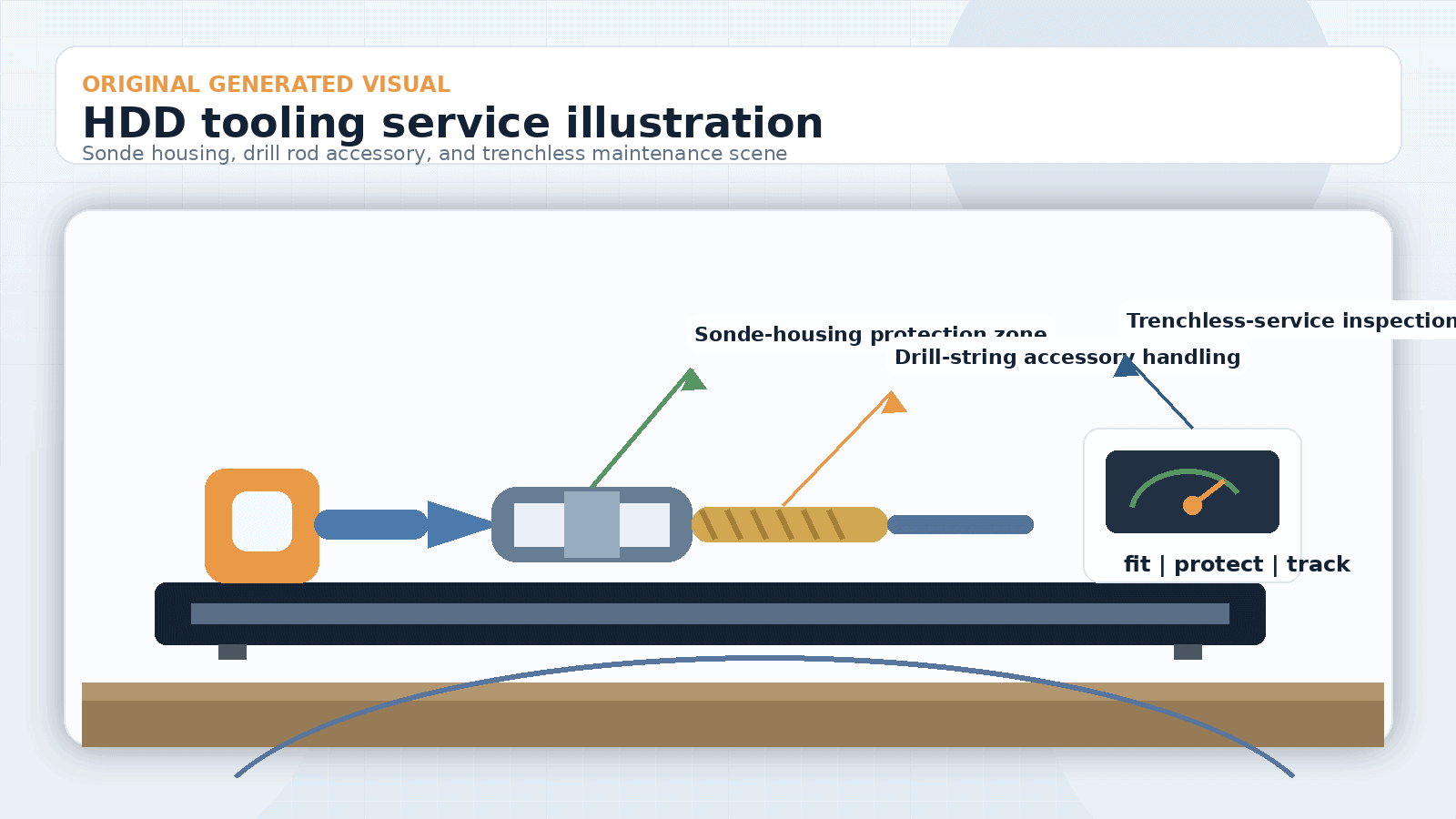
Table of contents
[rank_math_toc]
HDD tooling service habits that protect sonde housings and front-end assemblies
- HDD tooling service gets expensive when threads, fit surfaces, and front-end accessories are handled casually between field return and the next bore.
- Sonde housings, reamers, swivels, subs, and drill-string accessories need one cleaner service lane instead of scattered handling habits around the yard.
- Controlled opening matters most when stubborn joints, valuable accessories, or repeated fit issues keep turning into avoidable downtime later.
- A breakout-style workflow is usually the first bridge product for trenchless service teams because the pain often starts with disassembly and workshop make and break discipline.
- The commercial win comes from better asset life, steadier front-end performance, and cleaner condition tracking rather than from machine category alone.
HDD tooling service in practice
HDD tooling service becomes much easier to evaluate when the shop names the real failure points, uses a controlled process, and records what better handling should prevent the next time the job returns.
In HDD work, people love to talk about rock, fluid, steering, and pullback. All of that matters. But a lot of avoidable cost shows up much earlier and in a much quieter place: the way drill-string accessories and front-end tooling are handled between jobs.
That includes drill rod threads, adapter subs, reamers, swivels, sonde housings, locating-tool interfaces, and the small mechanical decisions that either keep the tooling package healthy or slowly grind value out of it.
A front-end assembly does not have to fail catastrophically to become expensive. Sometimes it just gets a little rougher to make up, a little harder to track, a little more vulnerable to wear, and a little more likely to interrupt the next bore at the wrong time.
This is why HDD tooling service is a strong adjacent topic for Galip. The site already has trenchless pages, sonde housing coverage, and a BU/BOU product base that can support a controlled make/break discussion.
What it does not yet fully own is the service-discipline article that connects trenchless tooling care to workshop control and buyer intent.
The opportunity is not to pretend HDD crews need oilfield language. It is to speak to a familiar trenchless problem in practical terms: if you want longer tooling life, steadier front-end performance, and fewer ugly surprises in the field, you need better make/break discipline in the yard and the shop.
Why HDD tooling often gets treated too casually
HDD crews are problem solvers by nature. That is one of the strengths of the industry, but it can also create a blind spot. Because crews are used to adapting in the field, the line between practical and casual handling can drift without anyone noticing.
A sonde housing is a good example. Everyone agrees it matters. It protects the locating tool, influences front-end fit, and plays a role in directional reliability. But the service habits around it are not always treated with the same seriousness.
Threads get dirty. Accessories are opened with whatever is nearby. Fit issues are tolerated until they become pattern problems. Wear gets discussed in passing instead of being tracked.
Drill-string accessories suffer from the same mindset. A reamer sub, adaptor, or swivel may look tough enough to handle rough wrenching, but repeat damage does not need to be dramatic to become expensive.
Thread wear, shoulder marking, contamination, distorted make-up surfaces, and poor storage habits all shorten usable life. The cost is not just replacement. It is also downtime, field confidence, and the subtle loss of performance consistency.
The hardest part is that none of this feels urgent on a good day. When the crew is moving and the bore is on schedule, small handling compromises stay invisible. They become obvious later when a connection feels wrong, a part no longer fits cleanly, or the front-end package starts behaving less predictably than it should.
Where the real losses show up
The real losses in HDD tooling service show up in four places.
First, thread condition. Dirty or damaged threads are expensive because they make every later decision worse. Make-up becomes less predictable, breakout becomes rougher, and the part begins to carry a service history that nobody has fully documented.
Second, fitment. Sonde housings and related front-end components live or die by fit. A housing that is only “close enough” can still create tracking, wear, or handling headaches that get blamed on something else later. Good shops understand that front-end fit is not a detail. It is part of directional reliability.
Third, surface condition. Reamers, subs, and accessory parts that are repeatedly gripped in poor locations or opened with uncontrolled force age badly. Again, the damage may be incremental, but that does not make it harmless.
Fourth, handoff quality. Many trenchless yards do not have one clean workflow that takes a tooling package from field return through inspection, make/break service, condition review, and release.
Instead, the parts move through habit. That works until the business grows, the crew changes, or a customer starts asking more questions.
These are the kinds of operational losses that are perfect for SEO content because they are both searchable and under-addressed. People do search for sonde housings, drill rod care, HDD tooling, and accessory maintenance.
What they often do not find is a useful article that connects those topics to workshop control and equipment decisions without sounding generic.
What better make/break discipline looks like in trenchless work
Better discipline does not have to mean overcomplicating the yard. It means creating a cleaner, more deliberate path for the jobs that damage tooling when they are rushed.
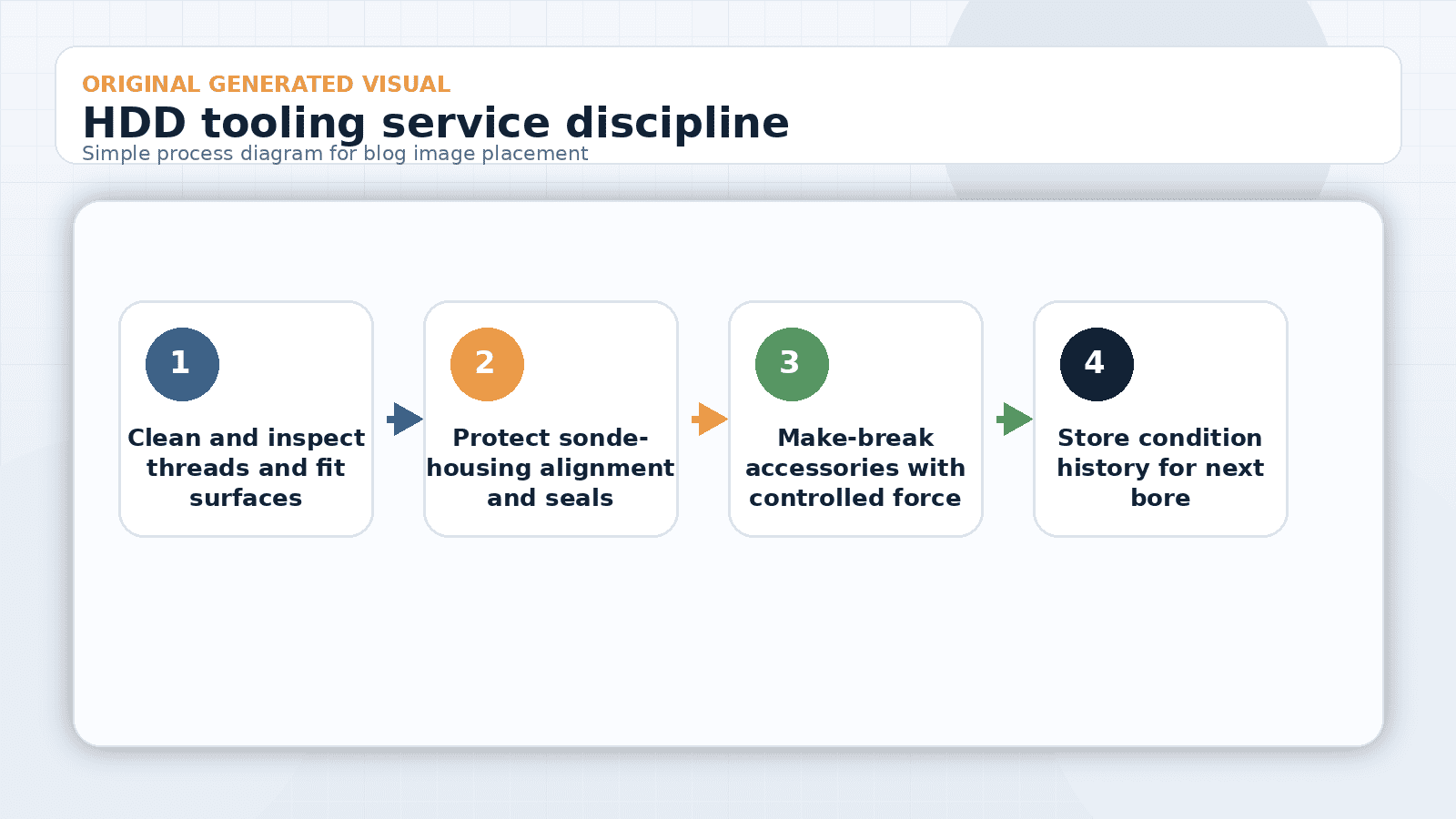
Start with cleaning and identification. Returned tooling should be inspected before the dirt and field residue hide what happened. Threads, shoulders, bearing surfaces, and sonde-housing fit points deserve deliberate review, not a quick glance.
Move next to controlled opening. Not every HDD accessory requires heavy equipment, but the principle matters. If the part is valuable, awkward, or showing signs of resistance, the shop should use a method that protects the component instead of gambling on manual force.
Controlled make/break is not about looking sophisticated. It is about preventing small damage that keeps compounding.
Then come fit and alignment checks. This is especially important for sonde-housing and front-end packages where the “good enough” standard can quietly undermine performance. If the reader works in trenchless operations, they know how expensive a front-end problem can become once the tool is already in the bore.
Finally, build a simple condition history. The goal is not bureaucratic paperwork. It is practical memory. Which accessory is wearing faster than expected? Which housing has repeated fit issues?
Which thread family is coming back rough? The answers matter more than most shops realize, and they are hard to answer if nobody records anything beyond a parts invoice.
Where the Breakout Unit belongs in the conversation
For many HDD and trenchless service environments, the Breakout Unit is the most natural first bridge into better control. The reason is simple: a lot of the pain begins during disassembly and general workshop make/break work.
If the goal is cleaner handling of stubborn drill-string accessories, front-end components, and repeat workshop jobs, a breakout-style workflow often makes sense before a BU-style workflow. It gives the shop a more controlled place to apply force, improves stability, and reduces the need for improvised wrenching that marks parts and wastes time.
That matters commercially because it matches the reader’s real problem.
Where the Bucking Unit still fits — in one small but important section
The Bucking Unit still belongs in this article, just not as the headline keyword.
A BU becomes relevant when the trenchless operation or service yard needs a more repeatable controlled make-up and break-out environment for higher-value threaded tooling, larger accessory packages, or a broader mix of jobs that now justify more formal process control. This is especially true when the business is no longer thinking only about “getting it apart,” but about repeatability, surface protection, and more consistent workshop output.
That is the right way to bring the BU into an HDD article. Not as a forced pitch, but as the next step for operations that are maturing beyond casual handling. The article helps the reader first. Then it gives them a natural path toward the BU product page if their requirements are growing.
Why sonde housings deserve more service attention than they get
Sonde housings are often discussed as products, but not enough as service responsibilities.
That is a mistake because the housing lives right at the intersection of protection, fitment, and field reliability. A housing can be built well and still perform poorly if the service habits around it are loose.
Debris, poor storage, rushed make/break work, worn mating parts, and unchecked fit issues all erode the value of the housing long before the buyer decides the product itself is the problem.
This is exactly why Galip’s Sonde Housing page is a strong internal-link destination for this article. The product page speaks to buyer priorities like compatibility, fit, durability, and protection.
The article can extend that conversation into service discipline and show that product selection and product handling are part of the same performance story.
That kind of content layering is good SEO architecture. One page serves the product decision. Another page serves the operational question that leads readers toward the product decision. Both pages become stronger because they are not trying to do the same job.
A yard workflow trenchless managers can actually use
The simplest way for trenchless managers to improve tooling life is to create one clear service lane for returned front-end and drill-string accessories.
Parts come back from the field and are cleaned, inspected, and photographed when needed. Threads and fit surfaces are checked before the parts are mixed back into general storage. Anything questionable is held aside instead of quietly re-entering circulation.
Stubborn joints are opened with a controlled method. Reassembly uses the same level of care as teardown. Sonde-housing fit and front-end compatibility are confirmed before the package goes back out.
Then the condition is logged in a way that helps the next decision.
None of this is glamorous, which is precisely why it works. Strong service routines rarely feel dramatic. They just reduce avoidable damage and help the crew stop learning the same lesson repeatedly.
For content performance, this section is important because it lets the reader imagine a better yard without having to buy into a heavy technical argument first. They can see the workflow. Once they see it, the value of controlled equipment and better product fit becomes easier to understand.
How buyers should evaluate equipment and process upgrades
Buyers in trenchless operations should compare equipment and process upgrades by looking at the exact tooling package they are trying to protect.
Are the recurring problems mostly with drill rod threads, sonde-housing fit, reamer accessories, or a broader mix of front-end service work? How often do those issues cause downtime, replacement cost, or inconsistent directional performance?
Does the yard need better disassembly control, better make-up control, or both?
Then assess the service model. Is the business large enough that repeat workflow matters now? Are multiple crews touching the same accessories? Is the current handling quality dependent on the most experienced person being present? Those are the signals that process improvement is overdue.
Finally, look at how the upgrade will connect to the rest of the trenchless package. A controlled make/break solution is more useful when it supports the larger business: tool protection, fewer field interruptions, better asset life, and a cleaner RFQ conversation when the company is ready to upgrade equipment or add support products.
Conclusion
HDD tooling service is one of the smartest adjacent topics Galip can use to widen traffic around the BU and breakout conversation. It is close enough to the company’s real product world to convert the right readers, but far enough from the current pipe-heavy cluster to bring in fresh demand.
More importantly, it is a genuinely useful subject. Crews and buyers in trenchless work do lose money through casual make/break habits, weak thread care, and inconsistent front-end service.
An article that names those problems honestly, gives the reader a better service workflow, and keeps the BU to one natural section has a real shot at attracting qualified traffic.
That is the point of the piece. It should feel like expert field advice that happens to create product interest, not product copy wearing the costume of advice.
Related Galip resources
External references
- Ditch Witch HDD damage-prevention best practices
- Vermeer tips on drill rod upkeep and maintenance
- Ditch Witch guidance on extending drill-pipe life
Frequently asked questions about HDD tooling service discipline
Why does HDD tooling service deserve its own make and break process?
Because front-end accessories, sonde housings, and drill-string connections lose value gradually through poor cleaning, rough opening, weak fit checks, and untracked wear long before they fail outright.
What does better HDD tooling service improve first?
The earliest gains usually show up in cleaner threads, better sonde-housing fit, fewer marked accessories, and fewer surprises when tooling goes back into the field.
Where does a bucking unit fit inside HDD tooling service?
It becomes relevant when a trenchless operation wants more repeatable make-up and break-out handling across higher-value tooling or a broader mix of service jobs that now justify formal process control.
If your trenchless yard wants better linkage between sonde housing protection, controlled breakout work, and accessory life, you can talk through your tooling service workflow with Galip.
Keyword recap: HDD tooling service
HDD tooling service is ultimately a shop-control question: how the assembly is identified, supported, opened, inspected, and returned to service without creating extra damage on the way.
HDD tooling service checklist
- Keep HDD tooling service tied to the actual failure pattern the shop is trying to stop.
- Document the support method, breakout method, and inspection findings in the same workflow.
- Use internal references and external standards so buyers can compare process control instead of guessing.
- Make the release decision defensible to operators, supervisors, and customer reviewers.
Why HDD tooling service matters for buyers
Buyers searching HDD tooling service are usually trying to stop recurring loss, not just compare a machine specification. That is why process control, equipment fit, documentation, and operator safety all need to appear in the same article.
When HDD tooling service stays connected to the exact parts, fixtures, and release decisions on the floor, the content becomes more useful for ranking and more believable for a technical reader.
HDD tooling service FAQ recap
A strong HDD tooling service workflow is the one technicians can repeat safely, supervisors can audit, and customers can understand after the job is already complete.
Related equipment: see the Galip hydraulic drilling mud motor.
Expert Consultation
Need more information on optimizing your equipment performance? Our engineering team is available for technical consultations.
Request a Quote
Tell us about your requirements and our engineering team will prepare a detailed proposal with specifications, pricing, and delivery timeline.
