
Bucking Unit Spare Parts Package: What Should Be Ready Before the First Job?
A practical guide to preparing a bucking unit spare parts package before commissioning, including wear parts, hydraulic spares, maintenance items, storage, labeling, and first-year support planning.
A bucking unit spare parts package should be prepared before the first production job, because small missing items can quickly become downtime, safety, or reporting problems. This practical ownership guide is written for buyers, service-shop managers, maintenance teams, and QA supervisors who want the bucking unit to enter production without avoidable downtime.
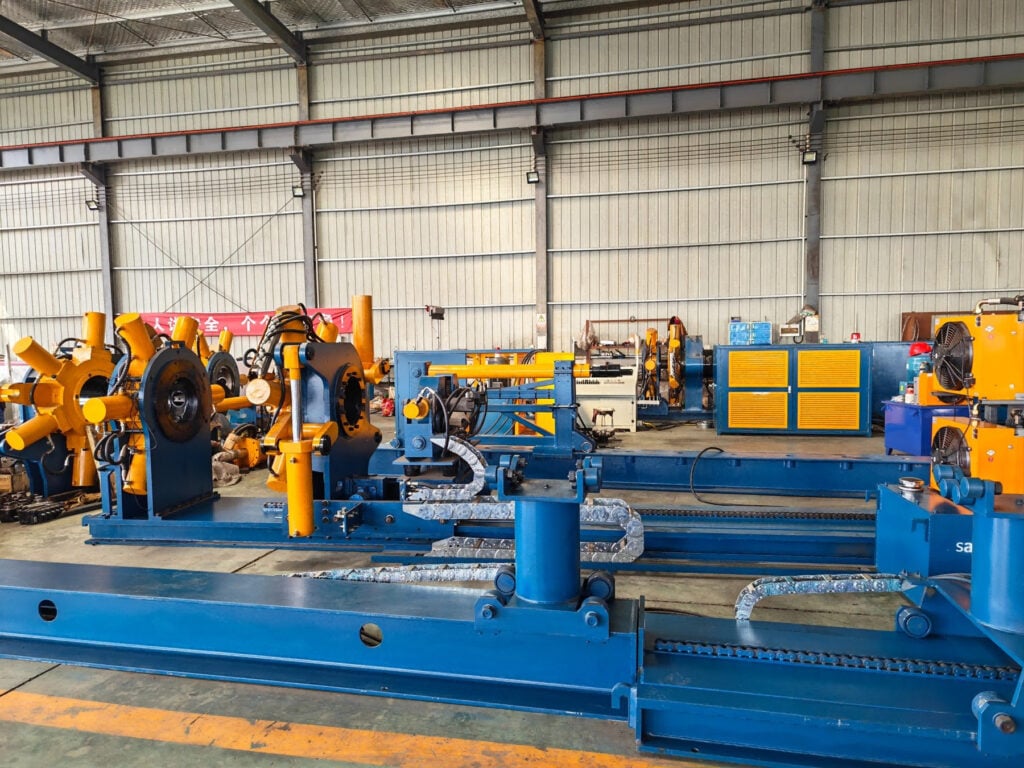
Real Galip production-floor photo: a spare-parts plan should be built around the machine areas that can stop production – clamps, supports, rails, hydraulic power, controls, and reporting workflow.
Why this topic belongs in the bucking unit hub
Most bucking unit articles talk about torque, clamping, make-up curves, pipe handling, and premium connection quality. Those subjects are important, but they do not answer a question that appears after the purchase order is signed: what should the buyer have on the shelf before the first production job starts?
For buyers still comparing machine configuration, see Galip’s hydraulic bucking unit page for torque range, clamping structure, report export, and workshop application details.
A bucking unit spare parts package is not just a box of extra parts. For a service shop, it is a downtime-control plan. The best package is built around the real job envelope: pipe and tool sizes, working hours, connection sensitivity, customer-witness work, local lead times, and how quickly the workshop must return to production after a fault.
This article is written for buyers and workshop teams preparing to receive a hydraulic bucking unit or torque machine. It does not explain confidential measurement design, software logic, or internal data-capture methods. It focuses on the practical ownership items that help a workshop keep the machine safe, usable, and audit-ready.
| Practical pointA cheap part can become expensive if it stops a full shift, delays a customer witness job, or leaves a completed joint without a usable record. Stock decisions should be based on production risk, not only part price. |
The mistake: buying the machine but not the first-year support plan
When a workshop buys a bucking unit, the discussion usually starts with the big specification items: torque range, OD range, clamp configuration, pipe support, rotation control, report export, and installation footprint. Those are the right starting points. But once the machine enters daily use, small items begin to decide whether production stays smooth.
A damaged hose, worn jaw insert, missing filter element, faulty switch, misplaced guard bolt, dirty report-transfer media, or unavailable seal kit can stop work at the wrong time. The machine may still be mechanically strong, but the job cannot continue safely or cleanly until the support item is available.
That is why the spare parts package should be discussed before shipping, not after the first stoppage. The supplier, buyer, maintenance lead, and operations supervisor should agree on what belongs in the commissioning kit, what belongs in the first-year operating stock, and what should remain supplier-controlled because replacement requires service approval.
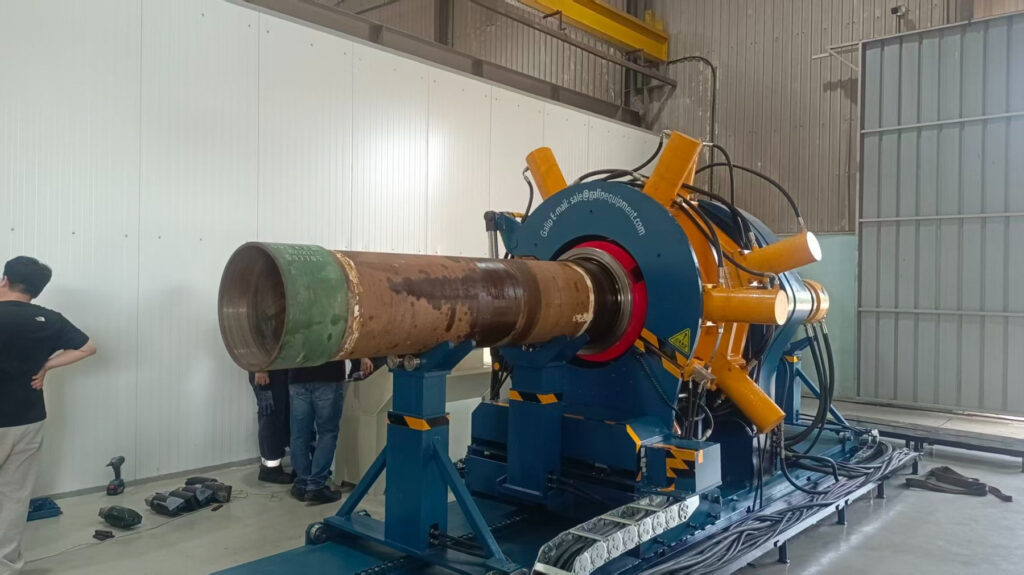
Real customer-site photo: when pipe is already loaded and a job is waiting, the missing spare part is no longer a purchasing detail – it becomes a production problem.
Start by separating spare parts into four risk groups
Do not build the bucking unit spare parts package as one long random list. Divide it by production consequence. This makes the package easier for procurement to approve and easier for the maintenance team to manage.
| Risk group | Typical items | Why it matters | Stocking logic |
| Immediate stop items | Hoses, fittings, emergency-stop hardware, key switch parts, required fuses, critical seal kits | The machine cannot run safely or cannot be restarted without them. | Keep on site before first job. |
| Wear and marking-control items | Jaw inserts, jaw protection items, roller-contact parts, wipers, common fasteners | They protect the pipe body, connection area, and repeatable setup. | Stock based on workload and product mix. |
| Maintenance interval items | Filters, breather elements, lubrication items, standard seals, cleaning tools | They prevent gradual loss of performance and reduce unplanned service. | Stock by maintenance schedule. |
| Supplier-controlled items | Approved control/reporting components, calibrated items, software-related parts, safety-circuit parts | Wrong substitution can create quality, safety, or warranty problems. | Identify lead time; replace only with approval. |
1. Wear and pipe-protection items
The first spare-parts conversation should begin near the workpiece. Any item that touches, supports, guides, protects, or locates the tubular can affect the job quality. Wear does not always look dramatic. A jaw insert may still clamp, but if it is damaged or contaminated it may increase marking risk. A roller may still turn, but if it drags or carries debris it can make loading less controlled.
For this group, the buyer should ask for a machine-specific list of contact and wear items. The list should identify which items are normal consumables, which are size-specific accessories, which are optional for damage-sensitive work, and which require supplier installation or inspection.
Items to discuss before shipment
- Common jaw inserts or clamping contact items for the expected OD range.
- Pipe-body protection accessories for premium connections, CRA, chrome-plated parts, or customer-sensitive surfaces.
- Roller support contact parts and any replaceable wear pieces around pipe handling.
- Common guard fasteners, small covers, wipers, and protective pieces that get removed during maintenance.
- Cleaning tools for jaw pockets, rail areas, and support surfaces.
The important question is not simply, “How many jaw inserts do we get?” The better question is, “For our workload, which contact parts can stop a job, damage a part, or make the customer reject the surface condition?”
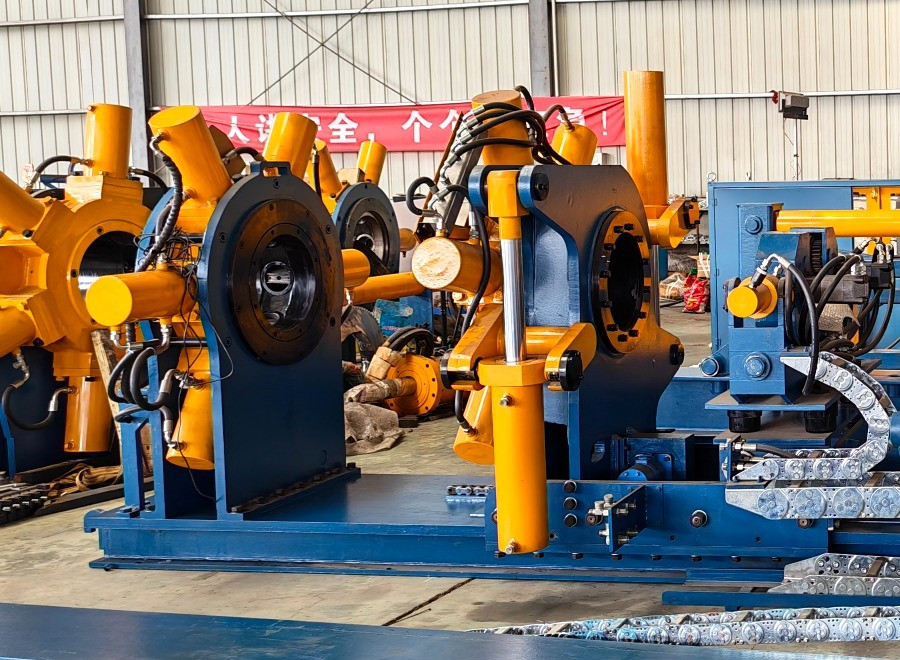
Real-photo detail: clamping and support areas are where wear items, protection pieces, guard hardware, and housekeeping habits become part of connection quality.
2. Hydraulic spares that protect uptime
Hydraulic systems do the heavy work in a bucking unit. They also require clean oil, correct pressure control, sound hoses, good seals, and stable fittings. The hydraulic section of a bucking unit spare parts package should be built around the items that are most likely to wear, leak, clog, or get damaged during transport, installation, or daily movement around the unit.
This does not mean the workshop should repair everything without training. It means the workshop should not be waiting for a basic approved part while the machine sits idle. For safety-critical or calibration-related hydraulic work, the supplier instruction should always control the repair process.
Hydraulic spare categories
- Filter elements and breather elements matched to the hydraulic power unit.
- Common approved hose assemblies or hose/fitting kits for exposed movement areas.
- Seal kits for cylinders that are expected to see regular service intervals.
- Common O-rings, washers, and fittings identified by the supplier parts book.
- Pressure gauges or approved indication parts that maintenance teams can replace safely.
- Spill-control and oil-cleanliness supplies for the workshop area.
The buyer should also ask which hydraulic items are user-replaceable and which items require supplier support. That line should be clear before the first job, not argued during a breakdown.
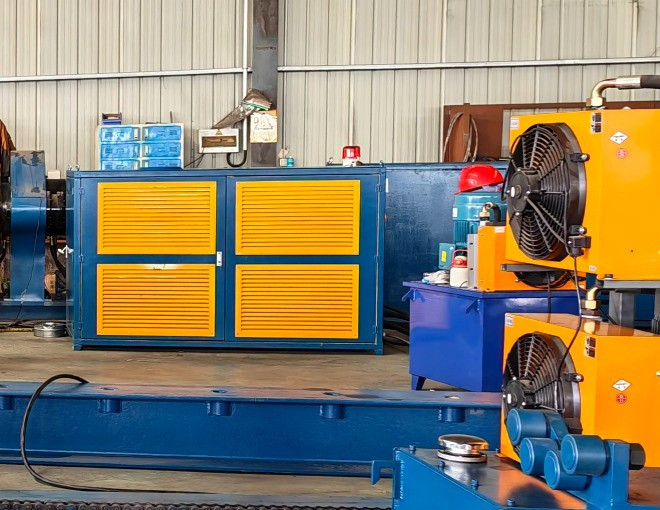
Real-photo detail: hydraulic power and support infrastructure should be included in the spare-parts discussion, not treated as separate from the bucking unit.
3. Movement, rail, and cable-management spares
Many production delays do not come from the main torque system. They come from the parts that allow the machine to move, support, guide, protect, and return to position cleanly. Rails, cable carriers, hose supports, rollers, limit hardware, guards, and small fasteners deserve more attention than they usually receive.
A cable carrier link may look minor, but if it breaks and exposes hoses or cables, the job should stop. A missing guard screw looks small, but it can become a safety issue. A dirty or damaged rail surface can make movement uneven and encourage operators to force a setup instead of correcting the cause.
For this reason, the spare package should include the simple parts that keep the machine moving in a controlled way. These are not expensive compared with the cost of a delayed shift.
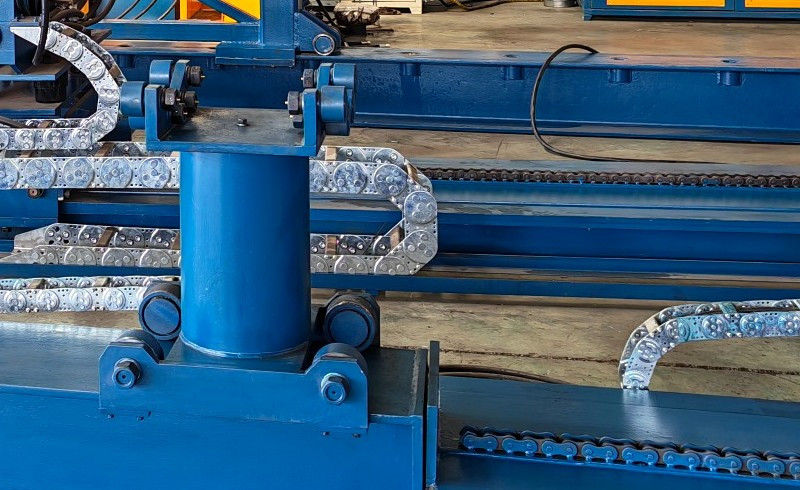
Real-photo detail: rail, cable-carrier, and hose-routing areas should be part of the ownership plan because they protect movement, service access, and safe operation.
4. Operator-interface and control-room continuity items
A bucking unit is not only a mechanical frame. The operator needs the interface, emergency controls, identification workflow, and report-saving process to remain reliable. If a button, key switch, indicator, keyboard, pointing device, or transfer accessory fails, the machine may still have torque capacity but the job record can become weak.
This area requires a careful boundary. Workshops should keep approved small interface spares available, but they should not modify control hardware, safety circuits, measurement components, report-generation systems, or software logic without manufacturer approval. The goal is continuity, not uncontrolled modification.
Safe items to plan for
- Approved emergency-stop replacement parts or complete assemblies, if recommended by the supplier.
- Common fuses, relays, indicators, selector switches, and push buttons listed in the machine documentation.
- Keyboard, mouse, industrial pointing device, or external storage media approved for the console workflow.
- Label sleeves, cable markers, and simple identification supplies for maintenance documentation.
- Backup report-transfer media and a clean process for copying files without losing job identity.
The highest-risk mistake is treating every electrical or reporting component as a generic local substitute. If a part is tied to safety, calibration, reporting, or machine control, replacement should follow the approved service route.
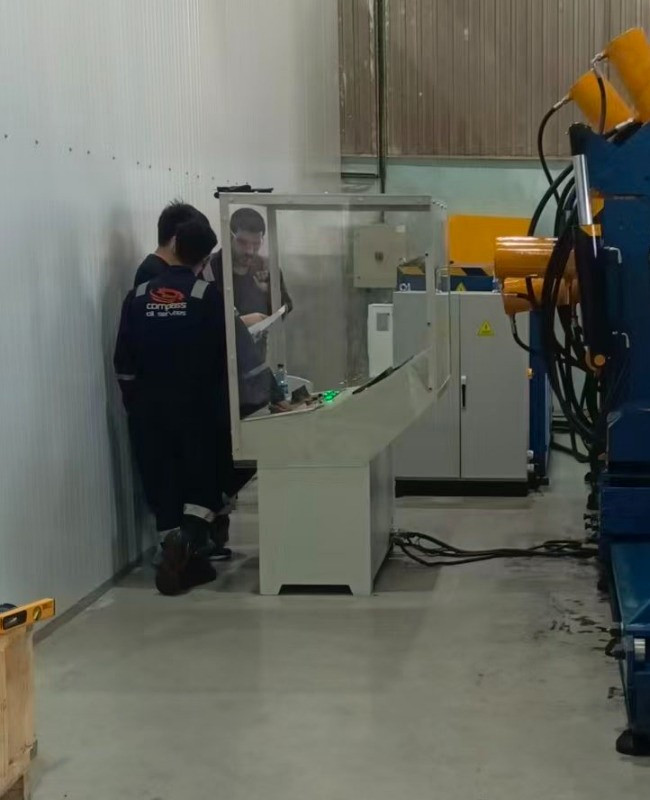
Real customer-site photo: the operator area is part of uptime. Control hardware, report-transfer discipline, and clean handover habits belong in the support package.
5. Record-continuity supplies: the overlooked spare-parts category
A workshop can finish the mechanical make-up and still create a problem if the job record is not saved, named, copied, backed up, or handed over correctly. For customer-witness work and premium connection programs, record continuity should be planned like any other spare-parts category.
This does not require exposing internal system design. It only requires the workshop to prepare the ordinary support items that help the operator keep the records usable.
- A clean report-naming rule approved by QA before the first production joint.
- Dedicated storage media or network-transfer method approved by the buyer and supplier.
- A backup routine for PDF and Excel reports after each job batch or shift.
- A simple abnormal-event note form for joints that required stop, recheck, remake, or supervisor review.
- A job folder structure that connects work order, pipe/tool ID, connection type, operator, report file, and customer witness notes.
This is a useful point for buyers: ask for a sample report and agree on the record workflow before the first job. A report is only valuable if the team can find it later and understand which joint it belongs to.
For general quality-management context, teams can compare their documentation discipline with ISO 9001 quality management principles, while keeping Galip machine-specific service instructions as the controlling document.
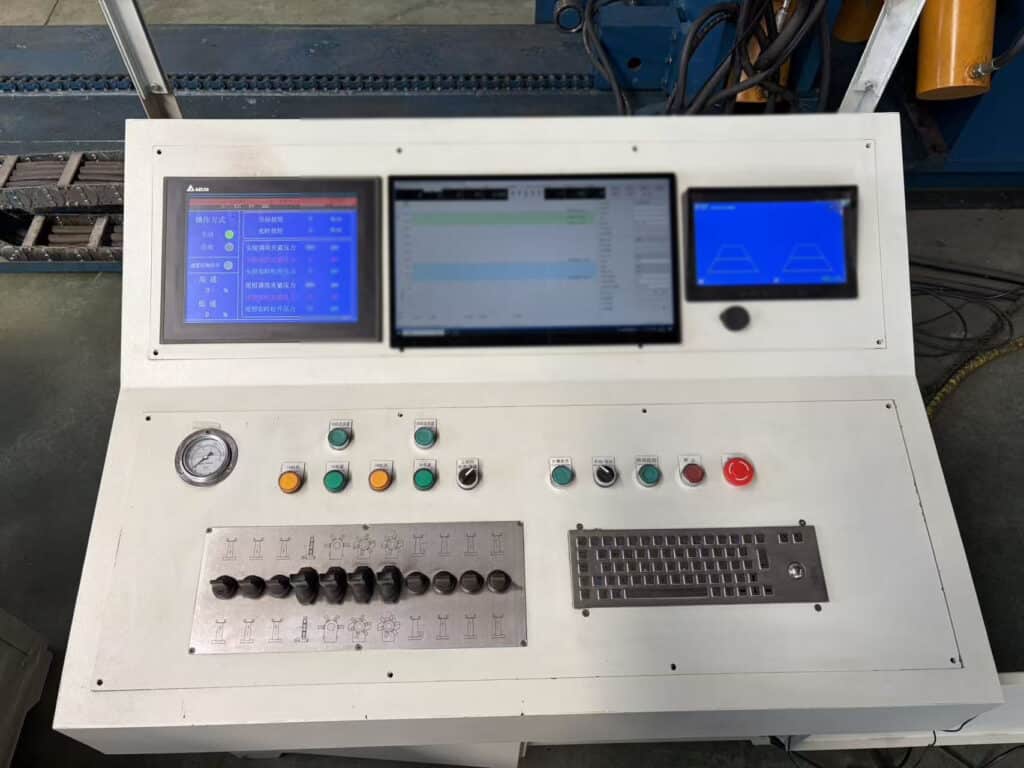
Real Galip control-console photo, with screen details intentionally softened: buyers should verify report workflow and operator-interface continuity without exposing confidential internal methods.
Bucking Unit Spare Parts Package Commissioning Check
The spare-parts package should be checked during commissioning, not stored unopened in a corner. The commissioning team should lay out the spares, compare them against the packing list, identify where each item belongs on the machine, and mark whether it is user-replaceable or supplier-controlled.
| Commissioning check | Why it matters | Owner |
| Match spare parts to packing list and purchase order | Confirms the buyer received the agreed support package. | Procurement + supplier |
| Identify each spare on the machine or parts drawing | Prevents the box from becoming mystery inventory. | Maintenance |
| Separate consumable, critical, and supplier-controlled items | Stops unapproved repairs and protects warranty/safety. | Maintenance + QA |
| Label shelves or bins by machine area | Speeds response during a job stoppage. | Workshop supervisor |
| Record part numbers and reorder points | Makes restocking routine instead of urgent. | Stores / purchasing |
| Review the report-transfer and backup routine | Protects audit trail and customer-witness records. | QA + operator |
Build the spare package around workload, not only machine size
Two shops can buy similar bucking units and need different spare packages. A high-volume completion workshop running repeated shifts has a different risk profile from a service shop that uses the machine for mixed tools and lower job frequency. A workshop handling damage-sensitive CRA or chrome components may need a stronger surface-protection package than a shop working mostly on rugged service tools.
Before finalizing the kit, the buyer should answer these questions:
- How many joints, tools, or assemblies will the machine handle per shift and per month?
- Will the work include customer witness jobs where delays affect inspection schedules?
- Which OD ranges and connection families will be most common?
- Which contact parts are size-specific and which are shared across jobs?
- What local parts can be sourced safely, and which parts must come from Galip or an approved supplier?
- What is the acceptable downtime for a missing hose, seal, filter, switch, jaw item, or report-transfer accessory?
- Who is allowed to install each spare part, and who signs off after replacement?
The answers make the spare package more realistic. The point is not to buy everything. The point is to stock the right things for the way the machine will actually be used.
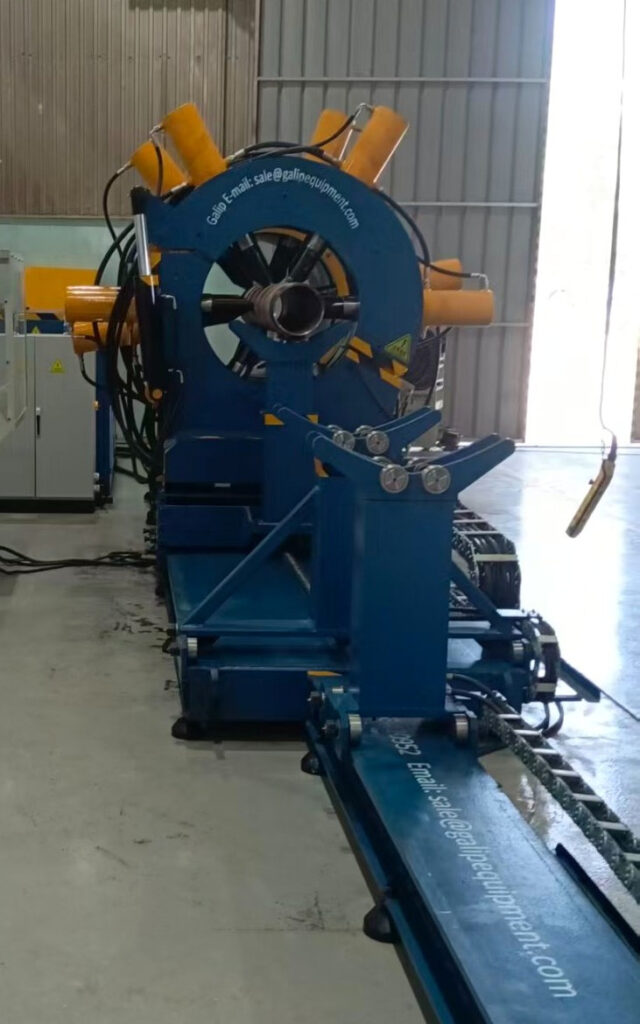
Real customer-site photo: the installed machine, operator area, rail, and access path show why spares planning should match the actual shop layout and workload.
How to Store Bucking Unit Spare Parts So They Are Useful
A bucking unit spare parts package only works if the right parts can be found during a stoppage. A spare part that cannot be found is only slightly better than a spare part that was never purchased, so storage discipline is part of the ownership plan.
Good storage practice is simple. Keep parts dry, clean, labeled, and separated by machine area. Keep rubber seals and hose items away from heat, sunlight, and contamination. Keep electrical spares in clean packaging. Keep calibrated or supplier-controlled items clearly marked so they are not installed casually. Keep a reorder line in the inventory log so the last part does not get used without replacement.
Recommended bin structure
- Bin A – Jaw, contact, and pipe-protection items.
- Bin B – Hydraulic filters, seals, fittings, and approved hose items.
- Bin C – Rail, carrier, guard, roller, and mechanical small parts.
- Bin D – Operator-interface small parts and approved electrical consumables.
- Bin E – Record-continuity supplies: approved storage media, labels, job-folder forms, and backup accessories.
- Bin F – Supplier-controlled parts: do not install without approval.
The 30-day review after the first jobs
The first month of operation will show what the original spare-parts list missed. After several jobs, the workshop should review what was used, what was almost needed, what operators asked for, and which items were difficult to identify.
This review should include the operator, maintenance lead, QA supervisor, and purchasing contact. The goal is to adjust the package before the first serious production stoppage. If a part was used twice in the first month, it probably needs a reorder rule. If a part was confusing to identify, it needs better labeling. If a part was supplier-controlled but operators thought it was user-replaceable, the instruction needs to be clearer.
| 30-day ownership questionAfter the first month, ask: What stopped us, what almost stopped us, what damaged the job record, and what would we not want to wait for next time? |
What to Ask Galip Before Ordering a Bucking Unit Spare Parts Package
A good RFQ for a bucking unit should include more than the machine specification. It should also ask for a practical first-year support package based on the buyer’s workload.
- Recommended commissioning spare parts package.
- Recommended first-year operating spares for the expected monthly workload.
- Critical spares with lead time and replacement approval level.
- Wear items by pipe/tool OD range and connection sensitivity.
- Hydraulic filter, seal, hose, and fitting support list.
- Operator-interface and electrical consumable list.
- Record-continuity support items and sample report workflow.
- User-replaceable vs supplier-service items.
- Shelf-life or storage notes for rubber, seal, and hydraulic components.
- Recommended reorder quantities after the first 30 days of operation.
This conversation helps Galip configure not only the bucking unit, but also the support plan around the machine. For buyers, that can be the difference between a successful commissioning and a frustrating first month.
Final Thought: Match the Bucking Unit Spare Parts Package to Real Workload
A bucking unit is a long-term workshop asset. The machine itself matters, but the ownership system around it matters too. Spare parts, storage, labels, maintenance instructions, record-continuity supplies, and clear replacement boundaries all protect production.
The best spare-parts package is not the biggest box. It is the package that matches the machine, workload, operator skill level, local lead time, and customer expectations. When that package is prepared before the first job, the workshop is not only buying a torque machine. It is building a more reliable make-up process.
| CTA for Galip money pageNeed a bucking unit spare parts package and a practical first-year support plan? Send Galip your OD range, torque range, connection family, daily workload, reporting requirements, shop layout, and expected maintenance capability. Galip can recommend a machine configuration and a spare-parts package matched to real workshop conditions. |
FAQ
What should be included in a bucking unit spare parts package?
A bucking unit spare parts package should include wear parts, hydraulic spares, maintenance interval items, operator-interface consumables, record-continuity supplies, and supplier-controlled critical parts. The final list should match the machine configuration, workload, OD range, local lead time, and service capability.
Should every bucking unit buyer order a spare-parts package?
Yes. The size of the package can vary, but every buyer should have a commissioning kit and a first-year operating kit before the first production job.
What spare parts are most important?
The most important items are not always the most expensive. Prioritize parts that stop production, affect safety, increase pipe-damage risk, or weaken the job record.
Can a workshop use local replacement parts?
Some simple consumables may be locally sourced if they match the approved specification. Parts tied to safety, control, reporting, calibration, or warranty should follow the supplier-approved route.
How often should the spare-parts list be reviewed?
Review it after commissioning, after the first month of work, and then at a fixed interval based on workload. Also review after any abnormal job, breakdown, or customer-witness delay.
Should report-transfer supplies be treated as spare parts?
Yes. If the workshop relies on recorded make-up data, then backup media, naming rules, and file-transfer discipline are part of operational continuity.
Expert Consultation
Need more information on optimizing your equipment performance? Our engineering team is available for technical consultations.
Request a Quote
Tell us about your requirements and our engineering team will prepare a detailed proposal with specifications, pricing, and delivery timeline.
